


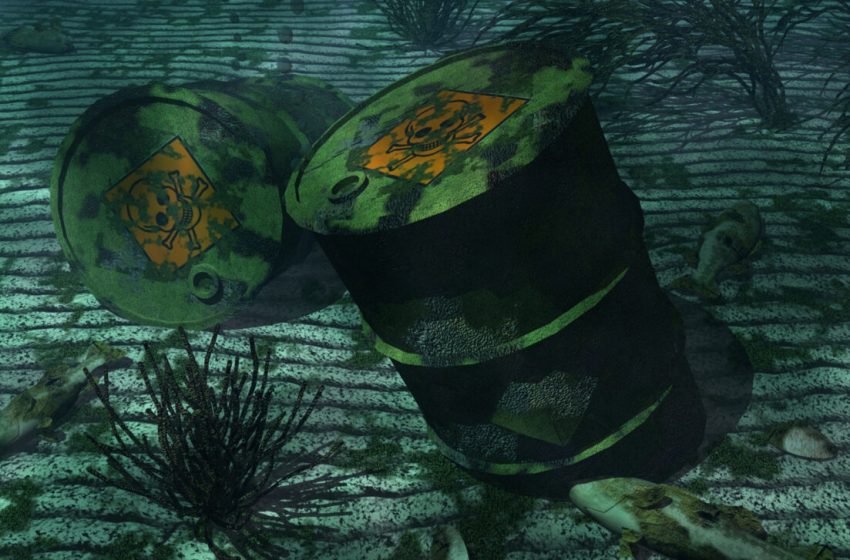
The U.S. Dumped Thousands of Toxic Barrels Into the Pacific Off The Coast of California, Now Scientists Say They’re Leaking
Faded white rings surrounding rusting barrels in the San Pedro Basin have been linked to leaks of caustic waste reacting with surrounding mud. The findings show that material discarded between the 1930s and early 1970s is still reshaping deep habitats today. Researchers have now traced those halos to highly alkaline material that continues to alter deep-sea chemistry and life more than 50 years later.
The study, published in PNAS Nexus, documents how chemical reactions triggered by the leaks hardened sediments, reduced microbial life, and created long-lasting mineral crusts. Scientists from the Scripps Institution of Oceanography mapped tens of thousands of debris targets across the basin, revealing the scale of what has become an underwater industrial graveyard.
White Halos Reveal Active Chemical Leaks
In mud cores collected beside corroded barrels, researchers found hardened white crusts and powdery patches contrasting sharply with the surrounding dark sediment. Sampling along these pale rings allowed the team to trace the crusts to leaking alkaline waste.
According to Earth.com, microbiologist Dr. Johanna Gutleben of Scripps Institution of Oceanography compared halo sediments with nearby control samples and detected almost no microbial genetic material in the affected cores. The halos, which remain visible on the seafloor, now serve as visual markers that help researchers quickly identify likely leakage sites before sampling what escaped.
Chemical measurements revealed that sediment within the halos reached a pH close to 12, while surrounding seawater remained near pH 8. Magnesium in seawater reacted with the alkaline material, forming hardened rims resistant to waves and slow seafloor currents. Over time, brucite, a magnesium hydroxide mineral that forms in strongly basic conditions, locked these rings in place for decades.
Mapping a Vast Underwater Dump Site
A deep-sea survey scanned roughly 58 square miles of the San Pedro Basin using robotic submarines equipped with sonar and cameras. What had once been rough estimates became a detailed map of debris scattered across the ocean floor.
Across that surveyed patch, analysts logged more than 74,000 debris targets, including about 27,000 barrel-shaped objects off Los Angeles. Each follow-up dive samples only a tiny fraction of sites, turning every mission into a triage operation.
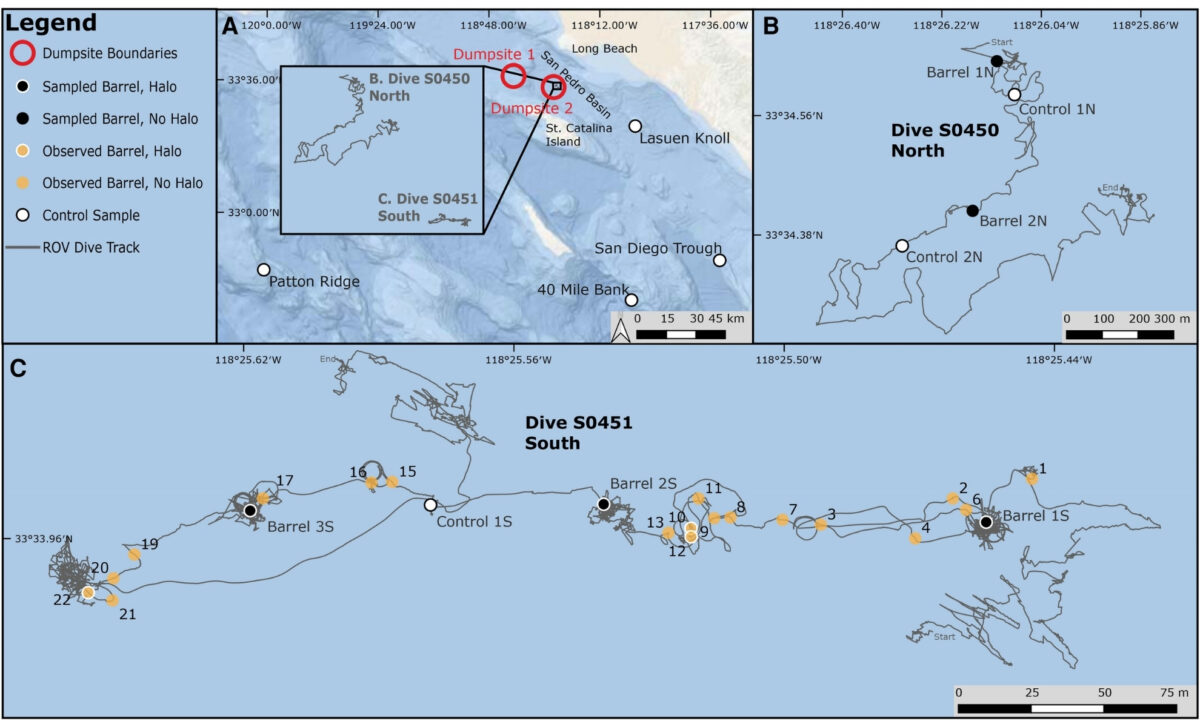
For years, many suspected that the barrels were tied to DDT, a pesticide banned in 1972 but still detected in nearby sediments. Yet new tests showed that DDT levels remained high across the dump site regardless of proximity to the barrels. This flat distribution pattern indicates the barrels are not acting as fresh DDT sources, even when white halos sit directly beside them. The pesticide continues to bioaccumulate in marine food webs decades after its ban.
Historical records from the U.S. Environmental Protection Agency (EPA) describe at least 14 deep-water dump locations off Southern California. Materials discarded included refinery byproducts, oil drilling debris, chemicals, obsolete military explosives, and even low-level radioactive waste. Thin steel barrels were never designed to withstand decades underwater, and their corroded seams now obscure the exact contents.
Microbial Life Altered for Centuries
Beneath the white halos, the sediment hosts far fewer microbes than neighboring mud. The microbial community also differs sharply from a typical seafloor ecosystem. At high pH levels, alkaliphilic bacteria dominate, microbes adapted to grow in alkaline environments.
Instead of diverse microbial groups living together, only a handful of lineages persist within the halos, leaving little genetic variety. Reduced microbial activity can alter how the seabed recycles nitrogen and sulfur, processes that influence larger seafloor organisms.
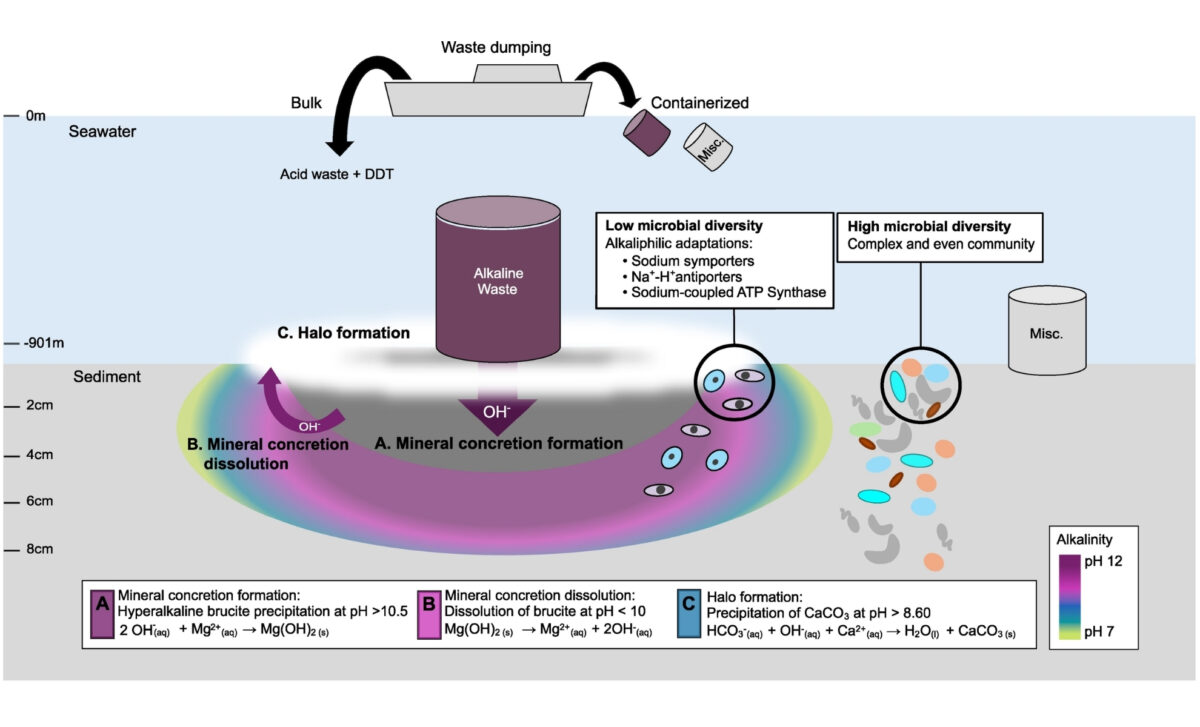
The mineral crust plays a central role in the persistence of these chemical scars. Brucite dissolves very slowly in seawater, gradually releasing basic compounds that continue raising local pH even after the original spill has stopped. Based on measured dissolution rates, the research team estimated that seafloor effects could last several thousand years in parts of the basin.
Scientists still cannot determine which barrels remain sealed and which have already emptied into surrounding mud. About one-third of the barrels display white halos, signaling alkaline leaks that altered only the surrounding few feet. Some leaks may also release metals trapped in sediment, and it remains unknown whether those metals have moved into fish or shellfish.
At depths of about 3,000 feet, any cleanup effort would rely on robots and cables. A misstep could spread caustic material farther. The EPA has conducted new surveys and sampling campaigns around the dumpsites, though a complete inventory of barrel contents remains out of reach.
First Appeared on
Source link






