


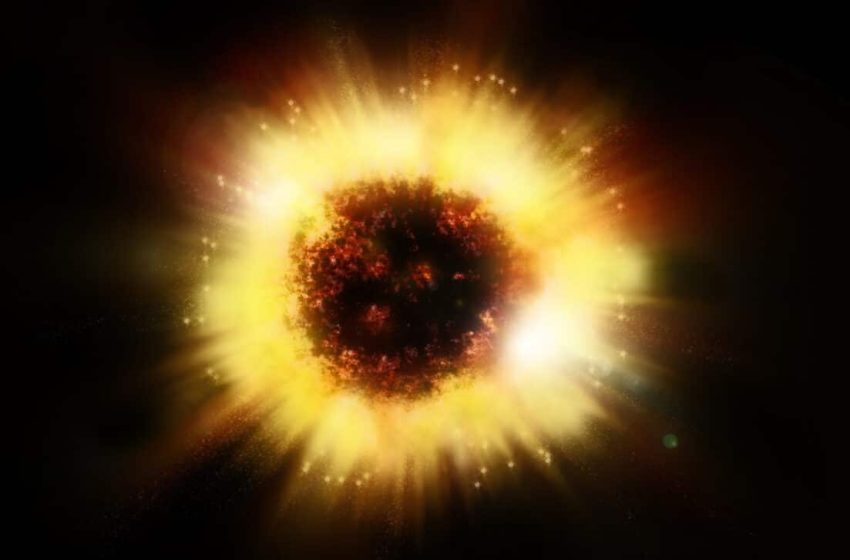
The Universe May Not Freeze After All, It Could Collapse in a Big Crunch
For decades, cosmologists have largely agreed on one ending: a Big Freeze. Driven by dark energy, space itself expands at an accelerating rate, pushing galaxies farther apart until stars burn out and the universe grows cold and empty.
Now, theoretical physicists at Cornell University are proposing a different fate. Henry Tye and his colleagues argue that the expansion may be temporary, and that the universe could have a total lifespan of about 33.3 billion years.
Dark Energy May Not Be What We Thought
The turning point lies in the cosmological constant, denoted by λ. Introduced by Albert Einstein, it represents the energy density of empty space. For roughly 20 years, scientists have assumed it is positive, meaning it fuels endless acceleration.
“For the last 20 years, people believed that the cosmological constant is positive, and the universe will expand forever,” Henry Tye, professor emeritus at Cornell, said, as reported by ZME Science.
Recent large-scale surveys have complicated that assumption. The Dark Energy Survey in Chile and the Dark Energy Spectroscopic Instrument in Arizona have mapped millions of galaxies to trace cosmic history. According to Tye, their data indicate that dark energy may not be constant after all, and that the cosmological constant could actually be negative.
“The new data seem to indicate that the cosmological constant is negative, and that the universe will end in a big crunch,” Tye said. A negative value would ultimately pull the universe inward rather than push it apart.
The Role of an Ultralight Axion
If the cosmological constant is negative, why is the universe still expanding? Tye and co-authors Hoang Nhan Luu and Yu-Cheng Qiu propose an explanation: an ultralight axion field permeating the universe. Axions are hypothetical particles that interact with normal matter only through gravity, making them extremely difficult to detect.
According to the study published in the Journal of Cosmology and Astroparticle Physics, the axion field initially mimicked a positive cosmological constant, driving the expansion observed today. But unlike a true constant, the field evolves. It is described as rolling down a potential energy hill, gradually losing strength.
As its influence fades, the negative cosmological constant would dominate. The universe, Tye suggests, would behave “much like a stretched rubber band snapping back.”
A Timeline Toward Collapse
The model estimates the universe’s total lifespan at about 33.3 billion years. Given its current age of 13.8 billion years, that leaves roughly 20 billion years before a final collapse.
The process would not be abrupt. “The Universe’s expansion is still accelerating now in our theory,” co-author Hoang Nhan Luu explained. The crunching phase may begin in about 11 billion years, followed by a Big Crunch around eight billion years later.
What happens beyond that point remains unclear. Luu acknowledged that the model cannot predict conditions after collapse, highlighting the unresolved conflict between general relativity and quantum mechanics at singularities.
Some physicists speculate about a Big Bounce, in which a new Big Bang follows the crunch. Tye, speaking to BBC Science Focus , was careful not to go that far. “Here, we predict the end of our Universe, but precisely how it ends remains an open question,” he said.
The theory depends strongly on DES and DESI data, particularly signs that dark energy’s equation of state, ω, is not equal to -1. If future observations align with the standard model, the Big Crunch scenario could fade.
More data are on the way. The European Euclid space telescope, the Vera C. Rubin Observatory in Chile, and NASA’s SPHEREx mission are expected to refine measurements of dark energy. As Tye noted, the idea that a negative cosmological constant would lead to collapse is not new. What is new, he argues, is estimating when and how it would occur.
First Appeared on
Source link






