


This Survival Capsule Is Built for the Moment There’s Nowhere Left to Run
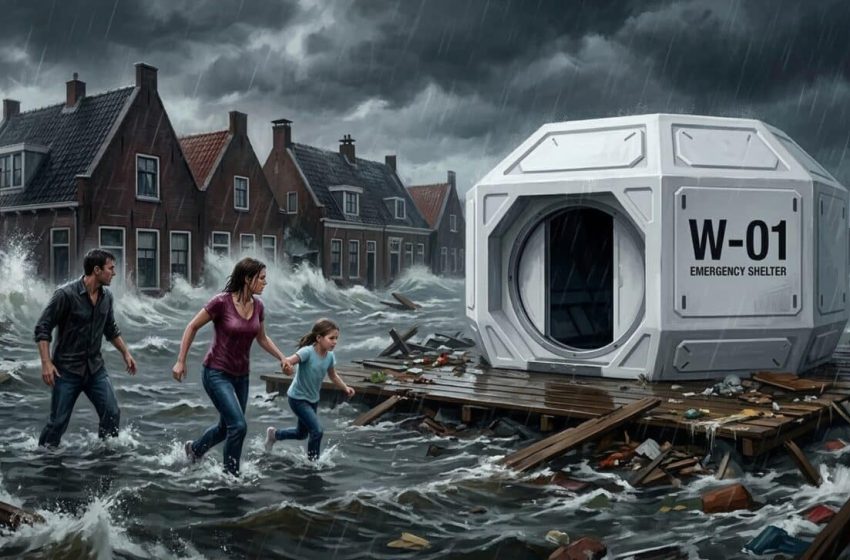
A white pod sits on a beach in the product render, its hatch open as children run toward it and a wave builds in the background. The scene is not framed as a bunker or a shelter room but as a sealed survival capsule meant to be reached in the last seconds before a disaster hits. On the front page of the W-01 brochure, the capsule is labeled an extreme flood hazard shelter designed for tsunamis, severe flooding, submersion, and extreme weather.
That compressed window is central to the pitch behind Momentum Technologies, the French company behind the LifePods line. Futuro Prossimo describes the concept as a portable mini-bunker that seals in 10 seconds, while the company materials present it as a rapidly deployable pod for people who may not have time to reach a conventional refuge. The focus is not on long-term living underground, but on immediate enclosure when impact, floodwater, or fire is already close.
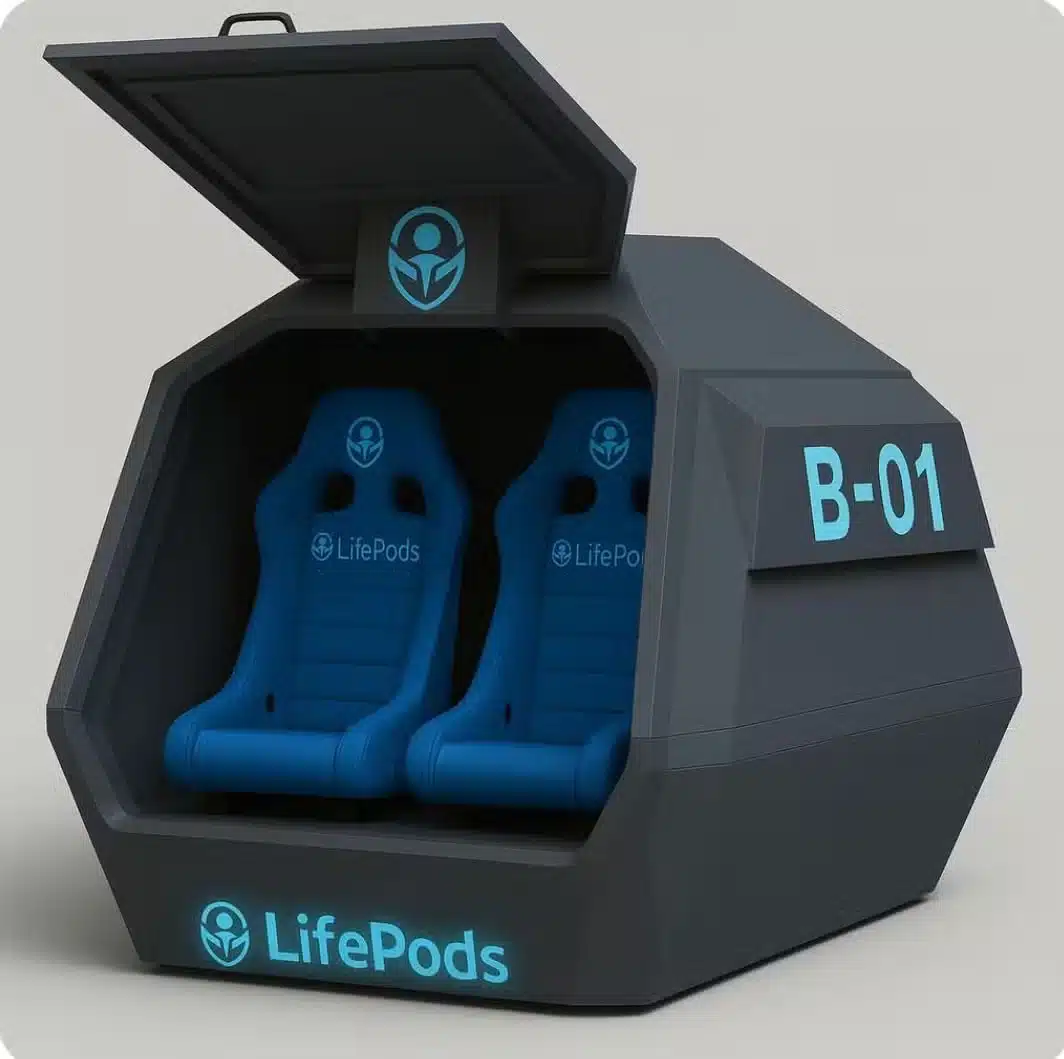
The project is tied to several kinds of emergencies at once. The official product lineup includes the B-01 for ballistic threats, fire, and explosions; the W-01 for water-related disasters; and the Q-01 for seismic collapse scenarios. That broader framing turns the capsule into more than a flood device, positioning it instead as an emergency shelter category aimed at households, schools, and other exposed sites.
The Idea Grew from a Disaster That Arrived Too Fast
The origin story points back to a single catastrophe. According to Wired Italia, company founder Cédric Choffat began developing the concept after the 2011 tsunami in Japan, the disaster that led to Fukushima and killed more than 20,000 people. The article places that event at the center of the design logic: a refuge built for situations where evacuation routes vanish quickly and public response may not arrive in time.
That background helps explain why the line now spans water, fire, armed attacks, and earthquakes instead of focusing on one market. The company has already presented the concept at Milipol Paris 2025 and CES 2026 in Las Vegas, suggesting that it is being pitched both as civil protection equipment and as a consumer-facing preparedness product. The sales pages also show a commercialization calendar rather than a distant concept phase, with launch dates and listed prices already attached to each model.
What the Flood Model Is Built to Endure
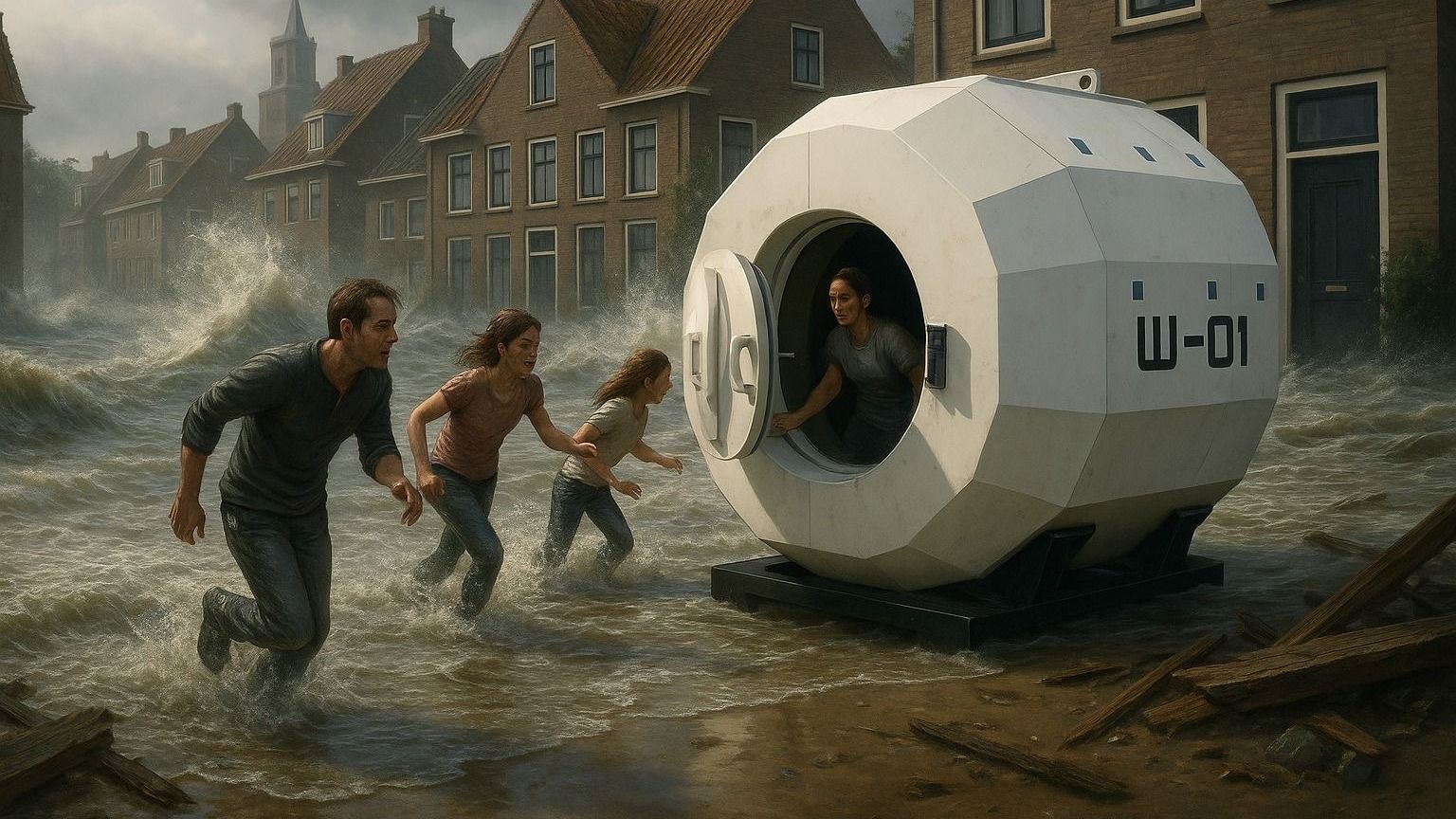
The technical details are clearest in the flood version. On the LifePods website, the W-01 is described as a floating, unsinkable capsule with an integrated ballast system designed to bring it back upright after rolling. The same materials say occupants are held in place by harnesses, while the pod includes anchoring points, internal opening controls, and a secondary exit concept at window level if the main door becomes blocked.
The construction sheet adds more specific numbers. The W-01 brochure says the pod uses Aluminum 5083 in a double-shell structure, with a 4 mm outer shell and 4 mm inner shell, plus welded transverse reinforcements and a reinforced lower section with double-thickness aluminum. That lower section is explicitly tied to protection against rocks and debris, which are often among the most destructive elements in a fast-moving flood.
The same document says the alloy is marine-grade and suited to humid or saline conditions. It also lists multi-functional insulating foam for thermal insulation, fire resistance and buoyancy contribution, along with an external thermal coating intended to reduce heat transfer and solar radiation. Together, those details place the pod somewhere between a floating shelter, a flood survival pod and a compact impact-resistant shell.
The Interior Is Designed as a Sealed Waiting Space
Inside, the flood model is configured less like a room than a controlled short-term enclosure. The brochure lists 6 ventilation channels of 10 cm² each, a water-ingress prevention design, and a fully sealed mode for submersion, with internal air volume of about 2.5 m³. It also gives the pod about 3 hours of autonomy without extra supply and says an optional oxygen cylinder can extend that duration.
Standard equipment includes seats with safety harnesses, a protective helmet for each occupant, an air filtration system, and a chemical toilet. Optional equipment includes food rations, drinking water for up to 2 weeks, a GPS tracking beacon, and an inflatable emergency raft. Those additions make clear that the pod is meant to keep people alive and locatable until rescue teams arrive, not to function as an independent long-term bunker.
One set of figures, however, does not align perfectly across the materials. The main company site says the capsules have integrated CO2 scrubbers and guarantee 72 hours of respiratory autonomy, while the dedicated W-01 technical sheet gives a much shorter duration for the flood version without extra supply. That gap suggests the broader line description and the current flood-model specification are not yet describing the same configuration.
Three Models Are Already Priced for Market Release
The company’s roadmap is unusually specific for a product still building public recognition. The B-01 is listed at €26,000 including tax with release in April 2026, while the W-01 is also listed at €26,000 including tax with release in September 2026. The Q-01, described as a lighter earthquake model for apartments in buildings that preferably do not exceed six floors, is listed at €18,000 including tax with a planned market release in Q3 2027.
Those figures show what the capsule is becoming: not a speculative drawing, but a priced portable bunker aimed at buyers willing to pay for private disaster protection. Across all three versions, the promise is the same and narrowly defined. The pod is meant to seal fast, resist the hazard outside and keep its occupants alive until rescuers can reach them.
First Appeared on
Source link






