


Tiny NASA Spacecraft Delivers Exoplanet Mission’s First Images
With the first images from the spacecraft now in hand, the team behind NASA’s Star-Planet Activity Research CubeSat, or SPARCS, is ready to begin charting the energetic lives of the galaxy’s most common stars to help answer one of humanity’s most profound questions: Which distant worlds beyond our solar system might be habitable?
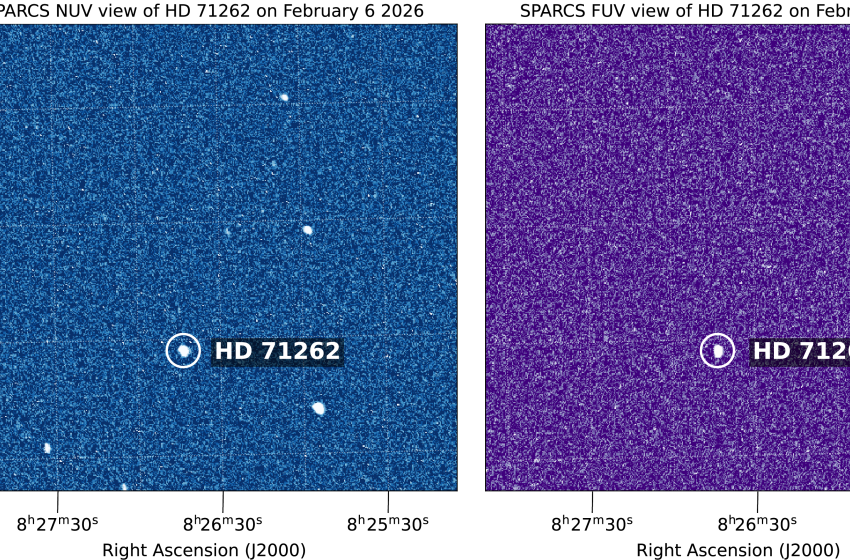
Initial, or “first light,” images mark the moment a mission proves its instruments are functioning in space and ready to transition to full science operations. This milestone is especially important for SPARCS, whose observations depend on highly precise ultraviolet (UV) measurements, making the demonstration of the camera’s performance critical to achieving its science goals. The spacecraft launched Jan. 11; the images came down Feb. 6 and were subsequently processed.
Roughly the size of a large cereal box, SPARCS will monitor flares and sunspot activity on low-mass stars — objects only 30% to 70% the mass of the Sun. These stars are among the most common in the Milky Way and host the majority of the galaxy’s roughly 50 billion habitable-zone terrestrial planets, which are rocky worlds close enough to their stars for temperatures that could allow liquid water and potentially support life.
“Seeing SPARCS’ first ultraviolet images from orbit is incredibly exciting. They tell us the spacecraft, the telescope, and the detectors are performing as tested on the ground and we are ready to begin the science we built this mission to do,” says SPARCS Principal Investigator Evgenya Shkolnik, professor of Astrophysics at the School of Earth and Space Exploration at Arizona State University, which leads the mission.
The SPARCS spacecraft is the first dedicated to continuously and simultaneously monitoring the far-ultraviolet and near-ultraviolet radiation from low-mass stars for extended periods. Over its one-year mission, SPARCS will target approximately 20 low-mass stars and observe them over durations of five to 45 days.
Although such stars are small, dim, and cool compared to the Sun, they are also known to flare far more frequently than our solar system’s star. The flares can dramatically affect the atmospheres of the planets they host. Understanding the host star is key to understanding a planet’s habitability.
First Appeared on
Source link






