


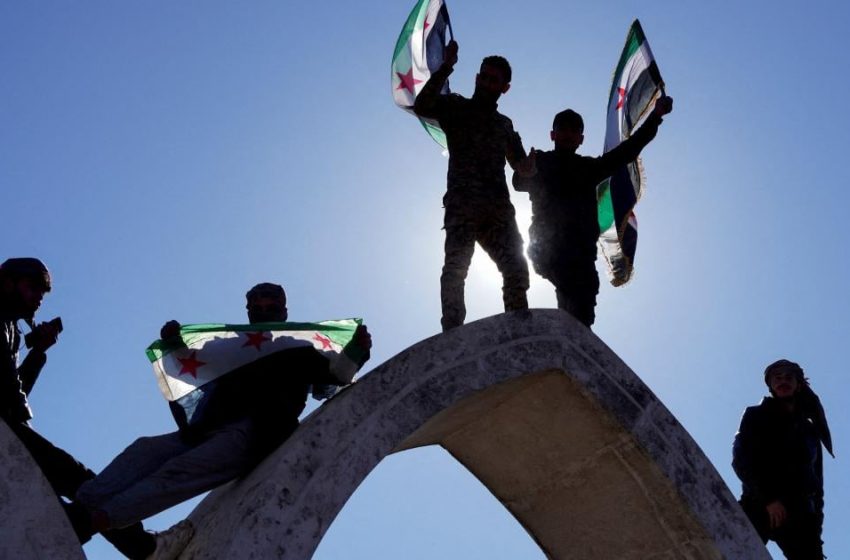
Trouble Is Brewing in Syria
Over the course of a year, Ahmed al-Shara, a former al-Qaeda commander, did the seemingly impossible. He not only toppled a dictatorship that had ruled Syria for half a century but also, upon assuming leadership of the country, convinced Western capitals to lift or suspend most of the sanctions imposed during the time of the old regime, obtained pledges from Arab and Western countries for billions of dollars in investment, and even joined the U.S.-led coalition against the Islamic State (or ISIS). The international rehabilitation Shara has achieved—for himself and for his country—was unimaginable when he emerged as Syria’s leader from the ruins of Bashar al-Assad’s regime.
Yet for all the diplomatic victories, Shara is confronting difficulties at home. The very qualities that enabled Hayat Tahrir al-Sham, the militant organization he led until its formal dissolution last January, to capture Damascus in December 2024 now complicate the new leadership’s efforts to rebuild the Syrian state. Tight command structures, prioritization of survival over ideological purity, and ruthless acumen in neutralizing rivals were necessary to forge a gaggle of former jihadi and other armed organizations into an effective battle force. A year into Syria’s post-Assad transition, however, these qualities have yielded a governing system that concentrates power within a narrow circle of former HTS leaders who have yet to articulate a clear vision for Syria’s political future.
Denied meaningful participation in the country’s newly reconstituted political institutions, religious and ethnic minority groups, as well as members of the Sunni majority who are wary of the ideological outlook of the new leadership, remain unsure of their place in the new Syria. Nowhere has this tension been more acute recently than in the country’s northeast, where Syrian government forces have swept into territory that the Kurdish-led Syrian Democratic Forces controlled for more than a decade. Last week’s agreement between the SDF and the government, which has begun a process of integrating the group into state institutions, may now begin to ease those tensions. But the momentum must not stop here. If Syria’s political transition stalls, the country could be drawn into new cycles of violence, jeopardizing the progress the government has made gathering international support.
The only way to ensure long-term stability is to truly open up the political system. So far, Shara has been hesitant to do so. But he is a shrewd politician who has demonstrated a capacity for pragmatic adjustment to head off problems before they become crises. Over the past decade, he has guided his movement away from global jihad and toward strategic alignment with international partners. And just a few months before Assad’s fall, while HTS ruled the province of Idlib, he allowed limited reforms in response to popular protest in the region. Now, to preserve and build on the progress he has achieved as Syria’s leader, Shara will need to grant Syrians a genuine political stake in their country’s future.
IN FROM THE COLD
The speed of Syria’s reengagement with the world has been impressive. When HTS took control of Damascus, Syria was a pariah, sanctioned by most countries primarily because of the Assad regime’s repression. HTS itself was on the UN Security Council Consolidated List of proscribed organizations, and the group’s jihadist roots made countries in the region leery of working with it. Shara and Syrian Interior Minister Anas Khattab were also subject to Security Council–authorized sanctions because of their ties to al-Qaeda until November 2025, which meant that countries hosting either had to secure waivers from the UN. Yet within its first few months in power, the new government had restored relations with hostile foreign countries such as Russia, secured pledges of reconstruction assistance from Gulf states, and persuaded Western countries to begin rolling back sanctions. In November, at Washington’s urging, the UN Security Council even delisted Shara and Khattab, although HTS itself remains on the sanctions list to assuage Chinese concerns about the participation of a militant Uyghur group in the new Syrian army. The same month, Shara visited the White House and committed his government to cooperate with the U.S.-led international coalition fighting the Islamic State.
This opening to the world did not happen by accident. Syria’s new leaders understood that securing legitimacy in the eyes of foreign partners—and unlocking the financial support and investment Syria desperately needs—depended on their ability to assure Western capitals that the government in Damascus could address their core concerns. The government launched an outreach campaign, offering concrete commitments on priority issues: confronting the Islamic State, dismantling chemical weapons infrastructure, preventing Iranian-aligned forces from operating on Syrian territory, and integrating thousands of foreign fighters into the national military to reduce the risk they might leave Syria and pose security threats elsewhere. Delivering on these pledges in the first half of 2025, together with deft lobbying from Qatar, Saudi Arabia, and Turkey, paved the way for the rapid easing of U.S. and European sanctions.
Equally important is the new Syrian government’s deft management of difficult relationships. It has preserved cooperation with Russia, which had propped up Assad’s regime for more than a decade. And it has erased Iranian influence by dismantling Iranian-aligned militias, curbing the Islamic Revolutionary Guard Corps’ access to Syria’s security infrastructure, and severing the overland link between Iran and its proxy, Hezbollah, in Lebanon—all while avoiding direct confrontation with Tehran. Even as Israel has launched hundreds of airstrikes on Syrian targets and sent ground forces to occupy land well beyond the Golan Heights, a territory on the Israeli-Syrian border that Israel has occupied since 1967 and officially annexed in 1981, the Syrian leadership has tried to de-escalate the situation, including through U.S.-mediated talks with Israel, rather than respond with military force. Israeli hostility to the new Syrian government has not eased, but Damascus’s pragmatic and restrained approach to foreign relations has otherwise paid substantial dividends. It faces no significant external antagonist apart from Israel, and no regional or international powers show any inclination to back an armed opposition within Syria.
PROBLEMS AT HOME
To be sure, the country’s political transition could have been far more turbulent than it was. HTS, although a highly cohesive force itself, was only one part of a victorious coalition that consisted of dozens of armed factions with a history of bloody infighting. Shara managed to take power without any of these factions rebelling—no easy feat. All the armed groups conceded to his leadership, and they allowed themselves to be formally dissolved in January 2025 and integrated into a new national army. Shara did what he could to take politics out of negotiations with these groups. He co-opted individual commanders by offering them promotions into high military ranks, and he made no promises of territorial autonomy or political representation to any faction, denying them the means to mount an effective challenge to the new military command or make a bid for political power. Consolidating control over the country’s armed forces is still incomplete. But the government’s integration of erstwhile rivals into a single military structure without triggering internal conflict or setting up rigid power-sharing arrangements that could cause problems in the future is a considerable achievement.
Another unexpected but promising development is that the new authorities, despite being former jihadis, have not imposed a hard-line Islamist agenda. Instead, they have focused on reconstructing state institutions and advancing a constitutional process. And although the interim government that took control in late 2024 was overwhelmingly composed of HTS leaders loyal to Shara, the transitional government appointed in March was surprisingly diverse. The new parliament, selected in a tightly managed process by committees that Shara appointed himself, is not dominated by HTS. Instead, it includes working professionals, technocrats, traditional figures of authority, and a few individuals with close ties to armed factions. (Women remain underrepresented; there are only six women among the parliament’s 119 members.) The 23-member cabinet, the country’s main administrative body, is not dominated by HTS, either. Although the most influential members are Shara loyalists, it also includes technocrats; civil society leaders such as Raed al-Saleh, the head of the White Helmets, the volunteer search-and-rescue organization; and respected figures from the diaspora, most notably Hind Kabawat, an activist and a Christian woman. Kabawat’s place in the cabinet is particularly striking because HTS did not accept women’s participation in politics when it governed Idlib before the fall of Assad.
Yet beneath this surface-level inclusiveness lies a troubling reality: as Syria’s political institutions are rebuilt, real power is concentrating in the hands of a narrow circle drawn from former HTS leadership. The extent to which appointees representing other constituencies have influence on decision-making seems to largely depend on the magnanimity of the president and his closest advisers. The government, moreover, has avoided giving the Syrian people any avenue for direct representation. All political parties were dissolved in January 2025, and no laws or decisions that would allow new ones to be established have been handed down since. Former HTS members, meanwhile, effectively function as an unacknowledged governing party. They hold the presidency, they dominate the security apparatus and key ministries, and even those who do not hold formal roles often function as de facto supervisors in the new institutions. Many Syrians therefore worry they are witnessing not a transition to an inclusive, representative government but the consolidation of a new authoritarian system.
Furthering Syrians’ concerns about the nature of the emerging state, government-aligned forces have responded with heavy-handed measures to a series of security problems over the past year, showing gaps in discipline and command. More than a decade of civil war has left Syria with a number of sectarian and political fault lines that have periodically produced violence. The new central government has tried to put a lid on such violence by folding disparate armed groups into a single army, but that army remains one in name more than in practice. The government cannot fully control its armed forces—establishing discipline in a newly formed army is inherently difficult, and dwindling resources and sectarian divides do not help.
The public must buy into the state-building project.
As a result, when the authorities have deployed the military to restore order, it exacerbated tensions instead. In March, government-aligned forces sent to conduct operations against pro-Assad insurgents on the Syrian coast ended up killing some 1,400 Alawite civilians. In July, a delayed and poorly managed intervention in clashes between Druze and Bedouin militias in Sweida, a city in southern Syria, was widely perceived as siding with the Bedouin over the Druze. Reports of sectarian abuse by government forces and the deaths of roughly 1,000 civilians pushed Druze leaders—including previously moderate ones—toward hard-line positions in favor of independence from Syria. Some even appealed to Israel for protection. The central government has begun trials for some soldiers involved in the abuses, but it is yet to be seen whether these proceedings will produce meaningful accountability.
Syria’s leaders have taken some corrective measures, such as expanding training and recruitment and deploying volatile units away from sensitive areas. The takeover of former SDF-held areas demonstrates that these reforms are indeed strengthening the army’s ability to control territory without civilians paying the price. Still, state forces remain unable to provide basic protection for many Syrians. Criminal networks and nonstate armed groups are still active in many parts of the country, killing, kidnapping, extorting, and looting with impunity. Minority groups face disproportionate risk, but the danger is widespread. Security forces, meanwhile, are stretched thin and are often staffed largely by people unfamiliar with the area, so they struggle to project authority.
Security failures feed directly into the broader uncertainty many Syrians feel about the nature of the emerging state. Communities across the country—not only minorities but segments of the Sunni majority, too—still do not know what kind of political order they are being asked to join. Experience has made them wary, and without a clear vision about how power will be distributed in new state institutions, there is little to reduce their unease. Every episode of violence, perceived slight from the central authorities, or rumor of favoritism therefore reinforces suspicions that the new government is simply consolidating control on behalf of a narrow constituency.
That wariness has long been present in Syria’s largely Kurdish northeast. Talks about the integration of the SDF’s large fighting force—which includes a sizable share of all-women units—into the army and the extension of central government authority into SDF-controlled areas made little progress for more than a year. SDF leaders wanted to preserve significant regional autonomy, and they were reluctant to submit to a political order dominated by a faction that they perceive as potentially hostile and that faces few institutional limits on its power. Damascus has gained the upper hand in recent weeks. After its forces took control over most of the territory the SDF once held, the government reached an agreement with the SDF last week that lays out how the SDF will be integrated into the national army and how the group’s leaders and local institutions, will be incorporated into the state. Together with the government’s recognition of Kurdish cultural, linguistic, and citizenship rights, the steps represent welcome progress. But even these stop short of addressing the kind of political system Syria’s Kurds and other groups will be joining.
THE ROAD AHEAD
The challenges confronting Damascus—including communal tensions and the lack of discipline in the security sector—are not problems that can be addressed in isolation. They are symptoms of an incomplete political transition. The new government has drafted a constitution and established a parliament, but it has not convinced Syrians that the country’s newly rebuilt institutions will allow for meaningful participation, protect their interests, and put checks on the exercise of power and the use of force.
HTS showed a willingness to make concessions during its governance of Idlib. It allowed more civil society activity, helped religious minority groups reclaim their lands and houses, and even considered setting up an elected parliament, albeit a tightly managed one, after a series of arrests and incidents of torture sparked local protests demanding accountability from the HTS-dominated security services. Yet these concessions were mostly tactical: they sought to defuse unrest while preserving HTS’s grip on power, not to share that power with political challengers. The same pattern continues today. Shara and his allies have appointed some individuals who did not belong to HTS to prominent positions, but they have made no genuine concessions to organized political forces. They have not carved out a role for political parties, laid out a road map for how power will be distributed, or offered guarantees for communities that fear marginalization or retribution. They have treated the transition as a technocratic exercise, as if all it takes to rebuild a country is to assemble the most competent specialists. But the political and social dimensions of that task cannot be ignored. The public must buy into the state-building project. For that to happen, their views must be meaningfully integrated into decisions about what the country is to become.
The Syrian leadership acknowledges that there is demand for broader political participation. It is better that they invite in the rest of Syrian society now rather than later. After a year of crisis management and securing support abroad, it is time to make the Syrian government more inclusive and institutionalized. That means expanding decision-making beyond a narrow circle of former HTS leaders. It means clarifying the roles that various social groups, political parties, and the former HTS members will play in the political system. It means empowering the new Syrian parliament with real prerogatives, not limiting its function to rubber-stamping executive decisions. And it means not merely assuming control of territory previously held by the SDF but fully integrating Kurdish communities into national political institutions on an equal footing with other groups.
These steps will be difficult, especially for a set of leaders who spent the last decade operating in an environment in which political dissent typically manifested in armed violence and in which keeping strict control was essential for survival. But now, clinging too tightly to power could cost the central government its domestic legitimacy, which in turn would jeopardize the legitimacy that Damascus has so carefully cultivated abroad. Syria’s future stability hinges on convincing Syrians from all the country’s diverse communities that the new state genuinely belongs to them. The coming year will reveal whether the leaders in Damascus are willing and able to make that case credible. The alternative is a hollow state, internationally recognized but domestically contested, lurching from one crisis to another—an incomplete transition that would plant the seeds of Syria’s next conflict.
Loading…
First Appeared on
Source link






