


Trump claims blue states have less-reliable, more expensive electricity. Here’s the reality
Electricity costs are climbing nearly everywhere in the United States. But, in recent months, the Trump administration has framed the problem as one impacting only blue states.
While several blue states like California, Massachusetts and Hawaii do indeed have some of the highest electricity rates in the country, federal data shows that electricity prices are now increasing in every corner of the US. In fact, some of the highest jumps since last year came from purple Pennsylvania and red Ohio.
Despite framing high energy prices as a policy choice of blue states pursuing wind and solar, there are a lot more factors at play. Experts told CNN costs are going up in red and blue states alike and are not tied to voting patterns. And plenty of red states (Texas chief among them) have installed far more renewables than many of their blue counterparts.
Residential electricity prices across the US have climbed about 40% since 2021, according to data from nonprofit utility group PowerLines.
“That is a very significant increase that significantly outpaces inflation during this time,” said Charles Hua, PowerLines’ founder and executive director.
A spokesperson for utility trade group the Edison Electric Institute disagreed, saying federal data shows “electricity prices have largely tracked overall inflation in recent years, with prices only rising significantly in a few areas.”
Regardless, the cost of electricity is only expected to increase; utilities requested another $31 billion in rate increases in 2025, more than double the rate increased they requested the year prior, the PowerLines report found. About half of that requested money is concentrated among Southeast utilities in red states, where grid hardening, hurricane recovery and an expensive new nuclear power plant in Georgia are factors driving up costs for ratepayers.
“Lowering electricity prices is a top priority for President Trump,” said White House spokeswoman Taylor Rogers, adding Trump is “aggressively unleashing reliable energy sources like coal and natural gas to reverse the catastrophic damage that Joe Biden did to our power grid.”
But experts cautioned that leaning on coal and natural gas could do more to drive prices up even further in the future.
Why prices are so expensive in New England and California
Electricity bills are indeed highest in several blue states, including California, New York, and the New England region (Hawaii and Alaska are also expensive outliers).
In past statements, the White House has characterized these high prices in blue states as a policy choice. Rogers, in a previous statement to CNN, said blue states were “stubbornly choosing Green Energy Scam policies that are making electricity bills unaffordable.”
But the reasons behind high bills are more complicated and vary by state. There is one factor they hold in common, however: Costly infrastructure that has come due for maintenance and upgrades.
Massive, deadly wildfires have driven up costs in California, where utilities are trying to harden their electricity infrastructure and are spending money on clearing vegetation and trees away from power lines.
“That has driven huge costs in the electricity system to adapt to that wildfire risk,” said Brendan Pierpont, director of electricity at think tank Energy Innovation.
Even though it has far less wildfire risk, New England has also been upgrading and modernizing its aging distribution and transmission systems, which have been contributing to higher consumer bills there. The region also suffers from a lack of available energy; it is the last stop on the nation’s system of natural gas pipelines and burns a substantial amount of oil to help generate power during cold winter snaps.
“We don’t have fossil resources in this part of the country, but [fossil fuels] still makes up the lion’s share of electricity generation in New England,” said Ari Peskoe, director of the Harvard Law School’s electricity law initiative. “We have to bring [fossil fuels] in from elsewhere.”
Because of this, the region wants to rely more on offshore wind to help relieve seasonal power crunches, especially in winter — when temperatures drop and blustery winds are frequent. Regional energy data shows the Massachusetts wind farm Vineyard Wind performed well during the recent winter storm.
New England states and New York are building this offshore wind, despite attempts from the Trump administration to shut the construction down. Recent court orders have overridden the administration and let four projects continue building. The delays have proved costly, but the fuel cost of wind is free — unlike gas or oil.
Rogers, the White House spokeswoman, said that blue states “that refuse to implement President Trump’s commonsense energy dominance agenda will continue to see prices rise at astronomical rates like they did under Joe Biden.”
Despite the charged rhetoric, wind power has proved to be a bipartisan form of energy. Red states in the middle of the country like Iowa, Texas, North Dakota and Kansas where electricity prices are relatively low rely substantially on onshore wind to generate electricity as well.
Recent federal data shows a clear trend in the US: electricity prices are rising in every region of the country. Just four states — Nevada, North Carolina, Rhode Island and Connecticut saw year-over-year electricity price drops, according to Energy Information Data released last week. Other than swing state North Carolina, those states are all blue.
Meanwhile, in other regions of the country, prices are rising exponentially in red and blue states alike.
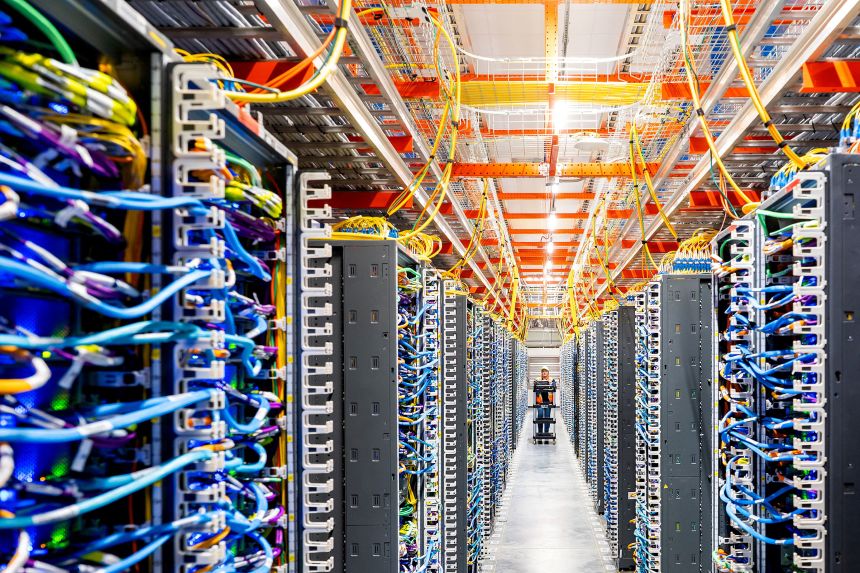
Nowhere in the country have prices spiked in recent years like the mid-Atlantic region, where the world’s biggest concentration of data centers is consuming far more power than currently exists on the grid.
The electricity price crunch in states like Pennsylvania, Ohio, New Jersey, Indiana, and Maryland has gotten the attention of the White House, which recently has been pushing big tech companies to pay for more of the power they consume, rather than shifting the cost burden to residential households. It’s a dynamic starting to play out in other parts of the country, as data center development booms.
Data centers and the artificial intelligence they power are driving a large increase in overall demand for electricity: A 2024 report by the US Department of Energy estimated that data centers would use between 6.7 and 12% of the nation’s electricity by 2028. More tech companies are vowing to pay for the electricity and infrastructure they need for these power-hungry centers, but federal regulations on the issue are scarce.
The high cost of energy infrastructure around the country is hitting consumers’ pocketbooks, as is rising natural gas prices. In addition to its use for home heating, natural gas is the largest source of electricity generation in the US. Its price suddenly spiked ahead of last week’s winter storm, as user demand soared.
“Even if the price volatility only lasts for a year or so, that impact on rates can stick around for many years after the fact” as utilities recoup their high fuel costs over a longer period of time, Pierpont said.
In addition to the volatility of gas, expensive coal power is making a rebound amid the excessive demand for electricity. Coal is coming back for another reason, too: the Trump administration has forced several retiring coal-fired power plants to keep running. Many of these plants are older and were being retired because they were too expensive to be cost-competitive with gas and renewables.
Experts told CNN that move will drive prices up further. As the Trump administration forced the retiring JH Campbell coal plant to remain open in Michigan this summer, it has cost ratepayers $80 million for the first four months of running that plant beyond its retirement date, said Dan Scripps, chair of the Michigan Public Service Commission.
That cost will show up in residential utility bills across the Midwest in the coming months, Scripps said. And as the Trump administration has used similar emergency orders to keep other coal plants open in Indiana, Colorado and Washington state, residents in those states could also see price impacts this year.
“There’s a lot of maintenance costs to keep them around and keep them operating,” said Michael Goggin, executive vice president of energy consulting group Grid Strategies. “These costs could be significant, and it is going to be an inherent price increase. That’s what is really going to hit the ratepayers.”
First Appeared on
Source link






