


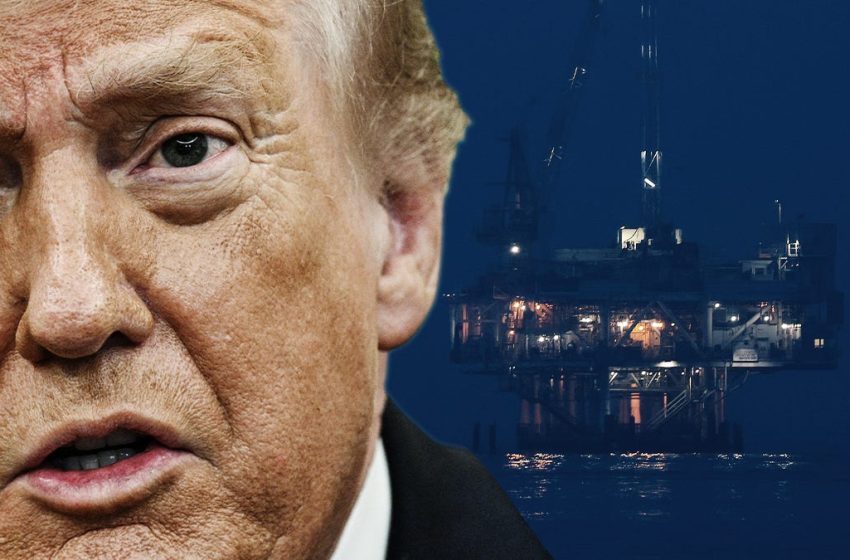
Trump Is Getting Drilled, Baby, Drilled
There has always been a chasm between the actual MAGA voters and the MAGA intelligentsia that purports to speak for them, but it has rarely been as visible as it is this week. Many of the leading lights of the literate right have been pulling their hair out (with good reason!) over the Iran war, with Christopher Caldwell declaring it “the end of Trumpism” in the Spectator and Sohrab Ahmari proclaiming that “Trump was never the one” in UnHerd. At least so far, the base does not agree: A new Politico poll finds that only 12 percent of 2024 Trump voters oppose the war in Iran so far. Happy Friday.
by Andrew Egger
Twenty four hours ago, it looked like our war in Iran might be about to spiral really, really out of control. Iran had been playing havoc with global energy prices by blockading the Strait of Hormuz, but until this week damage to the region’s actual energy production infrastructure had been minimal. That changed after Israel struck a major Iranian gas field Wednesday, to which Iran responded with further strikes against energy infrastructure around the region.
One Iranian missile managed to strike an oil refinery in northern Israel, although Israeli officials said the facility had escaped significant damage. Qatar wasn’t so lucky. Iranian strikes pummeled its liquefied natural gas infrastructure. Shell-shocked QatarEnergy officials emerged yesterday to quantify the damage: an estimated 17 percent of the country’s export capacity was knocked out, an estimated $20 billion in lost annual revenue until $26 billion in repairs can be made.
This latest alarming development in the conflict has put President Donald Trump in an extremely strange place. He remains the prime mover of the entire war; Israel, for all its own might, likely wouldn’t keep it going if Trump pulled out and demanded it do the same. It’s on his orders that America is still busily bombing the daylights out of Iran—and spending down stockpiles of precious munitions like missile interceptors. Every day that goes by with America seemingly no closer to accomplishing its vague war aims, the administration seems to relearn the same lesson: Okay, guess we just didn’t hit them hard enough yet. Yesterday morning, Defense Secretary Pete Hegseth promised that yesterday’s bombardment would be the most extensive one to date.
And yet Trump is plainly growing more and more preoccupied with the war’s toll in spiking energy prices. Asked in the Oval Office yesterday whether he was considering surging more U.S. troops to the region, the president pivoted instantly to economy talk: “No, I’m not putting troops anywhere. . . . And we will do whatever is necessary to keep the price low.” As he jabbered on, he fell into the same sort of wistful tone he used to strike, five years ago, when talking about his pre-COVID economy: “Everything was going great. The economy was great. Oil prices were very low. Gasoline was dropping. . . . And I saw what was happening in Iran, and I said, ‘I hate to make this excursion, but we’re gonna have to do it.’”
Trump is right to be worried. And he’s right in particular to be completely freaked out by the possibility of more attacks from either side on the region’s energy infrastructure. Putting LNG and oil production facilities on the legitimate-targets list would mean heavy long-term damage to the energy economy. Trump knows how little buy-in the American public has for this war even on its own merits, and how little pain people will be willing to suffer on its behalf. For him, the single most important thing he needs to accomplish in this conflict is a crisp end date—preferably very soon. Pretty much his worst-case scenario would be higher energy prices for the rest of his term because the Middle East’s energy infrastructure had been reduced to rubble.
So Trump, in addition to his role as bombardier-in-chief against Iran, has taken on a strange second role as well: independent referee trying to enforce a no-more-energy-strikes-or-else policy on the entire region, friend and foe alike. Here he was on Wednesday night on Truth Social:
Israel, out of anger for what has taken place in the Middle East, has violently lashed out at a major facility known as South Pars Gas Field in Iran. A relatively small section of the whole has been hit. The United States knew nothing about this particular attack, and the country of Qatar was in no way, shape, or form, involved with it, nor did it have any idea that it was going to happen. Unfortunately, Iran did not know this, or any of the pertinent facts pertaining to the South Pars attack, and unjustifiably and unfairly attacked a portion of Qatar’s LNG Gas facility. NO MORE ATTACKS WILL BE MADE BY ISRAEL pertaining to this extremely important and valuable South Pars Field unless Iran unwisely decides to attack a very innocent, in this case, Qatar – in which instance the United States of America, with or without the help or consent of Israel, will massively blow up the entirety of the South Pars Gas Field at an amount of strength and power that Iran has never seen or witnessed before.
Trump is playing with fire here, but this sort of Mad King threat has worked for him in the past and could work again: At least for the moment, the attacks on energy seem to have stopped.
But the whole alarming affair is a good analogy for the Iran conflict writ large—indeed, for Trump’s whole floundering second term. Trump is spending his time this week fighting tooth and nail just to get back to the previous status quo—an Iran war that mostly spares globally vital energy infrastructure. Zoom back and he’s fighting to get to another, higher-order previous status quo: no war in Iran at all to drive prices up like crazy. Zoom back one more time and it’s the story of his whole second term: He’s fighting just to get back to the levels of support he had this time last year as the midterms loom and his coalition crashes down around him.
Every one of Trump’s campaigns has been inherently nostalgic—look no further than “Make America Great Again.” What would it look like for Democrats to run nostalgic campaigns? Would it work? Let us know what you think.
by Jim Swift
As regular readers know, last year I wrote a profile of a member of the Bulwark community, Shane DiGiovanna. Shane was born with recessive dystrophic epidermolysis bullosa, a genetic condition that is guaranteed fatal and typically leads to a very painful, short life. While Shane’s life has been painful, it has been beautiful—and longer than anyone would have expected, at 27 years so far.
When I wrote my profile of Shane, the Bulwark community stepped up to show Shane some love: You helped fund his namesake charity at Cincinnati Children’s Hospital so future kids who come through those hospital doors get a stuffed animal, like Shane’s lifelong companion, Doggie. (You can also watch a video interview I did with Shane here.)
Last fall, I updated readers on Shane’s journey in JVL’s Triad. Not wanting a sad and somber funeral, Shane threw himself the best party I’ve been to in a while—a “celebration of life.” As the party faded into memory, the heartbreaking reality of Shane’s impending death became starker.
Shane is a graduate of Rice University, and I asked if I could bring him anything from Texas while I’m here for this week’s Bulwark Live events. Knowing that physical goods have little use, I figured maybe I could bring back a favorite snack. He didn’t want anything from Texas, he told me. Instead he wanted me to update you on a big part of his legacy: Earlier this week, Shane’s congressman (and mine), Greg Landsman, introduced H.R. 7877, the Shane DiGiovanna Act. Shane did an interview with a local TV station about it.
There’s no cure for Shane’s disease, and the bill wouldn’t change that. But what it would do is lighten the financial load of keeping somebody afflicted with EB alive. Shane’s bandages can cost $80,000 a month—and that’s just a fraction of his medical expenses. But each state gets to decide if its Medicaid program covers “wound treatment” for EB, and most don’t. Landsman’s bill would create a demonstration program to test what mandatory Medicaid coverage of wound treatment for kids with EB would cost. Once that cost is quantifiable, the next step would be to make that coverage mandatory.
Shane is a huge proponent of the bill. He’s spending all the time and energy he can advocating for its passage. He doesn’t have to—he could be spending his time with his family and friends. But instead he’s focused on other patients at Cincinnati Children’s and other kids with EB, first with his charity and now with the bill that bears his name.
The years I spent as a House and Senate staffer taught me that most of the time, slapping a sympathetic person’s name on a bill is a cheap way of making well-intentioned but often bad policy more popular—or at least harder to vote against. I’m happy to say that the Shane DiGiovanna Act is an exception: It’s a sympathetic person’s name on a smart policy idea.
THE HOT SEAT: Director of National Intelligence Tulsi Gabbard’s tightrope act is getting more perilous. The Tuesday resignation of Joe Kent, director of the National Counterterrorism Center and one of her direct reports, couldn’t have come at a worse time for her—she was already scheduled for two days of congressional hearings Wednesday and Thursday when he quit. She spent those hearings trapped painfully between three irreconcilable positions: (1) her own previous professional downplaying of the threat of Iran, (2) Donald Trump’s constant barrage of truth-agnostic claims on the subject, and (3) her own fierce anti-interventionist history.
Rep. Elise Stefanik (R-N.Y.) asked: Did Gabbard agree with Kent’s assessment that “high-ranking Israeli officials” had deceived Trump into believing that Iran posed an imminent threat to the United States? “He said a lot of things in that letter,” Gabbard said. “Ultimately, we have provided the president with the intelligence assessments, and the president is elected by the American people and makes his own decisions based on the information that’s available to him.”
Rep. Ami Bera (D-Calif.) asked: Did Gabbard still believe, as she said while serving in the House in 2020, that strikes on Iran without congressional approval constituted “an illegal and unconstitutional act of war”? “My own personal and political views” aren’t important, Gabbard replied; her role required her to “check those at the door.”
And Rep. Jimmy Gomez (D-Calif.) asked: Did Gabbard still maintain, as she said last year—and despite Trump’s continual claims to the contrary—that Iran was not building a nuclear weapon? “Iran had all the materials and capabilities to do so,” Gabbard said evasively. “I stand by the intelligence community’s complete assessment.” The intelligence community, for what it’s worth, has reportedly never assessed that the Iranian leadership has made the final decision to build a nuclear weapon.
POWER OF THE PURSE: The economic costs of the war in Iran aren’t just coming in the form of snarled shipping and spiking energy prices. After weeks of bombardment, the administration is reportedly asking Congress to backfill the Pentagon’s budget with an eye-watering ask of $200 billion in supplemental funding.
There’s a reasonable argument that this funding is a good idea even if the ongoing war isn’t: The Pentagon has dipped way, way into America’s materiel stockpiles in its more-is-more bombardment of Iran, leaving us worryingly defenseless to face other threats should those stockpiles go unreplenished. But that’s a tough case to make when the White House never asked Congress to authorize this war in the first place; in such circumstances, the funding bill becomes a proxy for the conflict itself pretty much by default.
As a result, it isn’t obvious Republicans will have the votes to pass it. Yesterday morning, Speaker Mike Johnson was guarded in his rhetoric around a possible funding request, which the White House hasn’t denied but has not yet made public. “Obviously it’s a dangerous time in the world and we have to adequately fund defense, and we have a commitment to do that,” Johnson said. Majority Leader Steve Scalise also declined to weigh in on whether they’d have the votes: “We will have a negotiation at some point,” he said. “But it hasn’t started yet.”
A NEW TACK FROM MASSIE: Rep. Thomas Massie (R-Ky.)—libertarian gadfly, gun nut, budget hawk, Epstein Files legislative mastermind—is Congress’s biggest remaining Republican thorn in the president’s side. Even as Trump has tried to punish him for his insubordination by standing up a MAGA primary challenger in his district, Massie has seemed unfazed, constantly tweaking the president online with what looks like merry bravado.
Massie thinks his heterodox brand will still carry the day in his district—but perhaps not all the way. Yesterday, Massie released an ad hitting his opponent, Ed Gallrein, on exactly the same grounds Gallrein is hitting him—that he’s insufficiently loyal to president Trump. The ad, which begins with a photo of Massie and Trump smiling side-by-side, accuses Gallrein of switching his party registration to “independent” after Trump won in 2016, and only switching it back after Joe Biden took office in 2021. “Woke Eddie Gallrein,” the ad finishes. “Not just a Trump hater, a Trump traitor.”
Obviously, one ad isn’t going to undo Trump’s endorsement and Gallrein’s relentless campaigning on that endorsement, but Massie seems to be hoping he can muddy the waters. Kentucky’s primaries are May 19.

First Appeared on
Source link






