


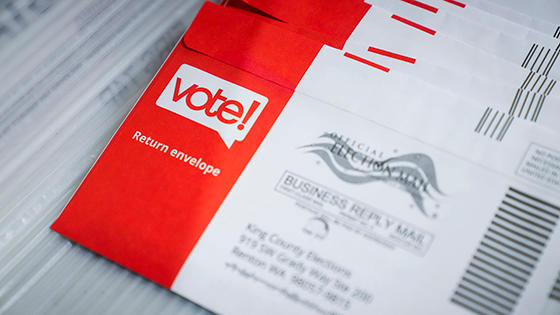
Trump just voted by mail again — one day after calling it ‘mail-in cheating.’ Why is he still trying to ban mail ballots?
In August 2025, President Trump vowed on social media to “lead a movement to get rid of MAIL-IN BALLOTS,” claiming, without proof, that “ELECTIONS CAN NEVER BE HONEST” if Americans cast their votes by mail.
Yet when the time came for Trump to cast his own vote in Tuesday’s special election in Palm Beach County, Fla., he chose to do it … by mail.
Just like he did in 2020.
The president hasn’t abandoned his outspoken opposition to mail-in voting — at least not for other people. “Mail-in voting means mail-in cheating,” he said during an appearance in Memphis on Monday. “I call it mail-in cheating, and we got to do something about it all.”
The same day, the Supreme Court heard a challenge to a Mississippi law that allows officials to count ballots postmarked by Election Day even if they arrive slightly late — a challenge backed by the Trump administration. The court’s conservative majority “appeared poised to reject” the law, according to the New York Times.
Meanwhile, the president has prevented Republicans in Congress from negotiating with Democrats to end the partial government shutdown by demanding that they use the standoff as leverage to pass legislation called the SAVE Act that would stiffen voter identification requirements and complicate mail-in voting.
“I, as President, will not sign other Bills until this is passed,” Trump declared on social media earlier this month.
So why is mail-in voting OK for Trump, but not the rest of America? Here’s everything you need to know to understand the president’s campaign against mail-in voting — and how it could affect the 2026 midterm elections.
President Trump speaks in the Oval Office.
(Jim Watson/AFP via Getty Images)
What is mail-in voting?
Americans started voting by mail during the Civil War, when several states passed laws allowing soldiers to cast absentee ballots. Federal law now requires all states to send absentee ballots to voters serving in the military or living abroad.
Nonmilitary, in-country voters first got a chance to vote by mail in the late 1800s — if they provided a good reason why they couldn’t go to their polling place on Election Day, like work or illness. In the 1980s, California became the first state to allow absentee voting for any reason, including convenience.
Today, there are basically three kinds of mail-in voting: absentee ballots that require an excuse; absentee ballots that don’t require an excuse; and universal vote-by-mail ballots, which are automatically sent to every voter in a given state. Absentee ballots need to be requested; universal vote-by-mail ballots do not.
How many states allow mail-in voting?
Every state allows at least one of these three forms of mail-in voting. Forty-two states require voters to request an absentee ballot. Fourteen of those states require voters to explain why they can’t vote in person; the other 28 allow eligible voters to cast absentee ballots by mail without providing an excuse. The remaining eight states — Oregon, Washington, California, Nevada, Utah, Colorado, Vermont and Hawaii, plus the District of Columbia — automatically send out universal vote-by-mail ballots to every eligible voter.
Wait, so how many Americans actually vote by mail?
A lot. In the 2024 general election, about 30% of all ballots were cast by mail. That’s 48 million votes. In the 2020 election — which occurred during the COVID-19 pandemic — the number was even higher: nearly 66 million votes. Since 2000, more than 250 million votes have been cast via mailed-out ballots in all 50 states.
Why does Trump want to ‘get rid of mail-in ballots’?
It all goes back to the pandemic. For decades, mail-in voting wasn’t seen as controversial — let alone partisan. In fact, Republicans were even more enthusiastic about the practice than Democrats.
Why? Because they saw it as a safe and efficient way to make voting easier for rural and older voters — a key part of their base.
In the 2000 presidential election, military mail ballots helped put GOP nominee George W. Bush over the top in Florida; in 2005, Georgia Republicans passed no-excuse absentee voting as soon as they won full control of the state government.
COVID-19 flipped the script. Ahead of the 2020 election, many states passed laws to expand early voting and mail voting. The logic was simple: At a time when millions of Americans were trying to minimize their exposure to the virus, why force them to crowd into a polling place on Election Day? Why not provide some alternatives?
As polls began to show Trump trailing his Democratic challenger Joe Biden by a sizable margin, the incumbent seized on mail-in voting as a preemptive explanation for any unfavorable election outcome. “2020 will be the most INACCURATE & FRAUDULENT Election in history,” Trump wrote online that July. “Delay the Election until people can properly, securely and safely vote???” He described mail-in voting as the “biggest risk” to his reelection, and both his campaign and the GOP unsuccessfully sued to stop it.
Trump’s rhetoric effectively polarized the practice. Democrats (who were already more prone to avoid pandemic-era gatherings) embraced it; Republicans resisted. As a result, 58% of Democrats wound up voting by mail that year; only 29% of Republicans did the same.
Trump lost to Biden by more than 7 million votes, but he’s been blaming election “fraud” — including supposedly fraudulent mail ballots — ever since.
So is fraud a problem with mail-in voting?
No. It’s never really been clear what Trump is alleging when he says elections can’t be “honest” if Americans vote by mail.
In 2020, the president was particularly upset when he seemed to be “winning” early on election night — only to see Biden catch up and surpass him as the evening wore on. But that effect — known as a “red mirage” or a “blue shift” — is easily explained by the fact that if Republicans tend to vote in person and Democrats tend to vote by mail, Republican votes will tend to be counted before Democratic votes.
At times, Trump has also tried to distinguish between absentee voting and universal vote-by-mail. But the same multistep security and verification methods apply to both processes, and states that rely on universal vote-by-mail haven’t experienced more misconduct because of it. One election expert dismissed as “nonsensical” any “distinction” between the two forms of voting “in terms of the potential for fraud.”
In truth, fraudulent mail voting is vanishingly rare. According to a Nov. 2025 analysis by the Brookings Institution — which relied on an election fraud database compiled by the Heritage Foundation, a conservative group — there were only between six and 46 cases of mail voting fraud in each general election from 2016 to 2022.
That means just 0.000043% of mail ballots — four out of every 10 million cast — have been found to be fraudulent during the Trump era.
In general, all of Trump’s allegations of widespread, result-altering election fraud — claims he has been making since he lost the popular vote to Hillary Clinton in 2016 — have been conclusively debunked, both in court and by GOP election officials.
Could Trump interfere with mail-in voting before the midterms?
Over the last five years, many states have already made their existing voting laws — including those governing mail voting — more restrictive. These states tend to be controlled by Republicans.
Last month, Trump told a conservative podcaster that he wants Republicans to “take over the voting” in 15 states in order to “nationalize” the 2026 midterm elections, raising concerns that he may try to defy the Constitution and interfere in ways that would benefit his party. (Article I, Section 4 of the Constitution explicitly says that “the times, places and manner of holding elections for senators and representatives shall be prescribed in each state by the legislature thereof” — not the White House.)
“We have states that are so crooked,” Trump said at the time. “We have states that I won that show I didn’t win.”
The president did not explain what he meant by “nationalizing the voting,” nor did he say which states he had in mind.
Last August, Trump said “the best lawyers in the country” were working on an executive order that would end mail-in voting, but it has yet to materialize.
Last March, Trump signed a separate order that would require people to show government-issued proof of U.S. citizenship in order to register to vote in federal elections and prohibit states from counting mail ballots that arrive after the polls close on Election Day (even if they’re postmarked in time).
Federal judges have repeatedly blocked that earlier order from taking effect.
“Put simply, our Constitution does not allow the President to impose unilateral changes to federal election procedures,” U.S. District Judge Colleen Kollar-Kotelly ruled in February.
In response, Trump has mostly focused on pressuring Congress to pass the SAVE Act (even as his administration has raided county election offices and demanded state voter files).
How would the SAVE Act affect mail-in voting?
As Yahoo recently explained, the SAVE Act would not override state mail-in voting rules — or fulfill Trump’s wish to ban the practice altogether. But it would make voting by mail harder. That’s because the bill’s new proof of citizenship rules would also apply to voters who register to vote by mail. Anyone registering for an absentee ballot, with some limited exceptions, would still have to go in person to a local elections office to present their passport or birth certificate for their registration to be valid.
Right now, only eight states require documentary proof of citizenship for voter registration. Expanding these standards nationwide would prevent 21 million eligible voters from being able to vote, according to an estimate by the Brennan Center for Justice. Only half of all Americans have a passport. Millions more either don’t have or can’t readily access their birth certificates.
What about the Supreme Court?
If the Supreme Court rejects Mississippi’s mail-in ballot law when it rules on the case in late June or early July, it could trigger chaos and confusion ahead of the midterms.
Like Mississippi, at least 18 other states and territories — including 2026 battleground districts in Nevada and California — count late-arriving ballots (again, as long as they’re postmarked by Election Day).
According to a recent New York Times analysis, “late-arriving ballots tended to skew Democratic in the 2024 election.” In Virginia, for example, 73% of ballots accepted after Election Day were cast for Vice President Kamala Harris, the Democratic nominee. Just 23% were cast for Trump.
It stands to reason, then, that any ban on late-arriving ballots could affect Democratic candidates more than their Republican counterparts. At the same time, recent changes at the U.S. Postal Service have already delayed the postmarking and delivery of ballots — especially in rural areas.
Why does Trump still vote by mail?
Presumably convenience. “As everyone knows, the President is a resident of Palm Beach and participates in Florida elections, but he obviously primarily lives at the White House in Washington, D.C.,” a White House spokesperson said in a statement.
(According to the New York Times, Trump “spent the last two weekends in West Palm Beach during the early voting period, which started on March 14 and ended on Sunday” — and “his polling location is within a 15-minute drive of both his residence and his golf club.”)
The White House went on to say that Trump has supported “commonsense exceptions” for mail-in ballots, including “illness, disability, military, or travel,” but that he opposes universal vote-by-mail due to it being “highly susceptible to fraud.”
Or as Trump told reporters in 2020, “I can vote by mail because I’m allowed to.”
Asked on Wednesday to explain how he “squares” the president’s own voting preferences with his opposition to mail-in ballots, House Speaker Mike Johnson, a Republican, said that “some states have handled mail-in balloting well. I think Florida’s a great example of that.”
Charts by Mike Bebernes
First Appeared on
Source link






