


Trump says US has plenty of jet fuel for Europe, market disagrees
By Shariq Khan
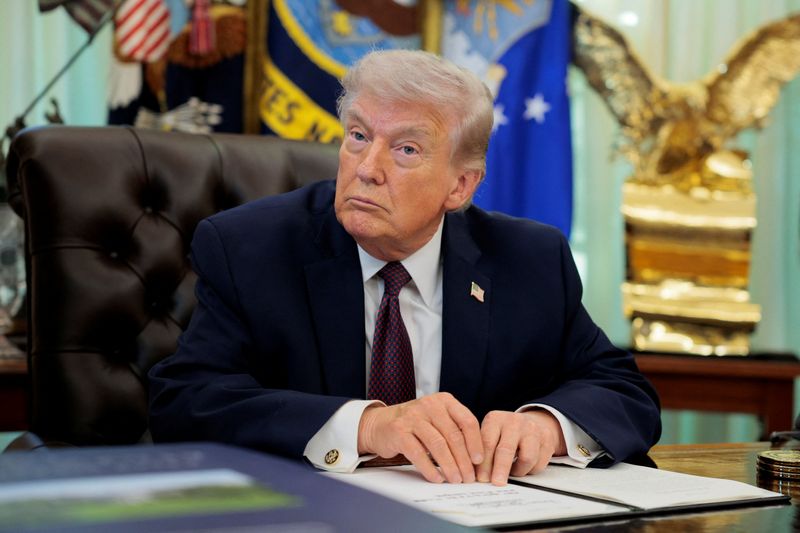
NEW YORK, April 1 (Reuters) – President Donald Trump this week told countries struggling to get jet fuel due to Iran’s blockade of the Strait of Hormuz to buy from the U.S., but analysts say there is a major problem with his advice: the U.S. can’t cover the global shortfall.
“We have plenty,” Trump wrote in a Truth Social post on Tuesday.
U.S. government data shows that’s not the case.
About half a million barrels a day of jet fuel is exported out of the Strait of Hormuz, mainly to Europe and some to Asia and Africa, data from vessel-tracking service Kpler shows.
Total U.S. jet fuel exports, meanwhile, averaged 219,000 bpd last year, data from the Energy Information Administration, the Department of Energy’s statistical arm, shows.
“It is very, very, very unlikely that the U.S. can replace the Strait of Hormuz supply,” Kpler analyst Matt Smith said.
REALITY CHECK
The United States is the top consumer of jet fuel globally, and most of the jet fuel the country produces is consumed domestically, EIA data shows.
Last week, refiners and fuel blenders produced 1.97 million bpd of jet fuel, which was just slightly above demand of 1.79 million bpd, EIA reported.
“Even if the U.S. had plenty of jet fuel, it has plenty of airlines too,” Smith said.
Moreover, most U.S. jet fuel production is concentrated in the U.S. Gulf Coast, and major demand centers along the country’s East Coast and West Coast have historically relied on imports to cover their needs.
The West Coast in particular is going to need more supply of the fuel from the U.S. Gulf Coast as many of its typical suppliers in Asia are among those hit hardest by the Strait of Hormuz closure. Asian refiners have had to cut production and ban exports, leaving California in search of alternate suppliers.
HIGHER EXPORTS WOULD RAISE PRICES FOR US CONSUMERS
To be sure, the U.S. is exporting more of all fuels, including jet fuel, to global markets as it is the one major fuel producer not directly impacted by the war.
Jet fuel prices have surged in the United States since the Iran war began, but to a lesser extent than other markets directly hit by the Strait of Hormuz blockade, encouraging higher exports from the country, said Tom Kloza, chief energy adviser to Gulf Oil.
At least four to five cargoes of jet fuel and diesel were loaded in the New York Harbor region for delivery to Europe, reversing the typical flow that sees these products come from Europe to the U.S. East Coast, Kloza said.
Wholesale jet fuel prices are at between $4 and $5 a gallon in most areas of the United States, according to GasBuddy data. For comparison, the typical cost of jet fuel in the U.S. Gulf Coast is between $2.50 and $3 a gallon, said Patrick De Haan, head of petroleum analysis at GasBuddy.
First Appeared on
Source link






