


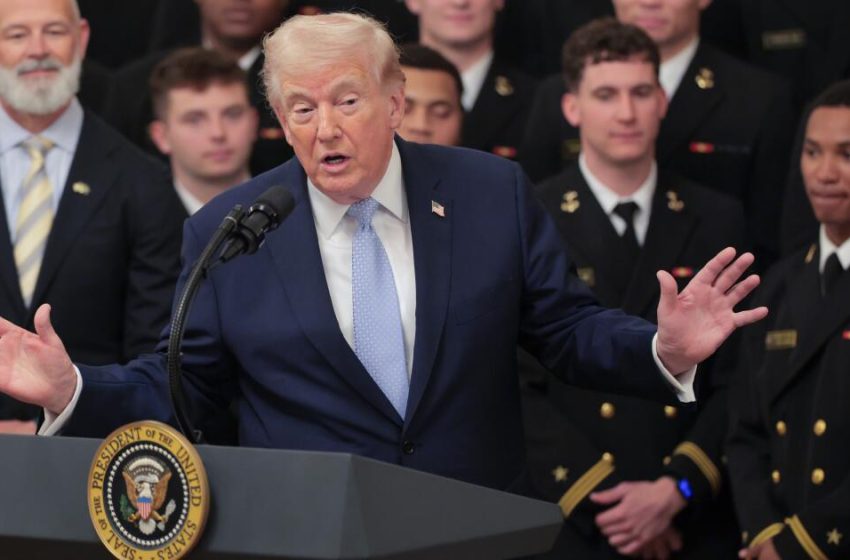
Trump weighs ‘winding down’ war as Pentagon sends 2,500 California Marines to Mideast
WASHINGTON — President Trump said Friday that the United States is considering “winding down” hostilities in the Middle East as the Pentagon is sending thousands of California-based Marines to the region and has requested billions in new funding for the Iran war.
“We are getting very close to meeting our objectives as we consider winding down our great Military efforts in the Middle East with respect to the Terrorist Regime of Iran,” Trump wrote on Truth Social.
He listed a number of military aims he claimed were close to being accomplished, including destroying Iran’s military and nuclear capabilities. He said the Strait of Hormuz will “have to be guarded and policed,” but provided no timeline or information detailing the fate of service members recently dispatched to the hostilities.
The Pentagon is sending three California-based warships and roughly 2,500 Marines to the Middle East, the second significant deployment in a week, the Associated Press and other outlets reported Friday.
The three warships, the San Diego-based USS Boxer and two warships from the 11th Marine Expeditionary Unit, departed from Camp Pendleton on Wednesday.
They were being deployed for “routine training,” according to official Pentagon statements, but defense officials told various news outlets that the final destination is the Middle East, where the U.S. military has amassed about 50,000 troops in total.
A 2,500-strong Marine unit accompanied by the USS Tripoli warship launched from Japan on Saturday.
The Pentagon declined to comment on the deployments: “Due to operations security we do not discuss future or hypothetical movements,” a Pentagon spokesperson said in a statement Friday.
Secretary of Defense Pete Hegseth, front, and Chairman of the Joint Chiefs of Staff Gen. Dan Caine arrive for a news conference at the Pentagon in Washington on Thursday.
(Mandel Ngan / AFP via Getty Images)
The major reinforcement comes as the war’s economic shock waves are felt throughout the world as Washington signaled a protracted conflict.
Defense Secretary Pete Hegseth confirmed at a news conference Thursday that the Pentagon has requested another $200 billion from the White House to fund the war, as the U.S. national debt hit a record $39 trillion.
The supplemental spending will require congressional approval. Sen. Chuck Schumer (D-N.Y.) called the request “unacceptable for a war without a plan.”
“No way,” he said. “That will never happen. It is a preposterous and dangerous risk.”
Increased troop presence in the region raises questions about the prospect of an American deployment on Iranian soil. Republican leaders in Congress have so far been noncommittal about the idea of holding formal votes to authorize an action.
Asked if the administration should get approval from Congress to send U.S. ground troops, House Speaker Mike Johnson (R-La.) told reporters this week that it would depend on the details of the mission they are asked to complete.
“If we are completing the mission and it is a limited scope then that is not a declaration of war,” Johnson said.
Rep. Ted Lieu (D-Torrance), who is a member of the Air Force Reserves, called Johnson’s response an example of “the emasculation of one branch of government in real time.”
As of Friday, 13 U.S. service members have been killed and 232 have been injured in the Middle East since the start of the conflict, according to U.S. Central Command spokesperson Capt. Tim Hawkin.
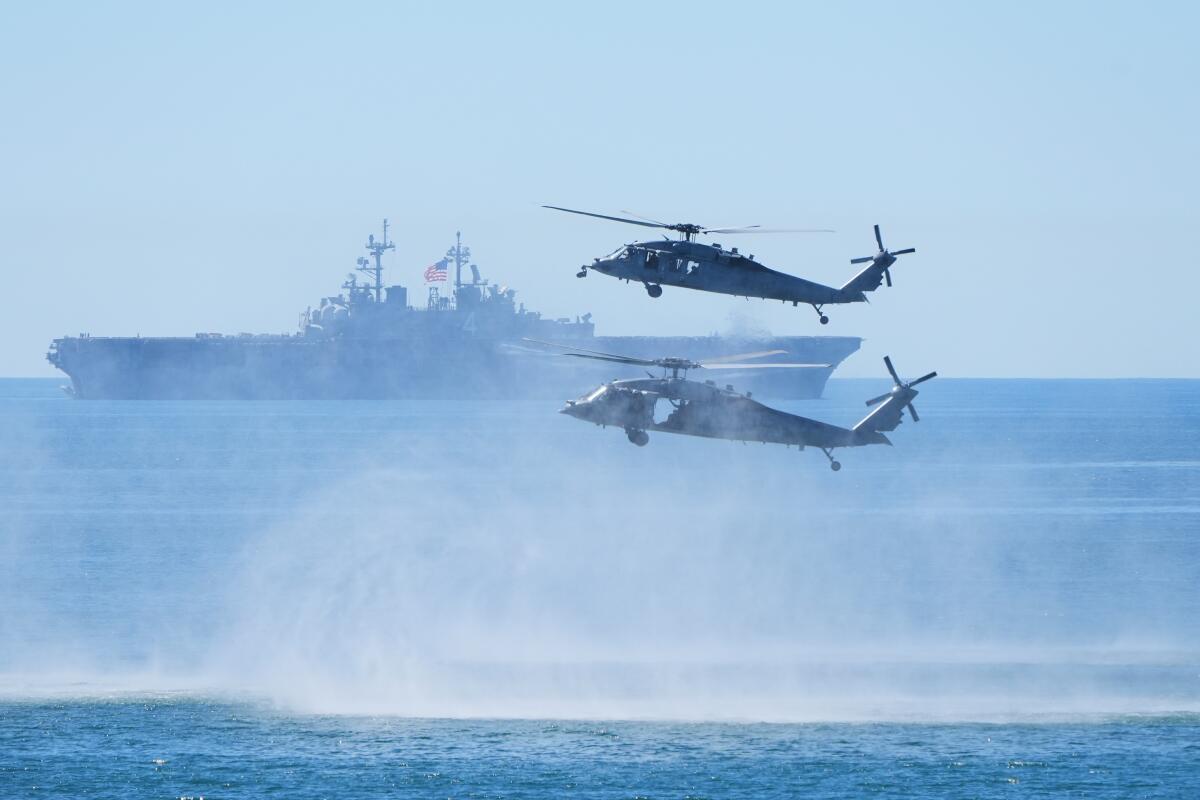
Marines perform a demonstration with helicopters and the amphibious assault ship USS Boxer on Oct. 18, 2025, at Marine Corps Base Camp Pendleton.
(Gregory Bull / Associated Press)
The amped up military spending and troop deployment come as Trump struggles to win allies to his proposed international coalition, which aims to send warships to secure vital shipping lanes and deter further attacks on energy infrastructure around the Persian Gulf.
Trump on Thursday said that Iran “is close to demolished,” but that securing the Iranian-controlled Strait of Hormuz remained a struggle. He suggested the U.S. was working to secure the strait not for its own oil needs, but “just to be nice” to other countries that rely on oil from the region to a much larger degree than the U.S.
“They complain about the high oil prices they are forced to pay, but don’t want to help open the Strait of Hormuz, a simple military maneuver that is the single reason for the high oil prices. So easy for them to do, with so little risk. COWARDS, and we will REMEMBER!” Trump wrote Friday on Truth Social.
On Friday, the U.K. agreed to allow the American military forces to use the British bases in operations “to degrade the missile sites and capabilities being used to attack ships in the Strait of Hormuz,” ministers said in a written statement.
It came as Iran continued its sweeping attacks on Mideast energy facilities, in response to Israeli strikes Wednesday on Iran’s South Pars field — the world’s largest natural gas field. The fallout has dragged the gulf states into the war amid the largest energy supply disruption in history.
Iranian Shahed drones hammered Kuwait’s largest oil refinery Friday. Similar attacks triggered fires at Ras Laffan Industrial City in Qatar, bringing energy production to a halt at the largest natural gas hub in the globe. Repairs are expected to take years.
Meanwhile, United Arab Emirates’ air defense systems were countering Iranian missiles overnight, and Saudi Arabia said it might respond with force if Iran continues to attack facilities in the kingdom.
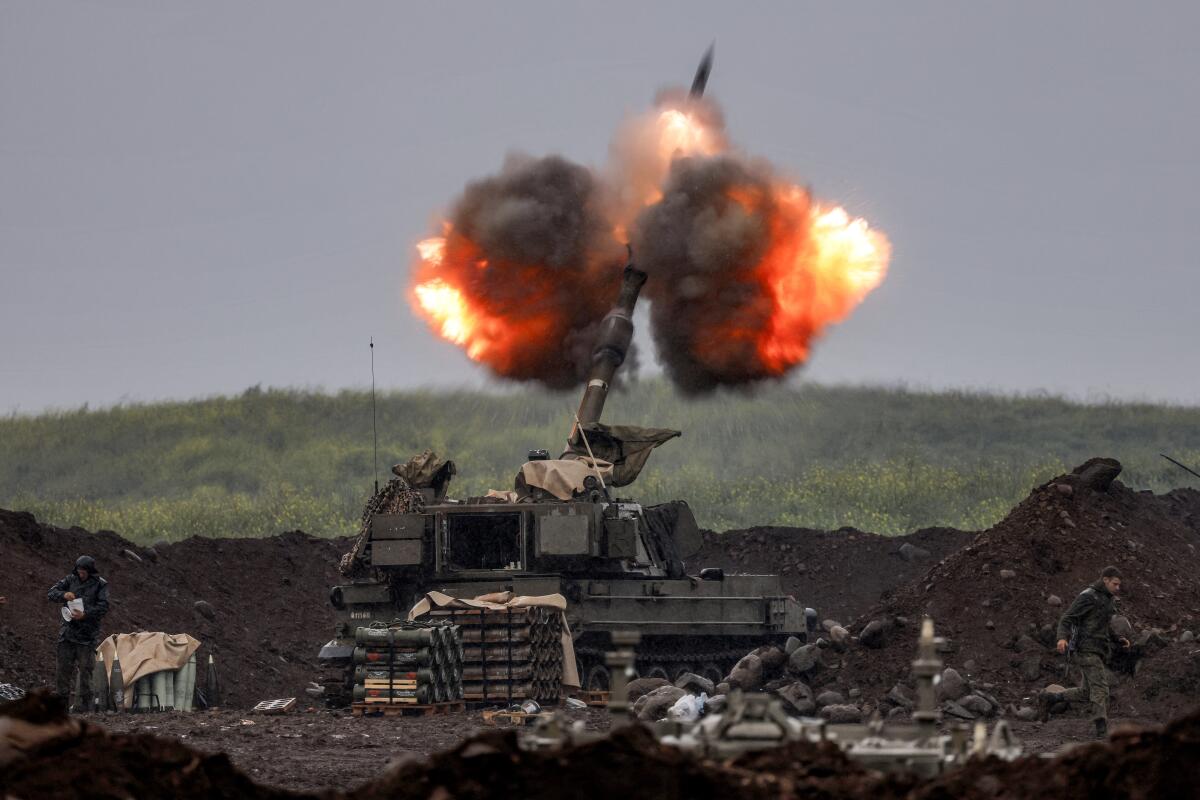
An Israeli self-propelled howitzer artillery gun fires rounds toward southern Lebanon from a position in the upper Galilee in northern Israel near the border on Friday.
(Jalaa Marey / AFP via Getty Images)
Israel said Friday that it had killed Esmail Ahmadi, a senior intelligence official in Iran’s Basij and deputy to its commander, in an airstrike. Officials described Ahmadi as “one of the most important pillars” of the Basij volunteer paramilitary force.
Even as Israel carries out daily decapitation airstrikes in Tehran and the U.S. deploys renewed forces to its front door, the Islamic Republic has not faltered.
Abolfazl Shekarchi, a senior spokesperson for Iran’s armed forces, said American and Israeli officials could be targeted worldwide.
“From now on, based on the information we have, even recreational and tourist locations around the world will not be safe for you,” Shekarchi said.
Oil prices have surged past $100 a barrel amid the chaos.
Financial markets have reacted with sustained losses. Wall Street has now posted its fourth consecutive week of declines, with investors increasingly pricing in the risk that higher energy costs could slow economic growth while reigniting inflation. Analysts warn that persistently elevated crude prices are likely to squeeze corporate margins and weigh on consumer spending in the United States and beyond.
The International Monetary Fund has cautioned that the conflict could push inflation higher too. The Federal Reserve is now facing renewed uncertainty as it weighs whether to hold interest rates higher for longer in response to rising energy costs.
At a White House event Friday, Trump maintained that the United States’ military operation is “going extremely well in Iran.”
“The difference between them and us is they had a navy two weeks ago and they have no navy anymore. It’s all at the bottom of the sea,” Trump said. “Fifty-eight ships were knocked down in two days and we have the greatest navy in the world. It is not even close.”
The president did not take questions from reporters in the room. But in unprompted remarks, he said the United States and Iran are not engaging in talks because their leaders “are all gone,” adding to the uncertainty about the war’s exit strategy.
“We are having a hard time, we want to talk to them and there is nobody to talk to,” he said. “We have nobody to talk to and you know what? We like it that way.”
First Appeared on
Source link






