


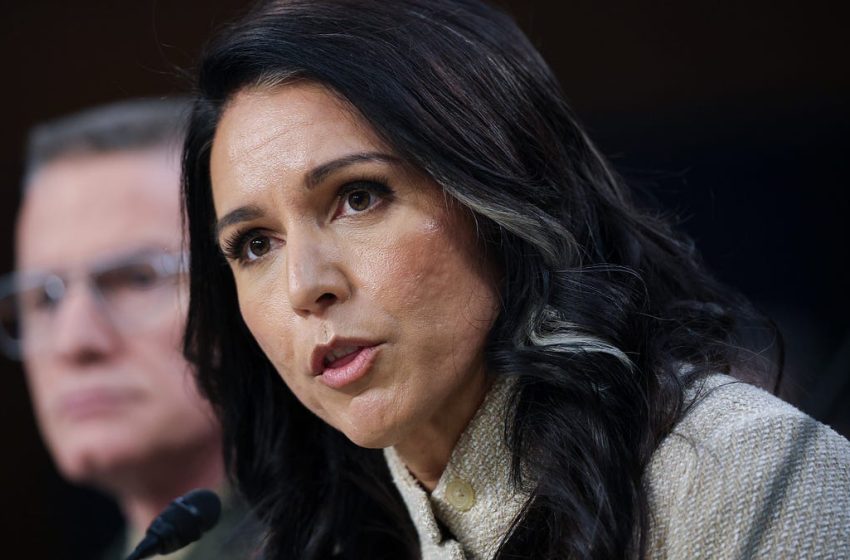
Tulsi Gabbard: Director of National Ignorance
IN AN AUTOCRACY, truth and falsehood aren’t resolved by fact-finding institutions. They’re dictated by the leader. This is what’s happening now in the United States. Donald Trump says he had to bomb Iran because it posed an imminent threat to the United States. And Tulsi Gabbard, the director of national intelligence, says only Trump himself can judge whether that claim is true.
In the years before America turned authoritarian, Gabbard didn’t talk this way. She insisted on testing the government’s claims against evidence. In 2013, as a first-term Democratic congresswoman, she spoke on the House floor about a danger facing her state, Hawaii. She titled her remarks, “The Imminent Threat Posed by North Korea.” To support her claim of imminence, she cited reports from U.S. agencies:
Intelligence and previous missile launches have shown that Hawaii, Guam, and Alaska are within range of North Korea’s intercontinental ballistic missile capabilities. New intelligence suggests that North Korea may be planning multiple missile launches in the coming days beyond the two Musudan mobile missiles it has fueled, raised, and positioned along its east coast.
After summarizing the evidence, she concluded, “We must take a forward-leaning approach to address this imminent threat.”
Seven years later, when a U.S. drone strike killed Iranian Gen. Qassem Soleimani, Secretary of State Mike Pompeo claimed that Trump had ordered the strike “in response to imminent threats to American lives.” This time, Gabbard rejected the assertion of an imminent threat, but again she based her judgment on the quality of evidence. “I just came from the intelligence briefing that the administration came and brought to Congress,” she told CNN’s Jake Tapper. “They provided vague comments, no justification whatsoever for this illegal and unconstitutional act of war that President Trump took.”
Tapper asked about the administration’s argument that Iran had been planning an “imminent attack against Americans.” Gabbard dismissed that argument, citing a lack of substantiation. “They failed to provide any compelling information to prove their point of imminence,” she said.
Two years later, Gabbard left the Democratic party. In 2024, she endorsed Trump for president, despite having repeatedly pointed out that he had broken his promises to stay out of wars. As a reward for her sellout, Trump appointed her to be his DNI.
That’s when Gabbard got into trouble. In a March 2025 hearing before the Senate Intelligence Committee, she testified that the intelligence community “continues to assess that Iran is not building a nuclear weapon, and Supreme Leader Khamenei has not authorized the nuclear weapons program that he suspended in 2003.”
That statement was true, but it got in the way of Trump’s war propaganda. In June, as he prepared to bomb Iran, reporters used Gabbard’s testimony to challenge him. “Tulsi Gabbard testified in March that the intelligence community said Iran wasn’t building a nuclear weapon,” a reporter reminded the president on June 17.
Trump dismissed Gabbard’s testimony. “I don’t care what she said,” he scoffed. “I think they were very close to having one.”
Three days later, another reporter asked Trump, “What intelligence do you have that Iran is building a nuclear weapon? Your intelligence community has said they have no evidence that they are at this point.” This reporter, too, cited Gabbard’s testimony.
“She’s wrong,” said the president.
Faced with this conflict between Trump and the truth, Gabbard could have defended the intelligence. Or she could have resigned. Instead, to appease Trump, she revised her position.
“The dishonest media is intentionally taking my testimony out of context and spreading fake news as a way to manufacture division,” Gabbard tweeted. “America has intelligence that Iran is at the point that it can produce a nuclear weapon within weeks to months, if they decide to finalize the assembly. President Trump has been clear that can’t happen, and I agree.”
Below the tweet, Gabbard posted video of her March testimony. But the video didn’t show her saying what the tweet said about Iran being close to producing a nuclear weapon. Why the discrepancy? Because she hadn’t said it. She was trying to rewrite history.
Since that episode, Gabbard has learned not to contradict the boss. On February 28, Trump launched a second bombing campaign in Iran, again asserting “imminent threats from the Iranian regime.” And rather than tell the truth—that U.S. intelligence showed no imminent threats—Gabbard has renounced her authority to speak on such questions.
ON TUESDAY, A DAY BEFORE she was set to testify again before the Senate Intelligence Committee, Gabbard posted an obsequious message on X. She pleaded that her job was to give Trump “the best information available to inform his decisions” but that such information did not include judgments about imminent threats. “Donald Trump was overwhelmingly elected by the American people to be our President and Commander in Chief,” she wrote. “As our Commander in Chief, he is responsible for determining what is and is not an imminent threat.”
That sounded more like a cult follower than an intelligence chief. At Wednesday’s hearing, Senator Jon Ossoff grilled Gabbard on that point. He quoted U.S. intelligence assessments that the 2025 bombing of Iran had wiped out the regime’s nuclear enrichment program and that since then, Iran had made no effort to rebuild its enrichment capability. Then he read aloud from a White House statement, issued on March 1, that said the current war was necessary “to eliminate the imminent nuclear threat posed by the Iranian regime.”
He asked Gabbard, “Was it the assessment of the intelligence community that there was a, quote, ‘imminent nuclear threat posed by the Iranian regime’?”
Gabbard tried to dodge the question. Eventually she declared, “Senator, the only person who can determine what is and is not an imminent threat is the president.”
Ossoff pointed out that the subject of the hearing was threat assessment. The session was titled “Worldwide Threats.” The underlying document was the “Annual Threat Assessment of the U.S. Intelligence Community.” And Gabbard was the director of national intelligence. If the Iranian threat was ever to be assessed, this was the place to do it. And if it was anyone’s job, it was Gabbard’s.
Still she refused. “It is not the intelligence community’s responsibility to determine what is and is not an imminent threat,” she told Ossoff. “That is up to the president, based on a volume of information that he receives.”
This is how an autocracy goes to war. The leader doesn’t seek approval from the legislature or the people. He acts on his own. He lies about the circumstances and his motives. And toadies in the government who know he’s lying—even toadies who used to preach against “warmongers,” and whose job it is to identify facts—tell us that only the great man can divine what’s true.
First Appeared on
Source link






