


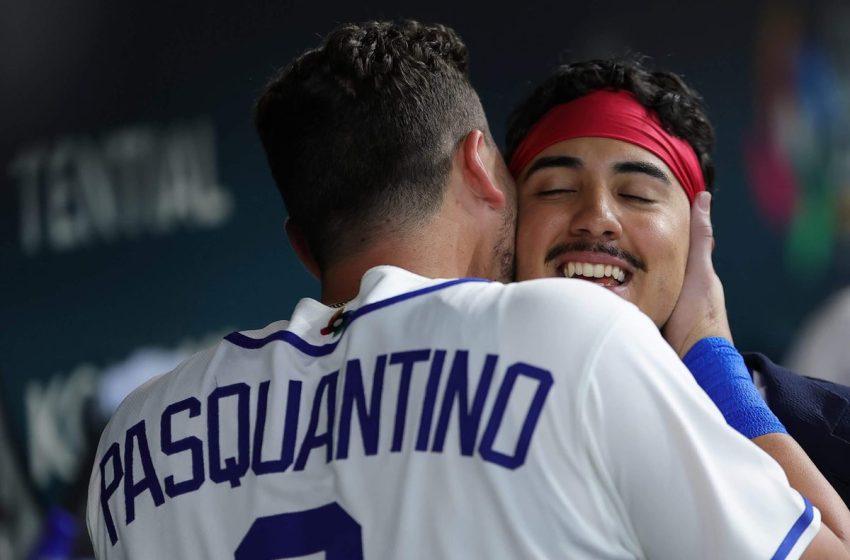
U.S.-born players savor chance to represent global family, heritage in WBC
The Athletic has live coverage of USA vs. Mexico in the 2026 World Baseball Classic.
Vinnie Pasquantino remembers his roots. He has someone who makes sure of that.
“My grandfather won’t shut up about asking me about Italy,” Pasquantino said.
Pasquantino’s grandpa, Denny, cares about his grandson’s day job as first baseman for the Kansas City Royals. But he’s way more invested when he suits up for Team Italy in the World Baseball Classic.
Grandpa Pasquantino obsesses over the Azzurri. He peppered his grandson with questions about when the tournament would start. (Vinnie told grandad he still had spring training games, to which his elder said, “I don’t care.”)
Gramps also asked where they were playing. “He thinks we’re in Italy,” Pasquantino said, not Houston.
It’s a bonding moment. For so many playing in this WBC, the tournament is an opportunity to represent the place where they grew up. For players like Pasquantino, who were born in the United States (Richmond, Va.) and are playing for another country, it’s a chance to tap into their family history.
“As selfish as this sounds, it’s the one kind of opportunity to play for the name on your back,” Pasquantino. “I don’t mean yourself, I mean play for your family. For your heritage and to just be proud of that.”
Rowdy Tellez was born in Sacramento, but he’s representing Mexico, where his grandfather had a distinguished playing career. (Christian Petersen / Getty Images)
Pasquantino is hardly alone. Team Italy’s ace, Aaron Nola, was born in Baton Rouge, La. Before Roman Anthony joined Team USA as a replacement for Corbin Carroll, Pasquantino attempted to recruit him to join them.
There are 21 players on Team Italy with big-league time who were born in the United States, the most for any team outside Team USA. But there are dozens of examples across the WBC. Austin Wells, born in Scottsdale, Ariz., turned some heads when it was revealed that he would represent the Dominican Republic in the tournament. (His mother, Michelle, is Dominican.) Miami-born Manny Machado represented Team USA in the under-18 Pan Am Games, but chose to represent the Dominican Republic in 2017, 2023, and in this tournament to honor his late grandfather. This time around, he’s the team’s captain. From Stuart Fairchild on Chinese Taipei to Jahmai Jones on Korea, a majority of the teams in the field boast at least one American-born player with big league time.
Nolan Arenado (Newport Beach, Calif.), who represented the United States when they won the tournament in 2017, is now honoring his mother by playing for Puerto Rico — a team he joined following encouragement from Kiké Hernández.
For Rowdy Tellez, his affiliation with the World Baseball Classic was never much of a debate. His grandfather, Greg, was a Mexican baseball legend, and several other family members in Mexico excelled in the sport as well.
“Being able to have our name on the back of our jersey and represent them, as well as Mexico, means a lot to me,” Tellez (Sacramento) said. “We’re very proud Mexicans. We don’t shy away from it. So I think it’s extremely special. And for me, being born here in America, I’ve always said I’m Mexican. I’ve always loved being Mexican. People consider me American. I always say, I will always represent Mexico.”
For Taijuan Walker (Shreveport, La.), representing Mexico means a connection to a grandparent the established veteran never fully got the chance to know.
“For me, it goes back to my grandma,” Walker said. “She died when I was younger…(and) she never really got a chance to watch me play baseball. I never really got a chance to learn about that side of my family from her. So for me, to represent her and her memory and honor is special.”
When he told his mother about the chance to participate with Mexico for the first time in 2023, “(She) cried, my aunts and uncles, they all cried.”
In the WBC, players who choose to represent their lineage rather than their birthplace is common practice. Every tournament since its inception in 2006 has had multiple teams with American-born players on their rosters. The climate is nowhere as fraught as, say, the controversy surrounding San Francisco-born Eileen Gu, winning Olympic gold for China.
The eligibility requirements allow, and even encourage, this to get the best possible rosters for the event. To qualify, a player must be a citizen of the country, be a permanent legal resident, be born in the country, have at least one parent born in the country, or have sufficient documentation that they would be granted citizenship or a passport to that country.
It’s opened doors for players who want to participate. Logan Allen’s (West Palm Beach, Fla.) parents met when his father was stationed in Panama. Getting the chance to represent his mother, Caron, and her home country provided a treasured opportunity. Detroit Tigers minor-leaguer Austin Bergner (Boca Raton, Fla.) wasn’t even sure he’d be eligible to play for his mother’s Colombian side before fellow teammate Rio Gomez (Miami, Fla.) gave him a nudge.
“It’s been great,” Bergner said. “I don’t necessarily understand everything that’s going on, but I like to pretend that I do.”
Bergner’s experience with the language barrier is hardly unusual across the WBC. Team Mexico has 13 players born in the United States and with MLB experience, and Benji Gil’s staff will chirp out instructions in both Spanish and English to ensure everyone is on the same page.
“Everybody messes with everybody,” Tellez said. “Like some guys’ Spanish isn’t as good as others. Some guys’ English isn’t as good, but we just mess with each other, and they help each other out. There are no uncomfortable times.”
Pasquantino wanted to double-check that he was eligible to participate when Team Italy first came calling for the 2023 WBC. That meant digging into his family history and visiting Italy.
“Drank a lot of wine,” Pasquantino said. “Did what Italians do.”
The mission also unearthed something else. Nowadays, Pasquantino’s big-league career holds the top spot on any Google search for his last name. That replaced Pasquantino v. United States, a case that tried David and Carl Pasquantino for trying to avoid excise taxes and smuggle alcohol into Canada.
As one Italian-American icon said, “It’s a stereotype, and it’s offensive.” But in Pasquantino’s case …
“We’ve had some issues with the law,” Pasquantino said, “as any good Italian does. So that’s where we’re at.”
— Sahadev Sharma, Zack Meisel and Chad Jennings of The Athletic contributed to this report
First Appeared on
Source link






