


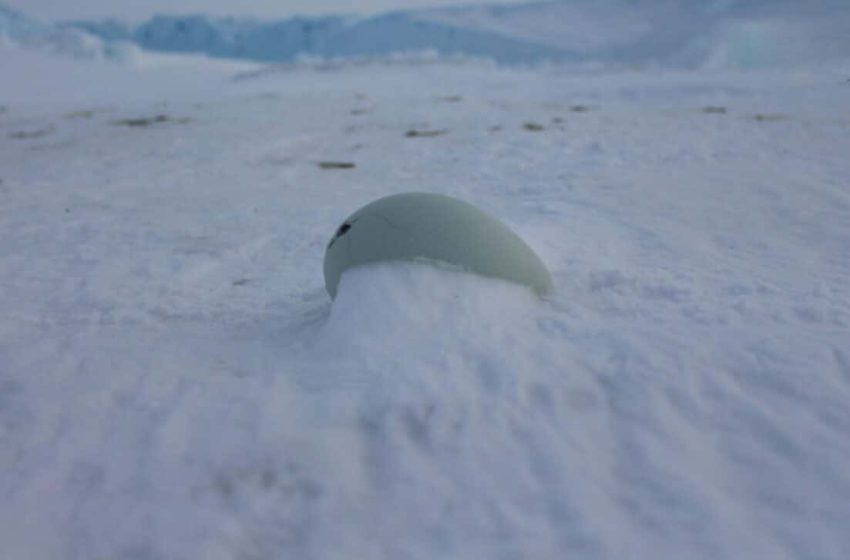
Unnoticed for 68 Million Years, Scientists Found One of the Largest Eggs Ever in Antarctica
A strange fossil discovered in Antarctica may belong to one of the ocean’s most formidable prehistoric predators. The football-sized object, now identified as a soft-shelled egg, could be the first known egg ever linked to a mosasaur.
The fossil was first uncovered in 2011 on Seymour Island by Chilean researchers, who were struck by its unusual shape. At the time, its identity remained unclear, and it was simply nicknamed “The Thing”.
Years later, further analysis revealed its true nature. According to statements reported by Live Science, paleontologist Julia Clarke immediately recognized the object’s resemblance to a “deflated football,” prompting deeper investigation into what is now considered an exceptional fossil.
A Record-Breaking Soft-shelled Egg
Measuring roughly 11 by 8 inches (29 by 20 cm), the fossil is the largest soft-shelled egg ever discovered and the second largest one of any kind known to science. The finding, published in Nature, stated that it dates back around 68 million years, placing it in the late Cretaceous period.
Its structure stands out. The specimen has a thin shell without pores, unlike the thick, rigid shells seen in many fossilized ova. This fragile composition explains why such fossils are extremely rare. As noted by Darla Zelenitsky, a paleobiologist:
“These soft tissues are quite fragile and destructible. Because of this, for many years we thought that fossilization of such eggs was nearly impossible.”
It was formally named Antarcticoolithus bradyi, reflecting both its location and its unusual characteristics.
Evidence Tied To A Marine Giant
Its features align more closely with those of lizards and snakes, placing it within the Lepidosauria group. This has led researchers to suggest a connection to mosasaurs, massive marine reptiles that dominated ancient seas.
According to the research team, fossils of Kaikaifilu hervei, a mosasaur measuring about 33 feet (10 meters), were found just 200 meters from the egg. This proximity strengthens the hypothesis, even though the authors emphasize that the exact identity of the egg’s parent remains unknown.
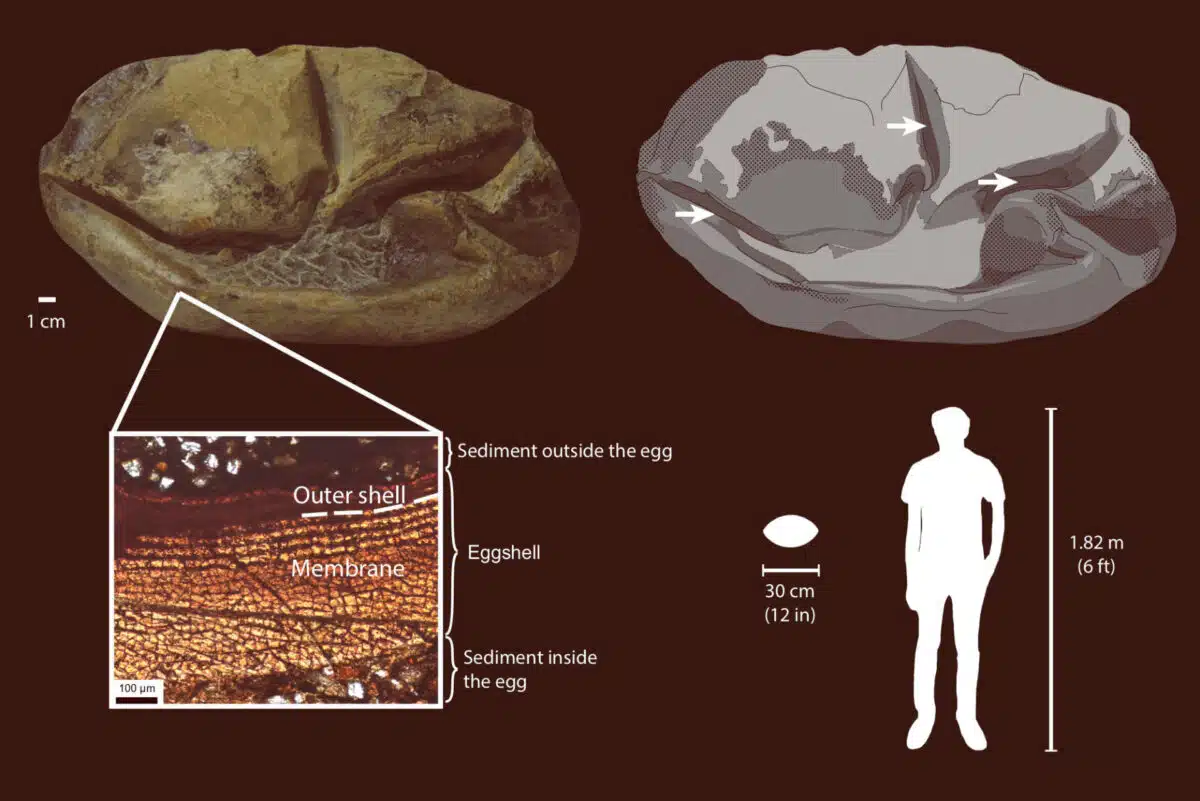
An analysis of 259 living lepidosaur species helped estimate that the egg’s mother could have been at least 23 feet (7 meters) long. As cited in Live Science, no known Antarctic dinosaurs or pterosaurs from that period were large enough to produce such an embryo container, further supporting the mosasaur link.
New Evidence, New Uncertainties
Some researchers suggest the clutch could belong to a dinosaur, noting similarities with recently identified ones. According to commentary accompanying the study, it is possible the find originated on land and was later transported to sea. Darla Zelenitsky also pointed out that comparing its soft tissue with other reptile fossils could help clarify its origin.
“The new egg looks a lot like the soft-shelled eggs of dinosaurs. Perhaps an analysis comparing the soft tissue of A. bradyi with those of other reptile eggs could shed light on what kind of animal laid it.”
At the same time, the broader context is compelling. Fossils of juvenile mosasaurs and plesiosaurs, along with adult specimens, have been found in the same region. According to the researchers, this raises the possibility that Antarctica once served as a breeding ground for marine reptiles during a warmer climatic period.
First Appeared on
Source link






