


Unprecedented March heat wave in SoCal has experts worried about what comes next
The most destructive wildfires in Southern California history. The region’s wettest holiday season. The hottest March heat wave on record.
In the last 15 months, the Southland has seen a trio of extreme weather events, and UC climate scientist Daniel Swain says there’s one clear through line connecting them all.
“All of the superlative extremes we’ve seen in recent years — from extreme heat to extreme dryness to extreme wetness, and even the severe wildfires — they all have clear links to climate change,” he said.
The ongoing heat wave shattering dozens of temperature records in Southern California is no exception, Swain said.
Climate change warms the atmosphere, raising baseline temperatures and making heat-trapping weather patterns more intense and longer-lasting. As a result, we see more frequent and more severe heat waves.
This unseasonable March streak of scorching heat is not only notable in its intensity, but also in its duration and its scale.
“It extends from Southern California all the way to the Great Plains and from Canada to Mexico,” he said. “I’m struggling to find the right superlative, because it is that extreme.”
It’s also paving the way for the state to head back into drought conditions.
In January, California achieved zero areas of abnormal dryness for the first time in 25 years thanks to a deluge of winter storms, according to the U.S. Drought Monitor. But now, just over two months later, abnormal dryness has returned to areas of Northern California.
A pedestrian crosses Spring Street in Chinatown during a heavy downpour on Feb. 19.
(Allen J. Schaben / Los Angeles Times)
Without a dramatic increase in precipitation, Northern California was on track to reenter drought conditions by spring, said Swain.
“This March is exactly what you wouldn’t want to see if you wanted to maintain that drought-free status,” he said. “A record-shatteringly warm month, and a very dry one at that, is certainly going to push us back in the other direction.”
A possible upcoming drought will look different from the long-lasting drought California saw from 2012 to 2016 and 2020 to 2023 — which prompted various water use restrictions — because there is still a significant amount of rain in the state’s reservoirs following a very wet winter.
“The good news about California water infrastructure is it really does take a multiyear drought of significant severity to seriously threaten the actual water supply,” said Swain.
Nonetheless, a sustained period of dryness can still cause damage to California’s agricultural industry and elevate the risk of wildfires.
This weather whiplash from intense rain to extreme heat can be hard for residents to wrap their heads around — but is exactly what scientists expect to see more of in Southern California as climate change worsens.
“Sometimes folks will say, well, no, you’ve got to pick one. It can’t be both getting wetter and drier,” said Swain, “and that’s actually not how the atmosphere operates.”
More rain and more dryness are “two sides of the same thermodynamic coin,” he explained. This is because a warmer atmosphere pulls more moisture out of soils and plants, deepening droughts. At the same time, a warmer atmosphere holds more water vapor, which is then released in fewer, more extreme rainstorms.
This pattern can lead to more intense and destructive fire seasons. Heavy rainfall leads to high growth of grass and brush, which then becomes abundant fuel during periods of extreme dryness.
It’s also exactly what Southern California went through in the run-up to the devastating Palisades and Eaton fires. There were extremely wet winters in 2022 and 2023, followed by one of the driest periods on record in the fall and winter of 2024.
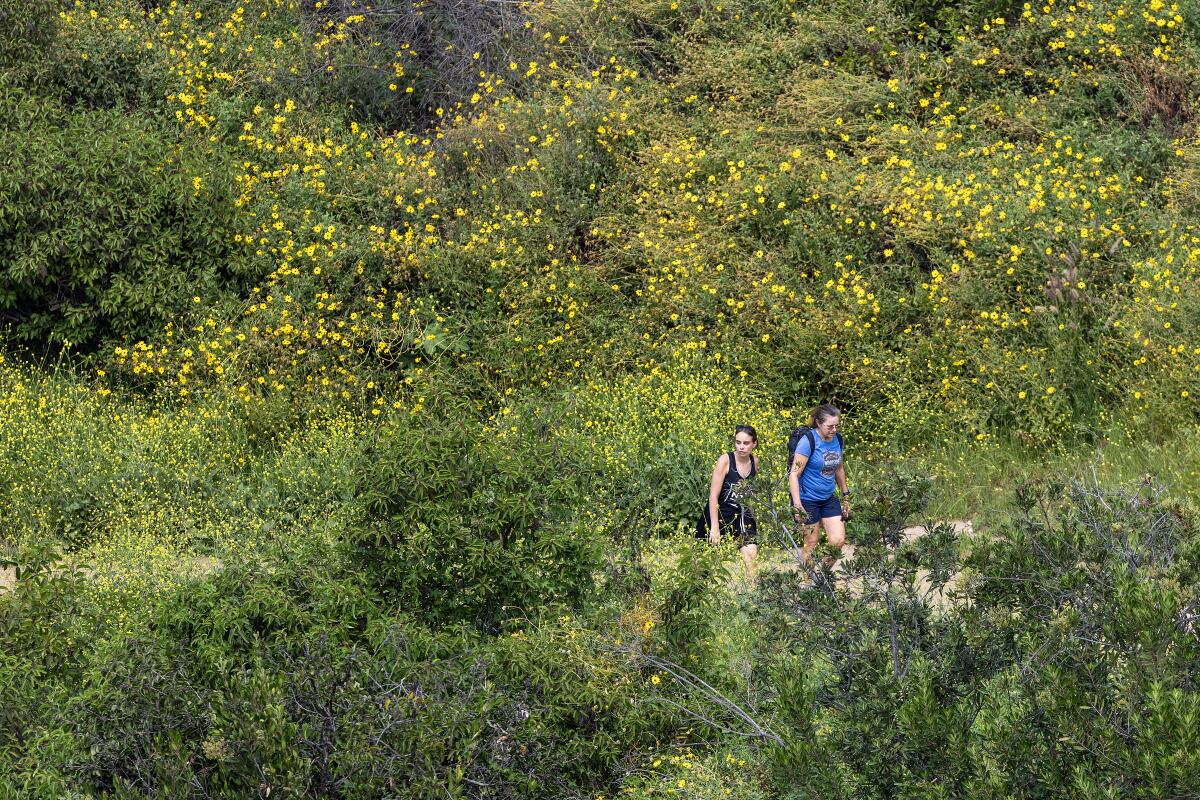
Hikers walk a trail amid green hills on a hot day at Griffith Park in Los Angeles on March 13.
(Allen J. Schaben / Los Angeles Times)
California is currently still soggy enough to be at low wildfire risk, thanks to the recent winter rains; however, the same cannot be said for the rest of the Western states amid the ongoing historic heat wave.
“I’m looking at satellite imagery right now as we speak, and I’m starting to see visible wildfire plumes pop up in states like New Mexico and Arizona and Colorado,” said Swain. “Today, it’s mid-March. That is extraordinary.”
It’s too early to tell what wildfire season will bring in California this year, especially given that we are entering a potentially very significant El Niño event, said Swain.
On the one hand, that brings the chance of remnants of a tropical storm making their way to Southern California in late summer, delivering a significant soaking that would stave off a serious fire season, as took place with the remnants of Tropical Storm Hilary in 2023, he explained.
Or it could lead to a dry-thunderstorm outbreak, with lightning that could cause multiple wildfire ignitions, as took place in 2020 in Central and Northern California with the remnants of Tropical Storm Fausto.
The only thing that is certain is that California, and the rest of the United States, will continue to see more extreme weather events in the months and years to come.
First Appeared on
Source link






