


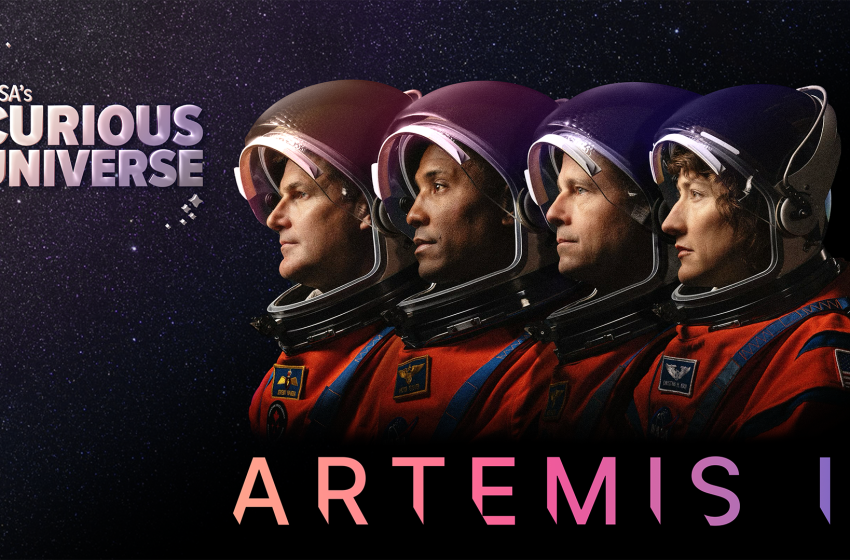
Update: Artemis II Crew Flies Around the Moon
Description:
NASA’s Artemis II mission has flown around the Moon, and its four astronauts traveled farther from Earth than anyone in history. Relive this historic mission through the astronauts’ own words, including their scientific descriptions of the Moon’s surface, as well as the role of “space plumber” troubleshooting the toilet and the astronauts’ unifying message for humanity.
HOST JACOB PINTER: You’re listening to NASA’s Curious Universe. I’m Jacob Pinter, and we’re bringing you a special update episode that is coming out in the middle of NASA’s Artemis II mission.
On April 6, 2026, four astronauts flew past the Moon and reached a distance farther from Earth than anyone has traveled, ever. They saw the Moon in ways that no human ever has, including a period of about 40 minutes when they flew behind the Moon, completely out of contact with all of us on Earth.
We’re going to begin there. From Houston, mission control sent a goodbye message.
MISSION CONTROL: Integrity, Houston. You are six minutes from your 40-minute lunar flyby LOS. From all of us, it’s a privilege to witness you carry the fire past our farthest reach. Thank you, Godspeed.
JACOB: This “loss of signal” was a planned event. There’s just no way to get a communication signal through the Moon.
Pilot Victor Glover responded:
VICTOR GLOVER: Thank you for that, Jenni. And thank you to all of you for allowing us the immense privilege to be on this journey together. It’s quite amazing. And as we go on this journey, thinking about the NASA mission to explore the unknown in air and space, to innovate for the benefit of humanity, and to inspire the world through discoveries. And as you’ve gone along on this journey with us, hopefully we’re doing just those things. And as we get close to the nearest point to the moon and the farthest point from Earth and continue to unlock the mysteries of the cosmos, I would like to remind you of one of the most important mysteries on Earth, and that’s love. Christ said, in response to what was the greatest command, that it was to love God with all that you are. And he also, being a great teacher, said the second is equal to it. And that is to love your neighbor as yourself. And so, as we prepare to go out of radio communication, we’re still going to feel your love from Earth. And to all of you down on Earth and around Earth, we love you, from the Moon.
MISSION CONTROL: Houston copies. We’ll see you on the other side.
JACOB: With that, the astronauts were completely alone. Just the four of them—NASA astronauts Reid Wiseman, Victor Glover, and Christina Koch and Canadian astronaut Jeremy Hansen—floating in their spacecraft more than a quarter of a million miles from Earth, seeing parts of the Moon with unaided eyes for the first time in human history.
Forty minutes later, the astronauts regained contact. Mission specialist Christina Koch came over the radio.
CHRISTINA KOCH: Integrity. Comm check.
MISSION CONTROL: Integrity, we have you loud and clear. How me?
CHRISTINA: We have you the same. And it is so great to hear from Earth again to Asia, Africa and Oceania. We are looking back at you. We hear you can look up and see the moon right now. We see you too. When we burned this, burn towards the moon, I said that we do not leave Earth, but we choose it. And that is true. We will explore. We will build we will build ships. We will visit again. We will construct science outposts. We will drive rovers. We will do radio astronomy. We will found companies. We will bolster industry. We will inspire but ultimately, we will always choose Earth. We will always choose each other.
MISSION CONTROL: Mission Control, all of your flight controllers and your flight director have flipped their Artemis II patches around. We are Earth bound and ready to bring you home.
JACOB: As this episode comes out. the astronauts of Artemis II are headed back to Earth. They have already sent back unique science data and incredible, moving photos. In this episode, we’re bringing you up to speed on the mission so far. We’re going to cover how the crew got to the Moon, including a firsthand account of launch. We’ll explain how the astronauts snapped into action as plumbers in space, and we’ll hear what the Moon looked like through their eyes.
First, let’s hear what launch was like. Producer Christian Elliott was at Kennedy Space Center in Florida last week. Christian, tell me all about it.
CHRISTIAN ELLIOTT: Hey, Jacob. It was amazing. So my week actually started on March 27. That was L-5, or five days before launch. That’s when Reid, Victor, Christina, and Jeremy flew their T-38 jets in from Houston and landed on the old space shuttle runway at Kennedy Space Center.
[JET LANDING SFX AND CHEERS]
CHRISTIAN: The Florida Sun was beating down on the tarmac. You could see the heat in the air. The astronauts climbed out of their planes in their blue flight suits and aviator sunglasses. They hugged each other, and then they walked they right up to a waiting microphone
REID WISEMAN: Hey, let’s go to the Moon! [CHEERS] I think the nation and the world have been waiting a long time to do this again. And on behalf of myself, Christina, Victor, Jeremy, we are really pumped to go do this for this entire team. It’s been a lot of work, it’s been a great journey. It’s great to be down here in the Florida warm air. The vehicle looked amazing on the pad on the way in. Victor and Christina led us here. It’s just been an awesome start to this journey here at Kennedy.
CHRISTIAN: I was standing right behind Charlie Blackwell-Thompson, the Artemis launch director. She’s the one who would make the final call on sending these astronauts to space in just a few days.
CHARLIE BLACKWELL-THOMPSON: Hi, nice to see you!
CHRISTIAN: I just wanted to ask you how it feels to have the crew here?
CHARLIE: It feels amazing to have the crew here. I mean we know this day’s coming. I was just at the pad this morning. The vehicle looks great. But when you see your flight crew arrival for launch day, there’s something incredibly special about it and there’s something incredibly real about it. Can’t wait.
CHRISTIAN: It’s going to happen.
CHARLIE: Yes indeed.
CHRISTIAN: Good to see you.
CHARLIE: Yes, good to see you.
CHRISTIAN: The next few days, we all kept a close eye on the weather forecast. It remained 80 percent go. The astronauts went into quarantine so they wouldn’t get sick before launch and waited for their big moment. About two days before launch, the big countdown clock outside the press site building turned on. The launch team powered on the rocket and checked out its systems. Then, finally, launch day dawned.
[Christian narrates on-site] Alright it’s launch day. Here at the Kennedy Space Center Press Site. The astronauts have woken up. In a little bit they’ll be getting their crew survival suits on. In the meantime, the SLS rocket fueling is underway. And so far, weather’s looking good for a launch.
[Christian voiceover] The Launch controllers were all at their consoles in Firing Room 1 in the launch control center. Over 700,000 gallons of liquid hydrogen and oxygen propellant was filling up SLS’s core stage tank. You could see the condensation rising like steam off the rocket in the distance. Meanwhile, the astronauts were a few miles away, getting into their orange crew survival suits.
Outside the press site, across from the towering Vehicle Assembly Building, there was this crowd of people gathering on both sides of the road. They were all waving these little U.S. and Canadian flags. Some of them were carrying cardboard cutouts of the astronauts. Pretty much everybody there had played a role in the mission in some way or another, like this guy from Johnson Space Center in Houston that I met.
LAUNCH SPECTATOR 1: I taught Reid Wiseman his first robotics lesson.
CHRISTIAN: Or an Orion spacecraft engineer who’d gotten engaged in front of the SLS rocket as it headed to the launchpad.
LAUNCH SPECTATOR 2: He proposed to me at rollout. That’s Barry, that’s my fiancé. So we’re just kind of like in the stars.
CHRISTIAN: They were all out here because the astronauts were about to drive by in their Astrovan, on their way to the launch pad. A NASA helicopter flew over. People started cheering. Then the silver Artemis van came into view around the corner.
Once they arrived at the rocket, Reid, Victor, Christina, and Jeremy rode an elevator more than 300 feet up the mobile launcher tower to the Orion capsule. The closeout crew—these specially trained experts in all-white suits—they loaded the crew into their seats and sealed the hatch. In four hours, the launch window would open. So I headed over to Banana Creek, a launch viewing site a little over three miles from the launchpad. That’s as close as spectators can safely get. Thousands of people were slowly gathering there. The live broadcast was piped in on these big screens beside the bleachers.
I met people who remembered watching the Moon landing in 1969 and many more who weren’t alive for it. I met little kids dressed as astronauts, and adults just as excited as those little kids. I met people who’d worked on Orion and SLS for decades and people had come here from around the world, like a European Space Agency engineer from the Netherlands who worked on the Orion service module’s solar panels. I even ran into Charlie Blackwell-Thompson’s mom, who was in the front row of the bleachers, wearing SLS earrings.
LAUNCH SPECTATOR 3: My daughter is the launch director, Charlene Blackwell-Thompson. And we came from Gaffney, South Carolina, to watch the launch.
CHARLIE: She said Charlie had dreamed of working at NASA since she was a little kid, like the kids running around the bleachers here.
LAUNCH SPECTATOR 3: When she was little, I gave her a Snoopy. She called me and said, Mom do you still have it? I said I most certainly do. I’ve had it for 50 years. She said I want it. So I mailed it to her. And she has it with her today.
CHRISTIAN: Then I made a new friend: Lucas Ye. He ran past his parents right up to the fence to look at the rocket on his tiptoes. Lucas is a third grader from California. He was excited to show me Rise. It’s this plushie of a little smiling Moon wearing an Earth baseball cap. It represents Earthrise, that famous photo from Apollo 8 of the Earth rising above the lunar surface. Rise was Lucas’ entry into NASA’s zero gravity indicator Moon Mascot contest, and it won. NASA fabricated a flight-ready version of Rise, and it was loaded aboard the Orion capsule. Rise floating up in Orion would be the first indication to the astronaut crew that they’ve reached microgravity.
LUCAS YE: And it’s so cool that just this little prototype of Rise is made into a real Rise that’s actually going to the Moon.
CHRISTIAN: Lucas had gotten to see the real Rise for the first time during crew arrival, when Reid Wiseman lifted Rise into the air after a ride in his jet.
CLARA ZHAO: There’s a zipper that commander Wiseman was putting a card in there. Do you remember what those card were carrying?
LUCAS: Our names!
CLARA: Yeah, along with other people’s names as well. We are just part of this along with everyone else, right?
CHRISTIAN: More than 5 million names are flying aboard Orion on Rise. I asked Lucas if he wanted to be an astronaut like, Reid, Victor, Christina and Jeremy.
LUCAS: Not an astronaut but probably work at NASA and be an astrophysicist and probably plan missions to Mars.
CHRISTIAN: As we talked, a giant mascot costume version of Rise walked around in the crowd. I asked Lucas how he was feeling.
LUCAS: Very excited. This is my very first time watching a rocket launch.
CHRISTIAN [to Lucas]: You know what? This is my first time watching a rocket launch too.
As we got closer to launch time, little issues with the rocket cropped up, but NASA engineers quickly fixed them and kept moving forward. Then, somehow, we were just minutes before the launch window opening. We heard Charlie’s voice.
CHARLIE: This is the launch director performing the final poll for launch. Verify no constraints and go for launch.
[Crowd cheers]
VICTOR GLOVER [over loudspeaker]: We are going for our families.
CHRISTINA KOCH [over loudspeaker]: We are going for our teammates.
JEREMY HANSEN [over loudspeaker]: We are going for all humanity.
CHRISTIAN: I don’t think there was a dry eye in the crowd. There was just this feeling of hearts swelling in our chests, of pride in what humanity can do. As launch inched closer, I noticed Lucas and his family standing next to me along the fenceline. And so I got to experience humanity’s return to the Moon through the eyes of a little kid with stars in his eyes, a head full of rocket facts, and big dreams for the future of human space travel. As the countdown began, Lucas’ mom lifted him up so he had a clear view through his binoculars.
[to Lucas] Are you getting excited?
LUCAS: Yeah.
CHRISTIAN [to Lucas]: Just a few minutes.
And then the moment of liftoff.
[ROCKET ENGINE SFX]
It caught us all by surprise. It started with this bright flash, almost as bright as the Sun, as the solid rocket boosters lit. You saw all these birds flying away. That’s when the cheering started.
[SFX FROM LAUNCH]
Then the rocket lifted off the pad with more than 8 million pounds of thrust. It cleared the launch tower so fast for something so huge and heavy. Then a few seconds later the sound hit us—this rumbling, crackling. And then the shockwave hit. You could feel it in your chest, in your hair, the sheer power of this thing taking four astronauts to space. Then it was a tiny bright speck riding this huge white plume into the blue sky.
LUCAS: It looks like a shooting star right now.
CHRISTIAN: It was surreal. That’s what I keep coming back to. It was sort of hard to believe thing that had really happened, that humans were on the way to the Moon. The day was over for us. We all filed out of the bleachers as the Sun set over some big new fluffy clouds. But for the astronauts, the mission was just beginning.
JACOB: So what did it feel like to be on that rocket? I guess most of us will never get to find out. But once the astronauts made it to space, they reported back.
VICTOR: And when those solids lit, you know, it was a ride where you’re trying to be professional, but the kid inside of you wants to break out and just hoot and holler.
JACOB: That’s Victor Glover. And I will just add that we did not hear any hootin’ and hollerin’ over the radio, so that’s how you know he’s a pro. All in all, the astronauts reported a smooth ride on the Space Launch System rocket. It takes a huge amount of teamwork to make that happen. In other episodes, we’ve gone deep into the launch engineers and ground support that made launch possible. You can find those episodes wherever you’re listening to this podcast.
For three of the four astronauts, this was a return trip to space. For Jeremy Hansen, a Canadian Space Agency astronaut, this was his first time off the launch pad.
JEREMY HANSEN: It just totally takes you by surprise, even though you’re expecting it—at least for me anyway—and I just had a huge smile across my face.
JACOB: Once the astronauts reached space, they had work to do. They had to set up their Orion spacecraft, which is named Integrity, to be their home for about 10 days. A major goal of the mission is testing the spacecraft’s life support systems. On NASA’s live coverage of Artemis II, we see slices of life inside Integrity. The astronauts exercise. They brush their teeth. They shave.
One thing they do that we thankfully don’t see is use the bathroom. In the early hours of the mission, the astronauts reported problems getting the toilet set up. But NASA astronaut Christina Koch was up to the task.
CHRISTINA: I’m the space plumber. I’m proud to call myself the space plumber. I like to say that it is probably the most important piece of equipment on board.
JACOB: Later in the mission, as the astronauts flew toward the Moon, there was more toilet troubleshooting. Artemis II is a test flight, and as engineers learn lessons for future missions they will be paying attention to the toilet too. Here’s Debbie Korth, deputy program manager for Orion.
DEBBIE KORTH: I mean, I think space toilets and bathrooms is something everybody can really understand . We’re flying it for the first time. Apollo didn’t have that kind of technology in the vehicle, so it’s always a challenge. They still have challenges on space station with toilets. It’s just a very complicated thing to accomplish.
JACOB: Before the astronauts left Earth orbit, there was also some flying to do. One key task was a test called proximity operations. Pilot Victor Glover took manual control of Integrity and became the first person to fly Orion in space.
VICTOR: We have good separation. Good motion, clear ATP. Go.
JACOB: This test drive gives NASA data about Orion’s handling, which will be useful for future missions when Orion docks with other spacecraft. During proximity operations Orion essentially did a backflip and faced a discarded stage of the rocket called the interim cryogenic propulsion stage or ICPS. Victor practiced this in a simulator many times, and over the radio, he described to mission control how the real thing performed.
VICTOR: Much quieter. Like we’re driving on a rocky road, but much quieter than in the sim. I’m showing about three degrees wide on ICPS, and it’s holding right near the center.
JACOB: Victor spent a little more than an hour flying Integrity. Through a camera feed, we can see this maneuver just as he did. Integrity slowly moves toward a small, circular target in the middle of ICPS. Then, Victor makes a few adjustments.
VICTOR: Here come six outs. One, two, three. Eight down pulses.
JACOB: And Integrity cuts a smooth path around to the side of the discarded stage. ICPS was a white cylinder floating in space. It had black and white markings meant to provide data for rocket engineers and a red, white, and blue American flag that popped against the black background of space.
VICTOR: I can see the side docking target. That is a good looking American flag. Wow.
JACOB: NASA will review data from the proximity operations demonstration, but the early reports are excellent. Rick Henfling is a flight director for Artemis II who watched the demonstration from inside mission control.
RICK HENFLING: It was pretty spectacular to watch Orion pretty much stop on a dime. You know, Victor would deflect the hand control or release it. And you saw the video of the interim cryogenic propulsion stage, you’d see it move and then just stop right, right on a dime. And so I would say we’ve got some pretty, pretty well engineered control laws on Orion.
VICTOR: Copy, going off vox. Great flying with you, Houston. Nice vehicle.
JACOB: After a long first day in flight, the crew eventually got some rest. And even for the seasoned space travelers like commander Reid Wiseman, there were still some small adjustments to make for life in microgravity.
REID: It’s nice to sleep in weightlessness again. Every time I was dozing off last night, I had that image that I was tripping off a curb and I was waking myself up. So my body’s getting re acclimated. It’s been a few years since I’ve been up here.
JACOB: For the beginning of their mission—for the first 25 hours or so after launch—the Artemis II astronauts orbited Earth. On the evening of April 2, they made the maneuver that sent them toward the Moon. It’s called translunar injection.
Artemis II is on a flight path called a free return trajectory, which uses the gravity of the Earth and the Moon to naturally guide the crew home. So translunar injection also set the course back to Earth. From mission control, flight controllers radioed Orion that they were ready to go.
MISSION CONTROL: Integrity, Houston has completed the poll for TLI. When the engine ignites, you embark on humanity’s lunar homecoming arc and set the course to return Integrity and her crew safely home. Houston is go for TLI.
CHRISTINA: Integrity copies, and your Integrity crew is go for TLI. With this burn to the Moon, we do not leave Earth. We choose it.
JACOB: With that, Orion’s main engine fired for exactly 5 minutes and 50 seconds.
MISSION CONTROL: Integrity, looks like a good burn. We’re confirming.
JEREMY: Integrity copies.
JACOB: After more than 50 years, humans were en route to the Moon. Shortly after, Reid Wiseman described the mood inside Integrity.
REID: You know, we just got done our translunar injection burn, and it was pretty tense moments there. It was pretty tense moments there for a second. And when we got done [with] that burn, we just kind of looked at each other as a crew. We have been to the moon before 1969—1968 through 1972. It’s been a long time since we’ve been back, and I got to tell you, there is nothing normal about this. Sending four humans 250,000 miles away is a Herculean effort, and we are now just realizing the gravity of that.
JACOB: A few days later, on April 6, Artemis II reached the Moon. As their flyby began, the astronauts notched a new record. They flew farther from Earth than any other mission, breaking a record held by Apollo 13. The astronauts also made their mark as explorers. They suggested names for two Moon craters that up until now have been unnamed. The first crater they named Integrity, after their spacecraft. The second crater they named Carroll. Carroll was also the name of Reid Wiseman’s wife. She died in 2020. Here’s Jeremy Hansen, announcing the crew’s decision:
JEREMY: A number of years ago we started this journey in our close-knit astronaut family, and we lost a loved one. There’s a feature in a really neat place on the Moon, and it is on the near side, far side boundary. In fact it’s just on the near side of that boundary, and so at certain times of the Moon’s transit around Earth, we will be able to see this from Earth. And so we lost a loved one. Her name was Carroll, the spouse of Reid, the mother of Katie and Ellie. And if you want to find this one, you look at Glushko and it’s just to the northwest of that at the same latitude as Ohm, so it’s a bright spot on the Moon. And we would like to call it Carroll. And you spell that C-A-R-R-O-L-L.
MISSION CONTROL: Integrity and Carroll crater. Loud and clear. Thank you.
JACOB: As the Moon grew closer, the astronauts shifted into scientist mode. They received intensive geology instruction leading up to Artemis II, and inside mission control, a science officer communicated with the astronauts directly, assisted by teams of other scientists working in backrooms nearby. One of those rooms is called the SER, the Science Evaluation Room. That’s an acronym you’re going to hear a few times. The astronauts began sending down detailed descriptions of the Moon’s surface.
CHRISTINA: Something I’ve never seen in photographs before but it’s very apparent—all the really bright new craters. Some of them are super tiny. Most of them are pretty small …
VICTOR: The terminator right now is just fantastic. It is the most rugged that I’ve seen it from a lighting perspective …
REID: We just realized that we have Earth out window four and Moon out window three, and it gives you the best idea of scale we have had yet …
VICTOR: … are catching sunlight on the peaks, and to the north and to the south is very, very interesting to see.
MISSION CONTROL: Integrity, SCIENCE. Oh my gosh, that was an amazing picture you just painted. I glanced over at the SER video and I literally saw fist pumps in the air. Those types of observations are things that humans are uniquely able to contribute …
REID: It’s magnificent. I got a picture of it with the wide lens. Such a majestic view out here.
MISSION CONTROL: Amaze, amaze, amaze. Thank you Reid.
JACOB: The astronauts had a long day observing the Moon. They did this for hours and hours. At times, mission control would pop in to tell an astronaut, “Hey, your kids are here, watching along with us.” Once, as Victor Glover finished a science description, mission control had a personal message. His wife was listening.
MISSION CONTROL: Victor, thank you. You got a cheer from SCIENCE there. I also want to let you know we have Dionna Glover with us in the viewing gallery. She’s all smiles.
VICTOR: Well you just got a bunch of cheers up here! Hey babe. I love you from the Moon.
MISSION CONTROL: We love that we got a “Hey babe”. And we also have one of your lovely daughters here, watching you guys work.
JACOB: All four astronauts kept on working, and Integrity kept giving the crew new views of the Moon. As they kept flying, the astronauts reached the point where they lost signal with Earth. That’s the part we heard at the beginning.
VICTOR: And to all of you down on Earth and around Earth, we love you from the Moon.
MISSION CONTROL: Houston copies. We’ll see you on the other side.
JACOB: Later, once they were back in communication with Earth, the astronauts witnessed something else that left them awe-struck. They flew into an eclipse. The Moon completely blocked the Sun for almost an hour. On Earth, total solar eclipses only last for a few minutes. So this was a special opportunity to study the Moon and the Sun. And just like eclipses on Earth, it was apparently pretty incredible to behold.
VICTOR: SCIENCE, Integrity in the blind. This is (laughs)—continues to be unreal. The sun has gone behind the moon, and the corona is still visible, and it’s bright, and it creates a halo almost around the entire Moon. But when you get to the Earth side … (fades out)
JACOB: Now, there was a scientific question on their list that could best be answered in the dark. Like Earth, the Moon is constantly bombarded by space debris from the size of grains of sand to rocks as big as boulders. Unlike Earth, the Moon has no atmosphere to catch that debris before it reaches the surface. On the Moon, those meteor impacts make a quick flash of light. They’re called impact flashes. We’ve detected them with spacecraft, and scientists wanted to know if the Artemis II astronauts could see impact flashes with their own eyes.
REID: We have seen three impact flashes so far. I saw two, and Jeremy has seen one. Undoubtedly—oh Jeremy saw two. So that’s four total undoubtedly quick impact flashes. It was not Sun glint off a particulate from the thrusters or the purge tanks. It was definitely impact flashes on the Moon. And Jeremy just saw another one. Go ahead with your next question.
MISSION CONTROL: (Laughs) Amazing news. I literally just looked over at the SER, and they were jumping up and down, literally. If you could describe where on the Moon you saw them, please.
JACOB: The astronauts kept feeding science descriptions to NASA teams in mission control, including the SER, the Science Evaluation Room. Astronauts are professionals, and the Artemis II crew was prepared for this moment. But I have to emphasize, they were seeing some truly mind-blowing stuff, especially during this eclipse. Over the radio, astronauts described space as a backdrop that almost looked deep blue, filled with many stars. They saw dots of light that they thought were planets. The Moon was dark, but they saw a glow around its edges.
VICTOR: Houston, Integrity. I know this observation won’t be of any scientific value, but I’m really glad we launched on April 1, because humans probably have not evolved to see what we’re seeing. It is truly hard to describe. It is amazing.
REID: No matter how long we look at this, our brains are not processing this image in front of us. It is absolutely spectacular, surreal. There’s—I know there’s no adjectives. I’m going to need to invent some new ones to describe what we are looking at out this window.
JACOB: After about an hour, the Sun reappeared over the edge of the Moon …
VICTOR: OK, we all think we’re starting to see something. I believe the most popular term is baby hair as the light grows in intensity … (fades out)
JACOB: … and Integrity reemerged into sunlight. As the astronauts continued flying, like all good things, their time observing the Moon came to an end.
MISSION CONTROL: Integrity, SCIENCE. This is basically wrapping up your flyby day observations. I can’t say enough how much science we’ve already learned and how much inspiration you’ve provided to our entire team, the lunar science community, and the entire world with what you were able to bring today. You really brought the Moon closer for us today, and we cannot say thank you enough. And SCIENCE signing off, and can’t wait to talk to talk to you tomorrow morning.
REID: We appreciate all of you, and this is what we do best when we all come together and work as a team. So y’all knocked it out of the park. Thank you for giving us this opportunity.
JACOB: With that, Artemis II began the trip back to Earth. And here is the part where I have to mention that Artemis II is also seeing Earth in new ways. One of my favorite quotes ever comes from the late astronaut Bill Anders. He was on Apollo 8, the first time humans ever flew to the Moon. Like Artemis II, the Apollo 8 astronauts paved the way for future missions to land on the Moon and then to explore it.
Apollo 8 gave us Earthrise, the iconic photo of our home planet rising above the Moon’s surface. Bill Anders is credited with taking that photo. Later in life, Anders said: “We came all this way to explore the Moon, and the most important thing is that we discovered the Earth.”
Well, the Artemis II astronauts have been observing Earth too. After their translunar injection burn, with Earth still outside the windows of Integrity, Jeremy Hansen called down to mission control.
JEREMY: And Houston, Integrity. We just wanted to share a little bit of the sentiment up here as we came around the planet, and we’re zooming over just 100 nautical miles above it, if you got a moment.
MISSION CONTROL: Please Jeremy, we are all ears.
JEREMY: Well, with that successful TLI, the crew’s feeling pretty good up here on our way to the Moon, and we just wanted to communicate to everyone around the planet who’s worked to make Artemis possible that we firmly felt the power of your perseverance during every second of that burn. Humanity has once again shown what we are capable of, and it’s your hopes for the future that carry us now on this journey around the moon.
JACOB: The Artemis II astronauts have said over and over they are flying in the name of all humanity. And on their way to the Moon and as they flew past it, they could see our home and all of us.
VICTOR: The first thing I would say is, trust us, you look amazing. You look beautiful. And from up here, you also look like one thing. You know, Homo sapiens is all of us, no matter where you’re from or, you know, what you look like. We’re all one people. You know, we call amazing things that humans do moonshots for a reason, because this brought us together and showed us what we can do when we put—not just putting our differences aside, when we bring our differences together and use all the strengths to accomplish something great.
JACOB: This is NASA’s Curious Universe, an official NASA podcast. You can find our whole Artemis II series at nasa.gov/artemispodcast. Again: nasa.gov/artemispodcast.
Our Artemis II series was written and produced by Christian Elliott and Jacob Pinter. Padi Boyd could not be here for this episode because she is in Houston as a member of the science team as the astronauts fly around the Moon, and we cannot wait to hear all about it.
Our executive producer is Katie Konans. Wes Buchanan designed the show art for this series. Music for the series comes from Universal Production Music.
We had support throughout this series from Rachel Kraft, Lisa Allen, Lora Bleacher, Brandi Dean, Courtney Beasley, Amber Jacobson, and Thalia Patrinos. For this episode we had extra help from Toni Jaramillo, Leah Martin, Tiffany Fairley, Grace Bridges, April Owens, and James Gannon.
You can find transcripts for every episode of Curious Universe and explore NASA’s other podcasts at nasa.gov/podcasts.
If you enjoyed this episode of NASA’s Curious Universe, let us know. Leave us a review wherever you’re listening right now. Maybe send a link to one of your friends. And you can follow NASA’s Curious Universe in your favorite podcast app to get a notification each time we post a new episode.
First Appeared on
Source link






