


US market selloff continues as Iran war sends consumer sentiment plummeting | US markets
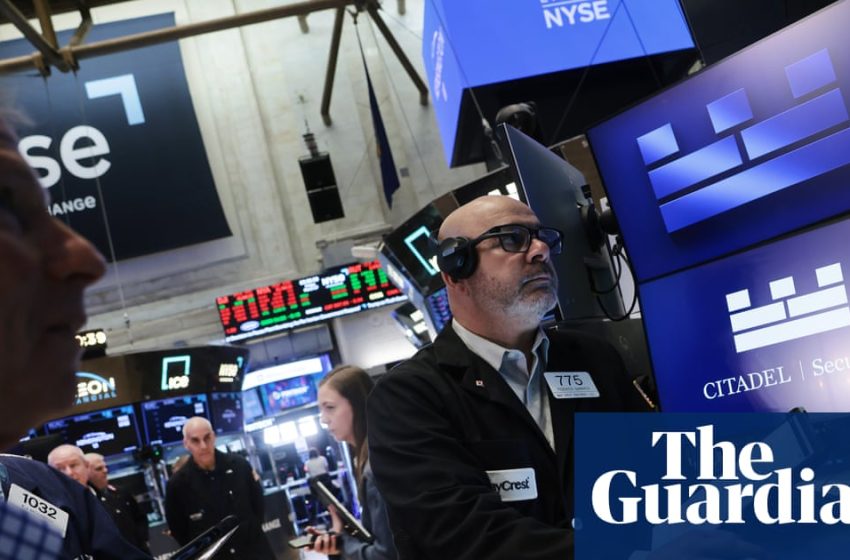
The US stock market opened on Friday with a selloff that briefly sent the Dow into correction territory as a new survey showed US consumer sentiment plummeted in March.
Within an hour into trading on Friday, the Dow fell more than 400 points, briefly pushing the index into correction territory. Oil prices continued to climb, with Brent crude, the global benchmark, hitting $110 a gallon.
US stocks on Thursday saw their biggest drop since the start of the US-Israel war on Iran. At closing, the tech-heavy Nasdaq index entered a correction, which occurs when an index falls 10% below its peak.
Markets are still on edge despite Donald Trump’s announcement late on Thursday that he will extend a pause on Iranian energy strikes. Trump has insisted that oil prices and the stock market will settle once the conflict ends, but it is unclear whether markets will believe him.
The president is also losing trust among consumers. US consumer sentiment dropped across age, political party and income levels in March, according to a new survey from the University of Michigan released on Friday that paints a bleak picture of how Americans are dealing with the economic fallout of the Iran war.
The survey found consumer sentiment fell 6% this month – its lowest level since December 2025. Consumers on the middle to higher end of income and stock wealth experienced “particularly large drops in sentiment”, according to the survey, which was conducted between 17 February and 23 March.
Inflation expectations for the year climbed this month from 3.4% to 3.8%, the largest one-month increase since last April, when Trump announced his plan for tariffs.
The short-term economic expectations of consumers plunged 14%, though long-term expectations saw less sharp declines.
“These patterns suggest that, at this time, consumers may not expect recent negative developments to persist far into the future,” Joanne Hsu, the director of the Surveys of Consumers, said in a statement. “These views are subject to change, however, if the Iran conflict becomes protracted or if higher energy prices pass through to overall inflation.”
Consumer expectations match economic calculations that show the conflict will cause higher inflation. The Organization for Economic Cooperation and Development revised its projections for global GDP growth downward on Thursday, and said that the war in the Middle East “generates significant uncertainty around global demand”.
“The evolving conflict in the Middle East has human and economic costs for the countries directly involved, and will test the resilience of the global economy,” the report stated. “A halt in shipments through the Strait of Hormuz and the closure or damage of energy infrastructure has generated a surge in energy prices and disrupted the global supply of energy and other important commodities, such as fertilisers.”
The group also warned of higher global inflation due to the spike in energy prices, and found that the Middle East conflict would damage the UK’s economy more than any other industrialized nation.
First Appeared on
Source link






