


Vaccine policy protects individual rights, not public health, top CDC adviser says
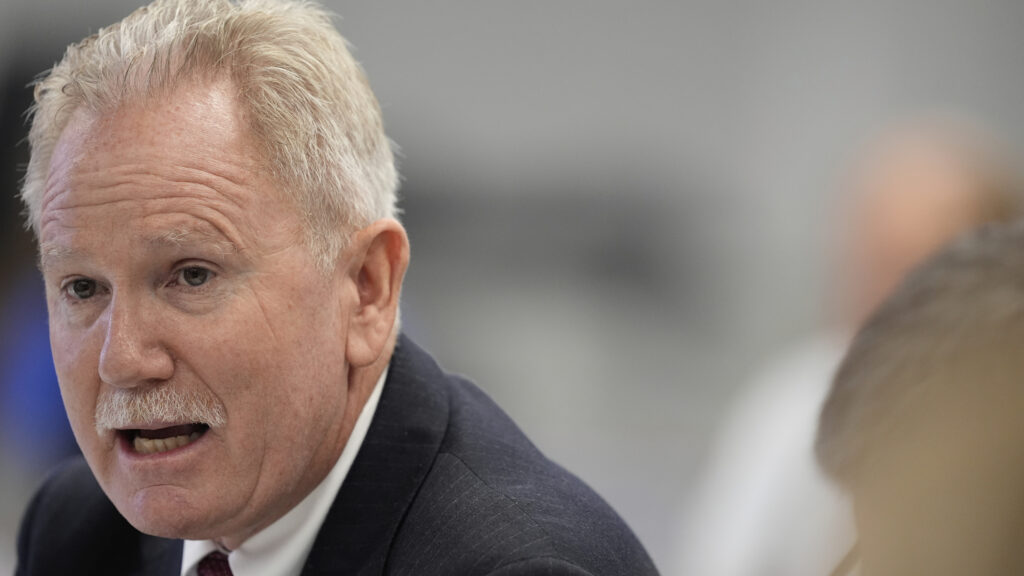
The chair of a federal vaccine advisory panel charted a new course for the committee in a podcast released Thursday — suggesting the public might want to reconsider the use of polio vaccines, arguing individual freedoms should be a north star of the panel, and pointing to the Covid pandemic as key to his thinking on health policy.
Kirk Milhoan, a pediatric cardiologist who became chair of the Advisory Committee on Immunization Practices in December, also downplayed established science on vaccines during an interview for the podcast and suggested policy goals, not new research, were the driving force behind changing recommendations in recent months.
In a wide-ranging interview with the podcast “Why Should I Trust You?”, Milhoan painted a more detailed picture of the committee’s strategy than has been previously known as it moves to weigh recommendations for vaccines given to children and pregnant people.
When asked why the committee had revised existing recommendations, including delaying the age by which some children are immunized for hepatitis B, Milhoan said plainly: “Yeah, because we were concerned about mandates, and mandates have really harmed and increased hesitancy.”
The current members of the ACIP were handpicked by health secretary Robert F. Kennedy Jr. after he dismissed its prior members last summer, accusing them of being influenced by the pharmaceutical industry. The new members, who include a number of Kennedy allies and vaccine critics, have since recommended removing thimerosal, a mercury-based preservative, from flu vaccines and splitting the measles, mumps, rubella and varicella combined shot with varicella taken separately.
The group now intends to continue to review long-settled recommendations for pediatric vaccines and those given to expectant parents.
This is the first interview Milhoan has given since a December ACIP meeting during which the hepatitis B recommendation was made and since he became chair. After the December meeting of the committee concluded, Milhoan was heard comparing the members of the panel to “puppets on a string.”
“I was referring to what it’s like to be a committee member when there are lots of different pressures and threats coming in,” Milhoan said in the podcast, pushing back when asked if Kennedy or his agency was the “puppet master.”
“I haven’t had anyone say, ‘Kirk, this is what we want to make sure is voted on,’” he said. Milhoan did say, though, that he and other members of the committee have been subjected to threats, and that his son bought him bullet-proof clothing for Christmas. “You know, we have a whole email thread of all the threats we get as ACIPs.”
Public health versus individual rights
In the interview, Milhoan clearly laid out what he sees as the goal of the new ACIP: protecting individual rights over public health.
“What we are doing is returning individual autonomy to the first order, not public health, but individual autonomy to the first order,” he said. Members of the panel have frequently questioned whether providers adequately inform patients of the risks and benefits of vaccines. At one point, Milhoan accused the American Academy of Pediatrics, which is suing the Department of Health and Human Services over its vaccine policies, of claiming their members don’t have time to adequately inform patients.
“[Patients] should be making the decisions on what the risks are of disease, what the risks are of vaccines, which is different for each person, what the family history is, and then make a decision from there, as opposed to what was sort of more of a heavy-handed, authoritarian thought of the vaccine schedule that led to mandates that if you didn’t have this set of vaccines exactly how they were prescribed, then you didn’t get in school,” he said.
Asked about Milhoan’s remarks, an AAP official said they were “only the latest step in an effort to sow doubt and confusion” about vaccines.
“Our answer is and has always been clear — talk to your doctor about the recommended vaccines for your child. Those decisions have always been made in partnership,” said Sean O’Leary, chair of the AAP’s committee on infectious diseases. “The answer isn’t biased government intervention, it’s trusted engagement between parents and doctor.”
Overall, the spectre of Covid-19 loomed large for Milhoan in the podcast: He frequently pointed back to messaging about the Covid vaccines, which he believes were made out to be more effective than they are. He also said that, as a pediatric cardiologist, vaccines weren’t front of mind for him until Covid-19 vaccine mandates.
“People couldn’t go to school, and they couldn’t do this, and they couldn’t do this, to get a vaccine that has really been a large failure,” he said.
Milhoan also addressed what top appointees at the Food and Drug Administration have described as evidence that at least 10 children died from getting Covid vaccines, calling it “a very large death signal.” Vaccine experts have called on the FDA to make the data public; to date it has not. Milhoan told the podcast hosts he had seen the data, but did not elaborate on them.
At the same time, Milhoan cast doubt on the scientific rigor of current public health decision-making. “I don’t like established science,” he said, adding “science is what I observe.”
He pushed back on co-host Brinda Adhikari’s assertion that vaccines have been proven to reduce the spread of polio and measles viruses.
“I’m looking at the observable science,” he said. “And what I’m saying is that there is an emotion when people use the word proven.”
He criticized previous iterations of the ACIP for not thoroughly considering the safety of vaccines — even though the committee has previously recommended pulling vaccines from the market because of safety concerns — and said the new committee is bringing an “increased level” of focus on safety.
Yet, he also said he had no new framework to evaluate vaccine safety, even as he criticized the CDC’s available vaccine safety reporting system.
“I don’t have a new solution. We’re working to figure out why it broke,” he said.
Questioning polio, measles vaccines
Asked about his thoughts on polio and measles vaccines, Milhoan seemed to question whether both are still necessary. There has been an international effort for nearly the past 40 years to eradicate the crippling polio virus, which still spreads in Pakistan and Afghanistan, and which occasionally makes its way out of that region. Measles, however, is running rampant in parts of the United States, with transmission occurring at rates that haven’t been seen since the early 1990s.
“I think also, as you look at polio, we need to not be afraid to consider that we are in a different time now than we were then. Our sanitation is different, our risk of disease is different, and so those all play into the evaluation of whether this is worthwhile of taking a risk for a vaccine or not,” Milhoan said.
“When … we talk about the risk of, let’s say, measles, many of those risks of not getting measles without having a vaccine was in the 1960s. We take care of children much differently now,” he added.
Milhoan’s suggestion that both better sanitation and less crowding could bring those diseases under better control than before the vaccines were introduced is a common talking point of Kennedy’s as well. One of Kennedy’s lawyers, Aaron Siri, prior to Kennedy’s confirmation, had petitioned the FDA to revoke approval for the polio vaccine.
Milhoan also seemed to suggest that the ongoing outbreaks will generate modern estimates of the risks measles poses.
“What we’re going to have is a real-world experience of when unvaccinated people get measles,” he said. “What is the new incidence of hospitalization? What’s the incidence of death?”
Milhoan said he didn’t want vaccination rates to decline — though many public health experts say health officials’ changes to vaccine policy will do just that by introducing further uncertainty and confusion for families wondering whether to vaccinate their children. Earlier this month, the HHS recommended an entirely new childhood vaccine schedule, which slashed the number of recommended vaccines. ACIP was not consulted on the change but Milhoan said didn’t offend him.
“I don’t have a desire for less people to get vaccinated,” Milhoan said. “My desire is to have as low a side effect profile as we can that has the maximum efficacy in preventing disease or preventing horrible outcomes.”
First Appeared on
Source link






