


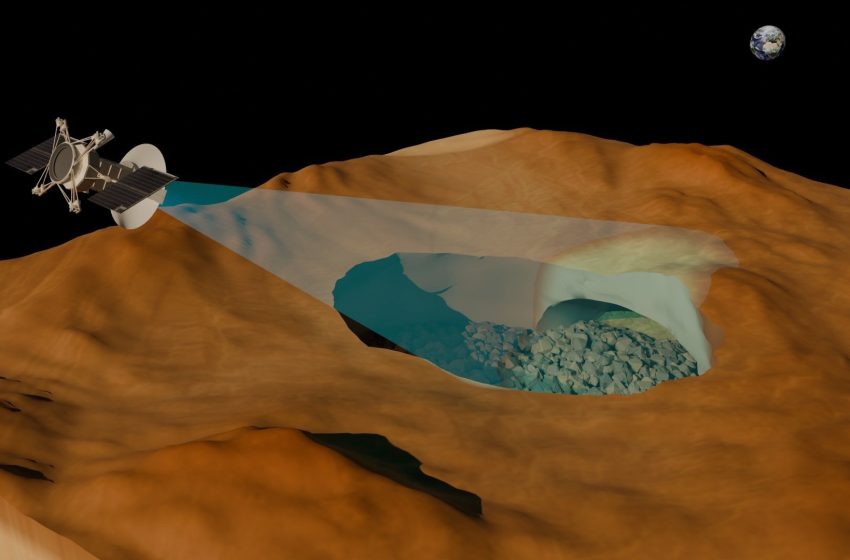
Venus may have an underground tunnel carved by volcano eruptions
Scientists analyzing decades-old data from NASA’s Magellan mission say they have identified what appears to be a vast underground tunnel carved by volcanic activity on Venus.
If confirmed, the structure would mark only the second time a lava tube has been reported on Venus, adding to similar discoveries on the moon and Mars.
“Our knowledge of Venus is still limited, and until now we have never had the opportunity to directly observe processes occurring beneath the surface of Earth’s twin planet,” study co-author Lorenzo Bruzzone of the University of Trento in Italy said in a statement.
“The identification of a volcanic cavity is therefore of particular importance, as it allows us to validate theories that for many years have only hypothesized their existence,” he added.
Venus is perpetually shrouded in dense clouds that block direct views of its surface, forcing scientists to rely on radar imagery to study the planet’s geology. Between 1990 and 1992, NASA’s Magellan orbiter mapped much of Venus’ surface using a radar system specifically designed for that purpose, producing a vast archive of images that researchers continue to analyze.
Magellan’s radar mapped Venus by transmitting radio waves toward the planet’s surface and measuring how long the signals took to bounce back, allowing scientists to construct detailed surface maps. Those maps revealed long chains of pits, or collapsed areas on the surface. Some stretched tens to thousands of miles, which hinted at the presence of underground lava tubes across the Venusian surface, the study notes.
In the new study, Bruzzone and his team focused on localized surface collapses that occur when sections of rock give way, creating skylight-like openings that can expose underground voids. One such feature, located on the western flank of Nyx Mons — one of the 1,600 major volcanoes and nearly a million smaller ones that dominate the surface of Venus — produced a distinctive radar pattern closely matching signatures known to arise from collapsed lava tube roofs, the study notes.
Analysis of the surrounding terrain suggests the conduit could extend for a few dozen kilometers underground, although only part of the structure can currently be confirmed, Bruzzone said in the statement.
Confirming its full size, shape and stability will require new observations, he added.
That opportunity may come soon. A fleet of upcoming missions to Venus are expected to carry more advanced radar instruments capable of capturing higher-resolution images. For instance, studying subsurface cavities is a primary goal of an instrument called the Subsurface Radar Sounder, or SRS, planned for the EnVision mission being developed by the European Space Agency, which can penetrate the planet’s surface to depths of several hundred meters.
The instrument is capable of “probing Venus’s subsurface to depths of several hundred meters and potentially detecting conduits even in the absence of surface openings,” Bruzzone said in the statement.
“Our discovery therefore represents only the beginning of a long and fascinating research activity.”
This research is detailed in a paper published Feb. 9 in the journal Nature Communications.
First Appeared on
Source link






