


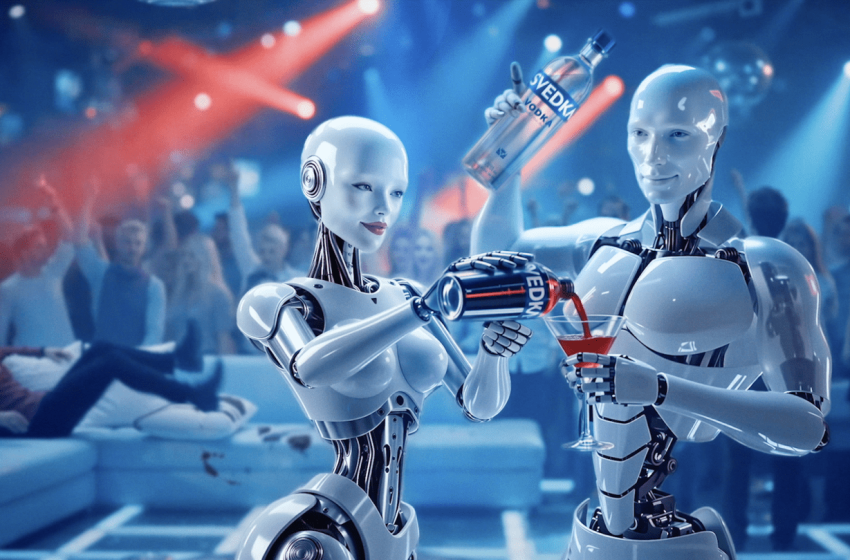
Watch Svedka’s Super Bowl Ad and You’ll See a Spot Mostly in AI
The fembot has been prompted.
Svedka’s famous robot character, gone from pop culture for nearly 13 years, has returned to the brand’s ad campaigns recently and will now appear in a Super Bowl commercial. The catch? Pretty much the whole spot has been created with AI.
The 30-second commercial features Fembot and her new companion Brobot as they dance in front of a group of human partiers while discovering Svedka products within their casing, in a video that was almost entirely prompted by AI instead of conventionally shot. The pair’s TikTok-y dance was selected from among a slew of user submissions as part of a contest (it was won by a 23-year-old Nashville native named Jessica Rizzardi), which puts the commercial at the nexus of more than just one tech-platform trend.
Svedka owner Sazerac is touting the spot as the first known Super Bowl ad created “primarily” through AI.
“We always knew we were signing up for risk because a vodka ad in the Super Bowl is polarizing to a certain degree,” Sara Saunders, chief marketing officer at Sazerac, told The Hollywood Reporter. “So the rest of it was ‘we might as well create conversation.’”
An even further irony: despite the AI auspices, the ad is meant to suggest the importance of putting down the tech and getting out there to dance and meet people the analogue way. (The message is subtly coded when Brobot drinks Svedka and short-circuits.) “The entire idea of the campaign is that the robots have returned to remind the humans to be more human,” Saunders said. “Our message is ultimately pro-human.”
Vodka is indeed a bit of a lift for a broad Super Bowl ad — the game usually features beer commercials, not plugs for harder drinks (Smirnoff is joining Svedka as the first vodka brand to advertise at the game in three decades). And because vodka itself isn’t a product with as many built-in possibilities as some other products, the company decided to lean in to the techno aspects. “It’s odorless, it’s colorless — we needed something that would go the other way,” said Saunders. The AI shaping of the robots’ moves, she added, did offer more humanistically expressive possibilities than conventional animation.
Saunders said the ad didn’t save as much money and certainly not a ton of time compared to a conventional shoot; the company chose to make the ad this way because of the aesthetic and thematic value. “For us its never been an efficiency play, it’s been a storytelling play; that’s why we’ve always had strong hands on the keyboard,” she said of the spot, which will air just after halftime.
The milestone is a culmination of an increasingly AI presence in Big Sports advertising. Last year’s Super Bowl featured a number of commercials promoting the power of AI, like a Google Pixel commercial in which a father preparing for a job interview is guided through the process by Gemini, while the NBA Finals this summer showcased an online ad for Kalshi that ran through a series of whacked-out AI-generated memes. LLM-driven robots is pretty much the only place this could go.
Other Super Bowl spots this year will use AI, but as more of a tool, like to change the appearance of characters from Jurassic Park or of the visage of Guy Fieri. And there will be ads from chatbot companies themselves, like a reported 60-second OpenAI spot. But a full tableau of AI images appears to be Svedka’s domain alone.
GenAI has become an increasingly large force in other big-budget ad campaigns, with equally forceful criticism to match. This holiday season Coca-Cola tried an AI ad that saw a slew of animals reacting to a convoy of beverage trucks. The company said it was the future; many viewers weren’t so sure. (One of the studios involved in the soft-drink ad, Silveside AI, was the studio behind the Svedka ad.)
Advertising experts say there will be more ads made with AI throughout the year as brands seek to cut costs. The Super Bowl, a place not known for cost-cutting, is thus a strange place to see content of a more slop-ified shade. But its presence there will almost certainly open the door to other high-profile uses.
As for this particular airing, a backlash isn’t out of the question, though that doesn’t mean viewers won’t be watching or talking about the ad, which in the upside-down logic of Madison Avenue can sometimes bring more value than a genially tolerated ad that everyone forgets.
Asked about the potential for criticism, Saunders made few bones. “We expect it and we welcome it,” she said, smiling. “We think that [the question of humans vs. technology] is a dialogue we should be having no matter which side you’re on.”
First Appeared on
Source link






