


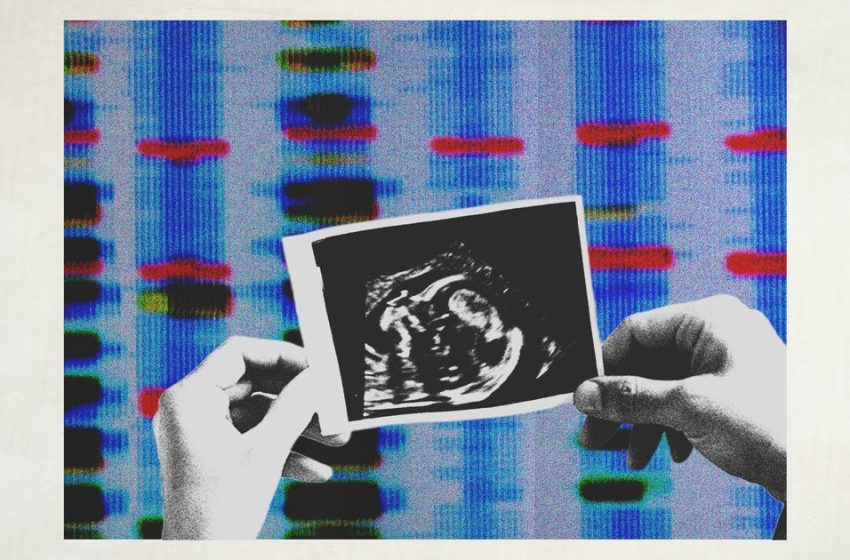
What If My Baby Inherits My Medical Condition?
Photo-Illustration: The Cut; Photos Getty Images
For many considering parenthood, the possibility that your child may inherit a family medical issue can result in more questions than answers: Can I physically manage pregnancy with my condition? Am I comfortable with the possibility of passing it on? If not, what alternatives are there, how do I approach them, and can I even afford to do it? And is my health stable enough to watch what all parents hope to see: our child grow up? Usually, there are no straight answers, only the decisions we make for ourselves.
With so much to consider, The Cut spoke to six people about their different heritable medical conditions and how they’re approaching one of life’s biggest decisions.
I was diagnosed with ALS on Valentine’s Day last year, but I’d had symptoms since 2022, mostly limping. My dad was diagnosed in 2010, but it wasn’t until 2018 that we learned it was genetic, the SOD1 gene specifically. All I could think was I hope I don’t have it. I was shocked and confused. It took me a year to decide if I wanted to know. I wasn’t angry at my dad, but I was angry at life. It was already difficult to see my dad, and I knew ALS is a death sentence. When I finally found out my diagnosis, it took me two months to tell people that I have it. I didn’t say a word to anyone. I always wanted to have kids. Before my diagnosis, my boyfriend and I were talking about it, but after, I completely shut that door. Anytime my boyfriend brought it up, I said no. It was a dark time. I was angry and sad. At the time, some of my friends were pregnant or discovered their pregnancy. I couldn’t stand the baby talk at dinner. I felt lonely because nobody could understand what I was going through. Those feelings stayed with me for months.
In October, I started a treatment called Tofersen, which is for people that have SOD1. It’s actually working for me and we are starting to have good results, which gives me hope. I’m still limping, but less than before, and in February I discovered that I walk faster. I’m also less tired and no longer need a daily nap. I can go to physical therapy and go shopping on the same day! So last month, I spoke to my neurologist for the first time. She basically told me that she doesn’t see any problem with me having kids, so now, it’s up to me.
It’s a very difficult decision. When you have a genetic disease, the only thing you want is to have a normal life. You want to have the same choices that everybody else has. There isn’t a lot of data about pregnancy and ALS. Not a lot of young people get it. [According to the ALS Association, the average age of diagnosis is 55 years old.] After Googling, I found out that a woman had twins in 2022. We also don’t have any data about pregnancy and Tofersen.
There are so many questions about my own health because pregnancy changes your whole body, but ALS is already changing my body. Will I be capable of handling the physical aspect? There is the psychological aspect of it: If my baby has this defective gene, I will feel guilty forever. I also don’t want my baby to see all the bad things ALS does to you, which means losing your mobility, losing your voice, losing your independence.
I’ve had this conversation so many times with my boyfriend. He’s told me word for word, “It’s your choice. I will support you no matter what, and I will stay no matter what.” And I know he will because that’s how he is. He also says, “You don’t know when your baby or if the baby will have it. And you don’t know if in that period we’ll find a cure.” But I’m scared — my dad has it in his 60s, and I’m in my 30s. What if my baby is diagnosed before their 30s? We booked a therapy consultation to talk about it. For me, I know it’s mostly fear.
Her ALS Story — an online community for women diagnosed with ALS before 35 — has helped me understand better what it’s like to care for a kid when you have the disease. There are lots of moms, and I can see the difficulties they have, the issues, the heartbreaking moments they have with their kids because ALS steals everything from you. Sometimes it steals your personality, the moments of joy that you can have with people around you or your kids because your muscles are dying. I was like, Do I want to rob that from my kids? Do I want to break my heart with all these stolen moments that ALS is not giving me?
But I also read an article asking 23 kids from the group questions about their moms. Obviously, the kids are sad that their mom can’t be like the other moms, but they find joy in so many things with their mom, which makes it very special. Reading that, I was like, Wow, I didn’t see that point of view.
I’ve also had conversations with friends and family. My mom said, “Go for it,” but she’s a mom. I have two sisters. One sister had a baby two months ago and told me I should do it because ALS should not decide what I do with my life, which is understandable, but I also need to balance things because it’s not that simple. There is a lot to consider. I won’t decide before my treatment anniversary in October, so I can see if the disease has stabilized or if the symptoms have reversed a little bit.
I have Pompe disease, which is a genetic condition. Neither of my parents had it, but I got both of their recessive genes. My sister has it as well. I was diagnosed in 2010 when I was a freshman in high school. I was very lucky to be diagnosed early, which allowed me to start treatment prior to when I had more obvious symptoms. Now every two weeks, I get a four-to-five-hour infusion at my house. I have muscle pain, a lot of muscle tightness and fatigue. I can walk, but I have to walk with a lot of intention. I’m a little wobbly. It can feel like a lot of management and a lot of mental energy sometimes.
My whole life, Pompe or not, I’ve never been the type of woman who is like, Oh, I can’t wait to have kids. I was always the person who said, If it happens, it happens, or Maybe I’ll get the feeling when I get older. Now that my fiancé and I are getting married in October, I definitely could see it in my future, but I wonder if I were a different woman, would I respond differently? I don’t know.
We have three main considerations when it comes to whether or not to have kids: One, there’s an oral-pill component to the medication I’m on that is contraindicated with pregnancy, so I’d have to switch to another infusion type or medication. Second, I don’t know how my body would handle it. Pregnancy is hard on everyone, and some perfectly healthy people have a really hard time with being pregnant. So for me personally, I worry about if I’m already fatigued and am a little wobbly, particularly later in pregnancy, what would that extra weight feel like to me? Would I be able to handle that? The third thing is I don’t feel comfortable passing this on to my kids, but that involves testing, money, and resources.
I’m not one to seek out medical information on the internet or get random Reddit inspiration. I’m a science-y person. I have a master’s in public health. So I know there have been maybe four or five studies about women with Pompe disease that have been pregnant, and all of their pregnancies were normal. I’ve also reached out to other women with Pompe disease from a support group that I’m in on Facebook that are similar to me to learn about their experience. That was really helpful to figure out, Okay, how did you prepare? And afterward, how do you manage that? It made me feel better. I also talked to my muscular neurologist and asked him bluntly about what it would be like. His perspective was that later in pregnancy with the weight, that may be difficult for me to manage, but he says I can “use assistive devices, do what you can.” He doesn’t think there’s anything specific to Pompe disease that would make it harder in those earlier months.
If we do it, I want to go all in and do it as safely, as researched, as informed as we possibly can. I want to understand every single aspect of it and be 100 percent all in. It’s like a hell yes or it’s a no. I’m just waiting for the feeling. I can be very methodical and research-focused, but unless it is a hell yes in my gut and in my heart, then I’m not going to do it.
I was diagnosed with schizophrenia when I was 22. I always say that I thought my life was over; nobody would ever love me. Then I went out to dinner with my three best friends from college and I was like, “Guys, I just found out I have schizophrenia.” And they all looked at me and they were like, “Isn’t that what you had the whole time?” So I kind of figured if my best friends already knew and didn’t care, why would I care about people I don’t know judging me?
I’m good now because I take six daily medications. I’m such a lucky person. If I didn’t have the help of my family, friends, and doctor, I could so easily be a homeless person on the streets having no medicine. When people think of schizophrenia, it’s so stigmatized. These mental illnesses exist on a spectrum, and people go straight to the end of the spectrum and they think, Can never do anything on their own, going to live in their parents’ basement the rest of their life, and if they don’t take their meds, they’re going to go crazy and probably kill somebody. But you can run a business like I do, you can speak to people, you can do well, you can advocate for yourself, and you can do what other people can do.
I think I would love kids. I see that my friends are all having kids, and sometimes I’m like, Oh, I like your kids too. But I need to take a nighttime pill so I can go to sleep. What if I won’t be able to wake up and help the baby in the middle of the night? My biggest fear, though, is that I don’t want my kid to have schizophrenia or a mental illness. I don’t want them to suffer. For me, it really started in ninth grade; I started hearing a voice that I didn’t know was a voice in my head. I thought everybody had a voice in their head. It tortured me, telling me how dumb I was, how stupid I was, what an idiot. I became so introverted, and I didn’t want to speak in class. At night, I would just cry.
There are people who have schizophrenia that have kids, but I just think they’re very strong. I see my friends with kids and it’s very stressful for them, and stress can trigger symptoms. I worry, How could I be a good mom with schizophrenia?
I have hypermobile Ehlers-Danlos syndrome (EDS), a genetic connective-tissue disorder that affects the way my body produces connective tissue, so it can affect all sorts of systems all the time because so much of your body is made of connective tissue. I wasn’t diagnosed until I was 28.
For me, it affects my energy levels as well as pain levels. My skeleton literally is not screwed in tightly, so it hurts more to support myself. You’re also more likely to cause injury. It is exhausting to live in a body that doesn’t hold itself together. Pain is a form of exhaustion. I also am not able to be on my feet, for example, for eight hours straight. I use canes to get around, which I love, by the way. I have amazing different colors like this pink ombré sparkly one.
We don’t, as a scientific community, know what the change is on the genome that causes this disorder. My understanding is that hypermobile EDS is autosomal dominant, meaning it is more likely that a child would have it than not. That doesn’t mean it is a hundred percent for certain, but it would seem so. I’ve always known I wanted kids, but it became a nebulous future thing until now, in my 30s. A lot of the discussion around genetic conditions in children is framed through the lens that disability is tragic, and I fundamentally don’t believe that. I believe it is absolutely reasonable to grieve a life that you imagined. Grief is normal, but a disabled life is not a tragic one. If my child were to inherit this, there would be systems already in place to help support them from the beginning. I can still see a beautiful, wonderful life for them.
I know lots of people who have been pregnant with EDS, and I also know people with EDS who know their body can’t handle pregnancy, and so they haven’t done it. It really seems to vary body to body. I don’t know how my body will tolerate pregnancy. That is its own question. It may be that this process begins and we discover that my body cannot tolerate this, and that’s also not fair to my future child, and there may be another way to have a child in my life that isn’t genetically related to me or maybe is; maybe there’s a surrogacy.
I don’t know how a disabled person cares for another disabled person. It’s more than anything, to me, a fear of the unknown. On top of all that, I have the normal concerns of a mid-30s pregnancy, which are for both the pregnant person and child.
We also live in a one-bedroom apartment in Vancouver, Canada, which is notoriously one of the most expensive cities on earth to rent in, and we can’t afford a normal two-bedroom on part-time artist incomes. We’re in the process of looking into co-op housing. There are just so many question marks.
In my 20s, I was diagnosed as basically allergic to everything. I manage more than 200 food allergies, feeding intolerances, and contact airborne allergies. Being allergic to everything means all the majors: wheat, milk, eggs, soy, peanuts, fish, chocolate. But I am also allergic to the processing of water, for example. So if you turn on your tap and you get tap water and you drink it, you’re probably fine. If I do the exact same thing, it’s like swallowing razor blades.
It’s only in the last year and a half where I feel like I want kids. What symptoms would prevent me from giving the child the full life that they deserve? We won’t be able to necessarily go to nearly as many places as the normal child would go to. I have to wear a full face respirator to leave the house safely — that’s going to put a damper on this kid’s life.
I’ve really been wrestling with this decision because it’s like, Okay, what would it look like now? Because right now when you’ve just turned 40, you’re like, Am I just too late? Did I miss the boat? But then I’ve got friends who are having a kid at 41 and I’m going, Okay, maybe I didn’t miss the boat, but if I didn’t miss the boat, the boat’s just about to leave.
So the one decision I’ve absolutely come to: I will not have a biological child. Why on earth would I do that to another human being? Which leaves me with a few options: egg donor, surrogacy, adoption … I’ve been allowing myself the time and space to go through a lot of different scenarios. I pay attention to how other people are experiencing things, how friends are experiencing things, their struggles, their ups and downs.
I’ve thought about all the things that can go wrong, and I’m also trying to allow myself to think about all the things that could go right and how fun it would be to get it right. It’s getting through the decision first and then having that bravery to actually do it. Let’s say I’m 98 percent there. Could I still back out? Yes, of course. I’m not on the boat. The beauty of being in this really weird spot right now is it’s not too late to just kind of go, You know what, never mind. Because I keep doing that.
I’ve been married to my husband for two years. I’m type-one diabetic, and in the beginning, we just never thought we could have kids. I know there are so many type-one diabetics that have kids, but your sugar levels have to be perfect the entire time you’re pregnant, especially in the beginning and toward the end; you are just in the doctor’s every day. You cannot guarantee that you’re good. There’s so much that you have to pay attention to on top of all the normal.
You also can’t guarantee that it won’t be passed on, and I didn’t want to risk that. I can’t imagine a baby wearing all the devices that I have to. And then when they go to school, are they going to get made fun of? Is the teacher going to be aware of low blood-sugar levels? What if they have low blood sugar, and, I hate to say it, but it’s a huge fear: What if they die? Diabetic women have kids all the time, and they aren’t perfect all the time. I just get so nervous of having an unhealthy baby, and then it’s my fault too. I couldn’t do that to a little one.
We talked to a lot of family members. We’re extremely close with my parents and then my therapist and doctors too. I think my endocrinologist was one of the most important people in making the decision, just telling me from the very beginning, “If you want to do this, I will make sure that you have a healthy baby. You are going to have to take five times the amount of insulin that you won’t even take now.”
I also go to a type-one diabetic monthly support group, which I found through my therapist. I see my therapist specifically because she’s a type-one diabetic. I meet with her once a month, and she has two healthy kids. She’s like, “You can ask me questions, it’s fine.”
I also started to post on Reddit and just ask the type-one diabetic group about other people’s journeys and what they considered. It was nice to read that some people had completely normal journeys; other people had difficulties with the insulin. No horrible stories that I read, but just more how you’re dealing with the day-to-day.
And so through this process, we decided to do IVF so that we could do PGD (preimplantation genetic diagnosis) testing to ensure the baby doesn’t have diabetes. They would not even start me on IVF if my A1C weren’t below a seven. It took me probably a year and a half to do that. We ended with two perfect euploids, two low mosaics, and then two that we couldn’t use. We are only going to use the two euploids. My uncle-in-law passed away from ALS, and my aunt-in-law agreed to use her inheritance to help us pay for a surrogate. So now we have a surrogate picked. Hopefully in the next month, we can do the transfer.
I am completely blessed with the option to do a surrogate, but it’s like, What if that doesn’t work out? And what if neither euploid embryo works? What if it’s something with the surrogate, miscarriages happen all the time? I’m also very much set on two kids. And with the second, do we take out our retirement fund to do surrogacy again?
First Appeared on
Source link






