


What We Did Before Our Moth Days
In My Dinner With André, the 1981 indie hit in which the director André Gregory and the playwright-actor Wallace Shawn talk for almost two hours over a meal off Central Park, the onscreen version of Gregory posits a theory of why people cheat on their partners:
Have an affair, and up to a certain point, you can really feel that you’re on firm ground, you know? There’s a sexual conquest to be made. There are different questions. Does she enjoy the ears being nibbled? How intensely can you talk about Schopenhauer at some elegant French restaurant? Whatever nonsense it is. It’s all, I think, to give you the semblance that there’s firm earth. Well, have a real relationship with a person that goes on for years — that’s completely unpredictable. Then you’ve cut off all your ties to the land, and you’re sailing into the unknown, into uncharted seas.
Like almost every idea expressed in the film, it’s stated casually, with the nonchalance that naturally accompanies cailles aux raisins and Amaretto. But the philosophical inversion it suggests is startling: Marriage isn’t staid and boring, and people don’t have affairs for the reckless thrill of it all. A lifelong relationship, seen under the microscope, is weird and terrifying, its routines masking literally infinite tiny unknowns. The facile novelty of adultery is its own mask, a sexy way of dressing up a deep, frightened longing for security.
The film’s stars wrote My Dinner With André together, but there’s something distinctly Shawnian in this construction. As a writer — perhaps also as the Upper East Side–raised son of New Yorker editor William Shawn — Wallace Shawn has a surgical instinct for delicately disemboweling the civilities of the American upper-middle class. He’s John Cheever’s natural heir, picking apart polite façades and, in language at once intellectually heightened and deceptively conversational (“I mean,” “You know”), defamiliarizing the sophisticated animal to itself.
These dissections and alienations produce the kind of rush you get in looking down from the top of a very tall building after you’ve forgotten for a while that you’re not on solid ground: They can be exhilarating and nauseating all at once. It’s a spiritual dizziness that My Dinner With André provokes in mostly mild, frequently very funny ways. By contrast, Gregory and Shawn’s new project, What We Did Before Our Moth Days, uses similar techniques to compose something still full of humor but much darker. Like the movie that preceded it by 45 years, the play (written by Shawn and directed by Gregory) presents a static surface — its four actors sit in a flat row of chairs facing the audience and speak to us predominantly in monologue — but I left it feeling seasick. What renders it profoundly theatrical is its obsession, as deep as Hamlet’s, with the treachery of surfaces, still or otherwise. Shawn, too, is wracked and fascinated by the human ability to smile and smile and be a villain. Beneath the playwright’s glut of affable language, an existential undertow takes hold, and soon enough you find yourself far from the sunny shallows, gasping in the murky, merciless sea.
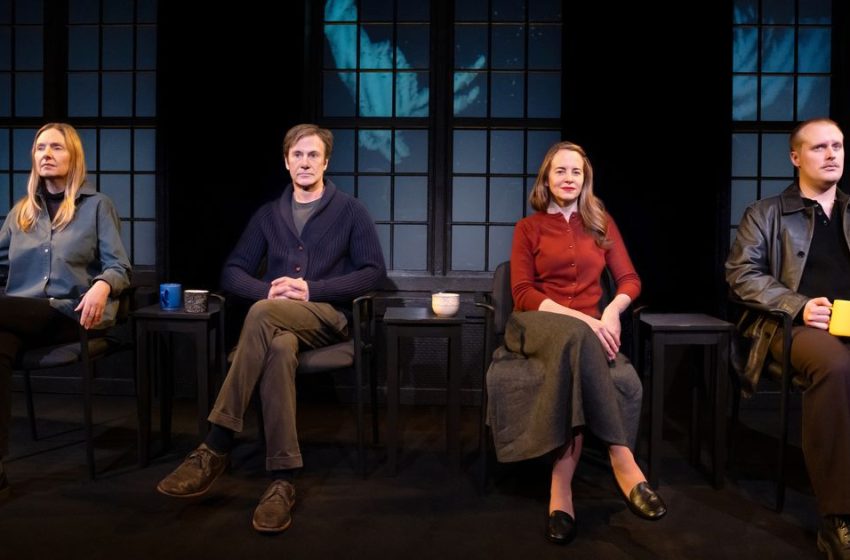
Ostensibly, Moth Days tells the straightforward story of a marriage and an affair. (Though is any such story straightforward? Shawn, whose father had a 40-year affair with the New Yorker writer Lillian Ross — a “shadow marriage” that the relationships on stage here mirror in some of their broader contours — might know better than most.) The chairbound players, arrayed in front of several large arched windows with no discernible landscape beyond, are Dick (Josh Hamilton), a successful novelist; his wife, Elle (Maria Dizzia), a teacher; their adult son, Tim (John Early); and Elaine (Hope Davis), a fellow writer of “extremely unpleasant — even grotesque” mysteries who has been Dick’s mistress for ten years. But in another, truer sense, the play is about death — more accurately, it is death. Dick, we learn from the monologue belonging to Tim that begins the play, is dead: unexpectedly, in his own bed, at the height of his career, just before his 45th birthday. But he’s also still here, unbothered by his demise and readily giving testimony. And it’s not just Dick. Wherever we are — call it purgatory, limbo, the beyond, the theater — none of these people are still breathing.
Dick and Elle both tip us off to the incorporeality of the container we’re occupying together. “I’d probably figured out by the age of 8,” Dick muses, “that everybody had many birthdays in the course of their life but only one day on which they died, and … I decided to call the day on which a person died not their death day but their ‘moth day’ … I guess I sort of pictured that when people died, they were sort of gently and vaguely and flutteringly escorted into death by a flock of blind moths.” (“Gently and vaguely and flutteringly” is its own fine description for how Shawn crafts his own unreliable surfaces. My colleague Chris Bonanos recently pressed him on his description of all the characters in Moth Days as “gentle”: He showed only a glimpse of his hand in insisting that they were so, “compared to Stephen Miller.”)
Dick, the writer, has ideated the play’s title and its shadowland: Before the show begins and at each of its two intermissions (it’s a solid three hours), flickering digital projections of moths appear behind the set’s windows. What we hear from the characters are, in a sense, pieces of the Great Accounting, the summing up of all the thoughts and deeds that make up an existence. Scenically, the place in which this occurs can be traced back to Elle: Riccardo Hernández’s set design unfolds like a somber pop-up book directly out of a staggering confession from her secret life. She and Dick met in their teens, and she describes her experience of love for him as like “living in a room filled with light.” But that sense of grace has been brutally inconsistent. She goes on to admit that that love has died many times (“You kick it — it doesn’t move. It’s dead.”) and that she has discovered she possesses a kind of “trick” to resuscitate it. “You see,” she confides in us, “I’d be sent away from that room filled with light, sent out into pure darkness, and I’d be wandering around in the darkness, totally lost, wandering, blind, for days, until one day I’d bump into a wall with a door in it, and I’d open the door, and I’d find myself in a sort of cold, dim waiting room …” Here Elle would wait (“maybe for weeks”) until some unpredictable shiver of feeling alerted her that, if she rose and left the room, she’d be able to find her way back to the light — to the place where she’d “been so happy … and Dick would be there, and I was delighted by him again, I loved him again, and maybe I loved him even more than before. And … I got to know the way back and forth to that waiting room very, very well.”
It’s hard not to quote Shawn at length — he and his characters are spinning something out, thread by infinitesimal thread. The work is painstaking and gradually revelatory. It’s as if — from this depressurized after-space, freed from the burdens of morality and time — each of these people is meticulously restoring the painting of their life, scraping away the crust of delusion and fear and so, so many little lies. From this perspective, Elle can speak, if not succinctly then still quite clearly, a truth that somehow both gives heart and wrenches it: We wander in and out of love and, more harrowing still, in and out of honesty with ourselves, and it’s a kind of intermittent living death. Our bodies go about their business, but our deeper selves flutter, like those blind moths, into that dim waiting room and linger until some inscrutable opening is granted us to start living again.
Shawn and Gregory have been grappling with the insoluble problem of just how much of one’s life one can or even should be fully alive to for half a century. It’s the thematic port they revisit like boats in My Dinner With André, Gregory playing himself as a kind of dashing, globe-traversing tall ship against Shawn’s dubious, electric-blanket-equipped houseboat. The destabilizing element of What We Did Before Our Moth Days rests in its characters’ subtle liberation from this mortal snare. The unflustered, funny-then-shocking intimacy with which they address us — in Tim, the depravity without shame; in Dick, the boyish wonder at the moment-by-moment discovery of his own capacity for cruelty — is almost human but not quite. It’s human at a crucial remove, a distance and a lightness and an eye for the psychological minutia of life’s muddle that have only been granted by the clarifying hand of death. The moths have done the work Shawn is most interested in: They have stripped pretense and dishonesty — even the most well-meaning varieties — away. What’s left is frightening because what’s under the bed always is.
A score at once so meticulous and so naked needs virtuoso players and a simpatico conductor. Gregory, almost 92 and utterly unbothered by any superficial drive toward physical action, is, instead, invested in the kind of exquisite tonal scoring What We Did Before Our Moth Days requires: How do you keep an ensemble from ever playing in the most common of keys? (Bitterness, for example, never enters any actor’s voice.) How do you grant attention to the dynamics and timbre of every note? The answer is time, which, in a paradox worthy of his work with Shawn, Gregory both does and doesn’t have. He is known for rehearsing plays for years — Moth Days took nearly a year and a half — and, though the flailing American theater will not and perhaps cannot take note, it should.
Because it shows. Davis is wry and quietly defiant of stereotype, her Elaine’s composure hard-won and her sacrifice of certain kinds of sympathy fully comprehensible. Hamilton achieves an airy mode of self-astonishment that by degrees turns completely chilling. Dizzia, playing the show’s heart, is precise and lyrical, devastating without ever going soft, and Early, known to many as a comedian (among other things, he and Kate Berlant are pals who make very funny shit), is light as meringue and simultaneously terrifying. He plays Tim like an escapee from Philip Roth or David Foster Wallace — perverse, articulate, amoral, normal, monstrous. The truly sinister implication of his character is that it takes no roaring horrors, no obvious abuse in a marriage to somehow produce a lost and twisted child. All it takes is what preoccupies Shawn and Gregory: living too long in the deadly waiting room of seeming, while the truth of being is choked, denied, or politely folded away. Another room waits for us all of course, and only there is there no more seeming. Only there does the play end.
What We Did Before Our Moth Days is at the Greenwich House Theater through May 10.
First Appeared on
Source link






