


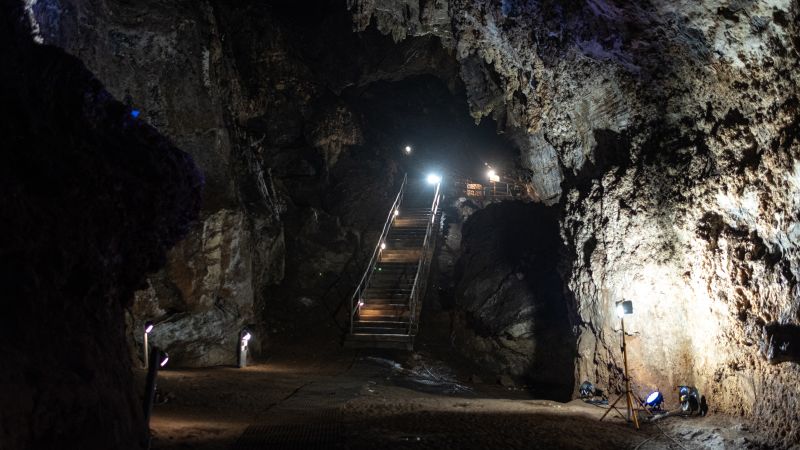
Who was Little Foot? Researchers digitally reconstruct the face of our early ancestor
Scientists can now come face to face with an early human ancestor nicknamed Little Foot who lived 3.67 million years ago, thanks to digital reconstruction technology.
Renowned paleoanthropologist Ronald Clarke identified four tiny bones in the University of the Witwatersrand’s museum collection and went on to discover Little Foot’s nearly pristine fossil in the 1990s in the Sterkfontein Caves northwest of Johannesburg, South Africa. Full excavation of the remains took a painstaking 20 years, but it was worth it.
At 90% intact, the specimen is the most complete known skeleton belonging to Australopithecus, chimpanzee-like ancestors who were able to walk upright on two feet but also adept at climbing trees to escape from predators like sabre-toothed cats.
The skeleton represents the oldest evidence of human evolution in southern Africa, said Dr. Amélie Beaudet, an honorary researcher in the School of Geography, Archaeology and Environmental Studies at the University of the Witwatersrand, Johannesburg, who has studied the fossil unearthed from the Cradle of Humankind World Heritage Site for years.
However, Little Foot’s skull, which became crushed as surrounding cave sediment grew heavier and shifted over time, has been difficult to study. The skull distortion was so extensive that physical reconstruction wasn’t possible.
Now, Beaudet and her colleagues have digitally rearranged the facial bones to their rightful places, providing a clearer look at Little Foot’s face — and hinting at features that may be shared across the human family tree.
“Only a handful of Australopithecus fossils preserve an almost complete face, making Little Foot a rare and valuable reference point,” said Beaudet, lead author of the study published Monday in the journal Comptes Rendus Palevol, in a statement. “Little Foot’s face preserves key anatomical regions involved in vision, breathing and feeding, and its skull will offer further key elements for understanding our evolutionary history.”
Little Foot’s fossilized remains left South Africa for the first time so researchers could capture precise images of the inner structures of her face, which had never been seen.
The skull was shipped to England so it could go through high-resolution scanning at the Diamond Light Source synchrotron, located at the Harwell Science and Innovation Campus in Oxfordshire.
The machine scanned the skull using bright, nondestructive X-rays, generating over 9,000 high-resolution images and terabytes of data. A supercomputer at the University of Cambridge processed the images and rendered the facial bones in 3D, enabling a digital reconstruction of the face.
Realigning the bones virtually in their correct anatomical positions revealed the upper part of the face for the first time, including the orbital region where Little Foot’s eyes would have been.
Her reconstructed face was then compared with three other Australopithecus specimens, including one from South Africa and two from Ethiopia, as well as modern great apes.
The size of Little Foot’s face fell between that of a gorilla and an orangutan, while the shape was closer to what is seen in orangutans and bonobos.
The team was surprised to find that the face size, as well as the shape and measurements of her eye sockets, were also more similar to the East African Australopithecus fossils, despite the fact that Little Foot was found in South Africa.
“All this shows the complexity of the patterns of variation in the genus Australopithecus and the latter’s proximity to the great apes,” said Dr. Zeray Alemseged, Donald N. Pritzker professor of organismal biology and anatomy at the University of Chicago, in an email. “Not surprising as they share a common ancestor.” Alemseged was not involved in the research.
Perhaps Little Foot’s lineage was more closely related to East African hominins, while South African hominins evolved distinct facial features later on, the authors wrote in the study.
“Rather than viewing early hominin evolution as occurring in isolated regions, the study supports the idea of Africa as a connected evolutionary landscape, with populations adapting to ecological pressures while remaining linked through shared ancestry,” said study coauthor Dominic Stratford, associate professor in the School of Geography, Archaeology and Environmental Studies at the University of the Witwatersrand, in a statement.
Understanding the faces of early human ancestors is of interest to researchers because their features represent a connection between hominins and their physical and social surroundings, Beaudet said.
“Studying the face may provide information on how our ancestors and relatives interacted with their environment,” she wrote in an email. “Moreover, characters identified in the face can be used to know more about the relationships between populations/species at that time.”
For example, the size of Little Foot’s eye sockets may have been due to changes in visual acuity or the environment — and linked with an extended visual area in her brain, something identified during previous research by Beaudet and her colleagues.
Little Foot’s skeleton is 50% more complete than the famed Lucy fossil, found in Ethiopia in 1974 by paleoanthropologists Donald Johanson and Tom Gray.
While Lucy lived 3.2 million years ago and belongs to Australopithecus afarensis, the exact species designation for Little Foot has been the subject of recent debate.
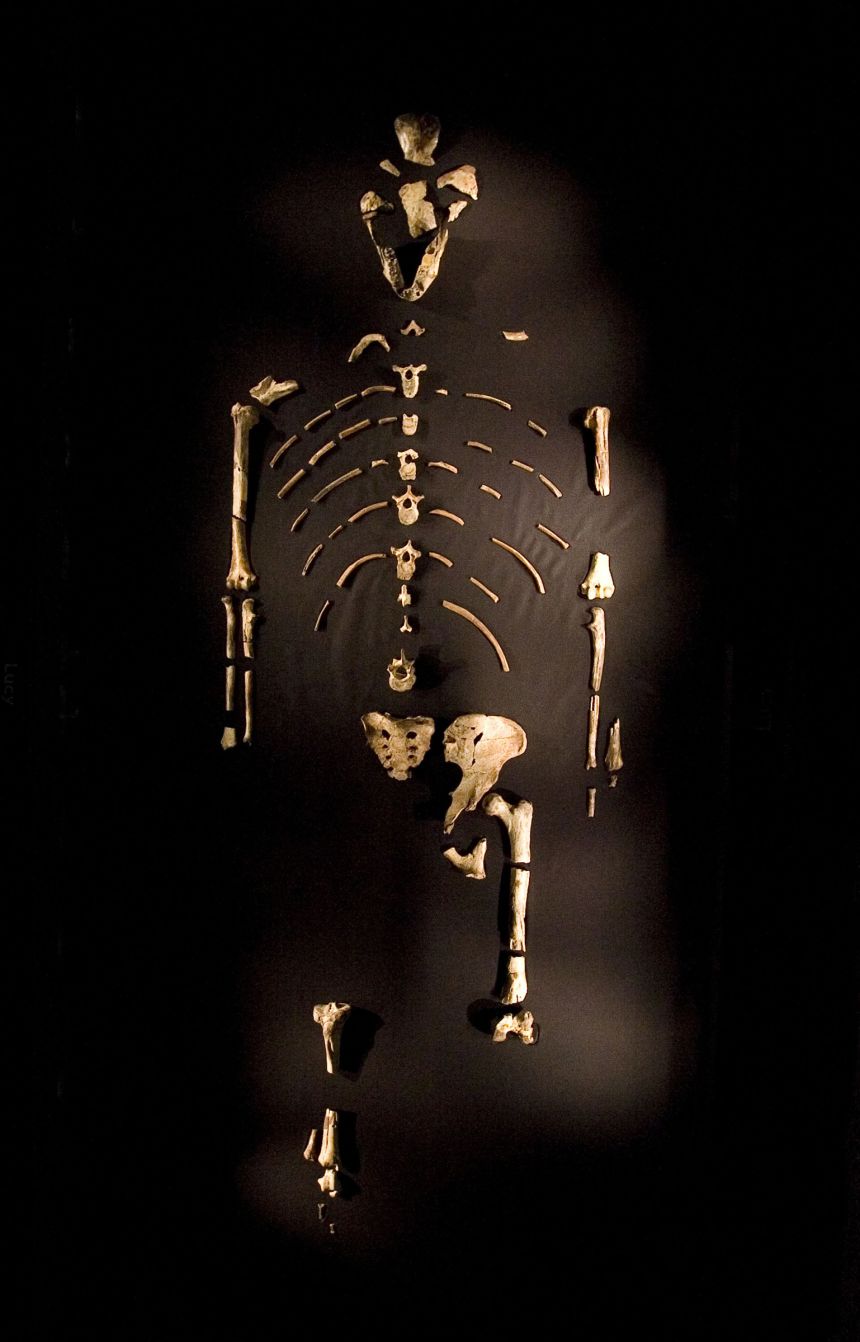
Researchers have suggested that Little Foot could belong to the prometheus or africanus species under Australopithecus, or perhaps even be a previously unknown human relative.
The competing hypotheses, which seek to identify common traits between Little Foot and any of these species, highlight why the fossil continues to be such a rich resource of information that could contain clues to human evolution.
“Many researchers, including myself, are skeptical about the current attribution of Little Foot to Australopithecus prometheus, in part because this species is generally considered to be the same thing as Australopithecus africanus,” said Dr. Jesse Martin, lead author of a recent study suggesting the fossil belongs to an unknown human ancestor, in an email.
While pleased to see the digital reconstruction, Martin said the geological age of the fossil remains unclear since different techniques have arrived at varied dates. Martin, an adjunct professor of archaeology at La Trobe University in Australia, was not involved in the new study.
“I therefore think any discussion about the evolutionary trajectory of cranial shape based on an older date for Little Foot is premature,” Martin said.
The findings of the new study don’t shed fresh light on the identity of Little Foot beyond what was already known, Alemseged said.
However, the aim of the team was to focus on possible adaptations that could have shaped hominin faces, rather than testing hypotheses on species attribution, Beaudet said.
Next, the team wants to use digital reconstruction methods to correct deformation on other parts of the skull, such as the braincase, to reveal insights about the brain size of Little Foot — and potentially unlock clues about the cognitive abilities of our early human ancestors.
Sign up for CNN’s Wonder Theory science newsletter. Explore the universe with news on fascinating discoveries, scientific advancements and more.
First Appeared on
Source link






