


Why Tehran sees war as a survival strategy
Among the emails released from the Jeffrey Epstein case is a letter written by Robert Trivers, a prominent American evolutionary biologist, referring to a meeting between Epstein and Mahmoud Ahmadinejad, Iran’s former president.
This is not the only instance in which Iran appears in the documents made public by the US Department of Justice.
The letter, dated March 24, 2018, appears among millions of documents released as part of the Epstein case. In it, Trivers refers to a meeting between Epstein and Ahmadinejad in New York following the Iranian leader’s speeches at the United Nations General Assembly, where he had delivered strongly worded remarks against Israel and Zionism.
Trivers notes that his own information about Ahmadinejad was limited and partly based on online research, including accounts that Ahmadinejad came from a poor family and had previously worked as an engineer and a teacher.
In the letter, Trivers poses a tentative question to Epstein, asking whether this social background may have served as a basis for a connection between the two men.
He also describes Epstein as “polymorphously perverse” in his political and social relationships, suggesting that he was capable of maintaining ties simultaneously with figures from sharply opposing ideological camps.
As examples, Trivers points to Fidel Castro, whom he characterizes as a symbol of radical socialism, and Ahmadinejad, whom he describes as representing radical Islamism.
Denial from Ahmadinejad’s camp
Ali Akbar Javanfekr, Ahmadinejad’s former media adviser, responded to the disclosure on February 1, rejecting the claim outright.
“The allegation raised in the media about a meeting between someone named Epstein and Dr. Ahmadinejad is completely false, and such a meeting never took place,” Javanfekr wrote.
He described the claim as nothing more than fabricated news based on lies and deception.
Ahmadinejad traveled to New York eight times between August 2005 and July 2013 during his eight-year presidency to attend and address the United Nations General Assembly.
His first trip became one of the most controversial episodes of his presidency after claims about a “halo of light” surrounding him during his UN speech. His final visit also drew criticism after he brought a delegation of around 120 people, reportedly including his son, daughter-in-law, and his daughter-in-law’s mother.
Alireza Ittihadieh in Epstein’s correspondence
In an earlier release of Epstein-related documents, the name of another Iranian also drew media attention: Alireza Ittihadieh, an Iranian businessman and chief executive of Freestream Aircraft, a private jet brokerage company.
The relationship between Epstein and Ittihadieh appears to have originated primarily through Epstein’s use of Ittihadieh’s private jet services. The two exchanged emails repeatedly between 2014 and 2018. Initial correspondence focused largely on coordinating private flights for Epstein and his guests, but over time their exchanges expanded to topics related to Iran.
These later emails included the sharing of political analysis and information about Iran’s domestic situation and US policy toward Tehran.
Political analysis and a warning before the nuclear deal exit
In May 2017, Ittihadieh forwarded parts of a New York Times report to Epstein addressing then-President Donald Trump’s speech on Iran, his efforts to build closer ties with Sunni-majority countries in the region, particularly Saudi Arabia, and social reactions inside Iran following the electoral defeat of Ebrahim Raisi.
The report included a quote from Fadel Meybodi, a political activist, pointing to the challenges faced by then-President Hassan Rouhani in expanding social freedoms and breaking hardliners’ monopoly over state media such as Iran’s national broadcaster.
Epstein replied to the email by writing: “I told you this would happen. Before things get better, they will get much worse.”
One year later, Trump withdrew the United States from the Iran nuclear deal.
Shift in tone and business exchanges
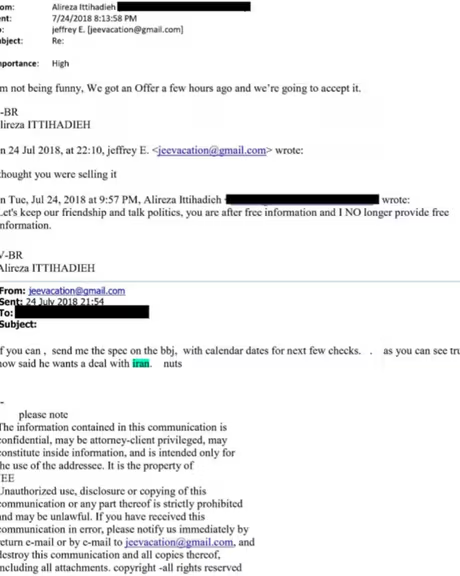
In an email dated July 2018, the tone of the correspondence changed. Epstein requested technical information about a Boeing business jet, asking Ittihadieh for detailed specifications and maintenance schedules.
In the same message, Epstein referred to Trump’s statements expressing interest in reaching a deal with Iran, describing the approach as “madness.”
Ittihadieh responded by writing: “Let’s keep our friendship and talk politics, you are after free information and I NO longer provide free information.”
In later exchanges, when Epstein inquired about the sale of a jet, Ittihadieh replied that another offer had been received and that accepting that offer was likely.
Arms trading and covert networks
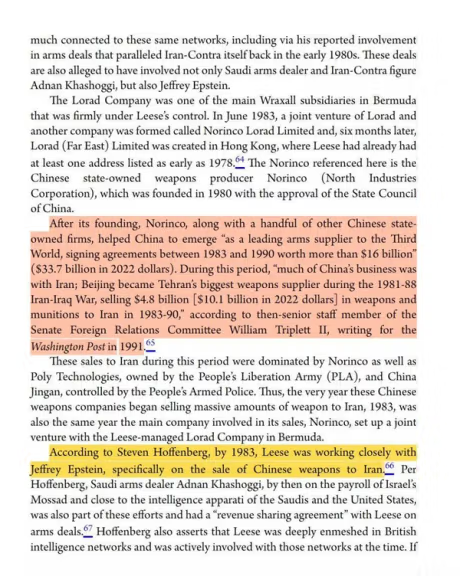
In recent days, images circulating on social media have highlighted passages from a book alleging Epstein’s involvement in arms sales to the Islamic Republic during the Iran-Iraq war.
The excerpts come from pages 20 and 21 of the second volume of the book A Nation Under Blackmail, published in 2022.
According to the book, Epstein’s connections with Iran date back not to the final years of his life, but primarily to the 1980s and 1990s, involving covert activities in arms trafficking, money laundering, and intelligence networks.
This period coincided with the Iran-Iraq war and secret operations such as the Iran-Contra affair.
According to statements by Steven Hoffenberg, a former close associate of Epstein, Epstein received training in the early 1980s under Sir Douglas Leese, whom Hoffenberg described as instructing Epstein in arms smuggling, the creation of shell companies, and money laundering.
Hoffenberg has said that by 1983, Epstein was directly involved in the sale of Chinese weapons to Iran through the state-owned company Norinco, at the height of the Iran-Iraq war.
Parallel operations and the role of BCCI
Hoffenberg claims these activities were carried out as part of an operation running “in parallel” with the Iran-Contra affair. According to this account, Epstein, Douglas Leese, and Adnan Khashoggi, the well-known Saudi arms dealer, worked together in these dealings.
Under this narrative, financing and money transfers relied heavily on the services of the Bank of Credit and Commerce International (BCCI), which was later shut down amid revelations of widespread money laundering, covert financing operations, and links to intelligence services in several countries.
Links to Israeli intelligence networks
In another account, Ari Ben-Menashe, a former Israeli intelligence officer, has claimed that Robert Maxwell, the British-Czech media tycoon and owner of the Mirror Group, sought to involve Epstein in the transfer and sale of military equipment and weapons from Israel to Iran as part of intelligence operations.
According to Ben-Menashe, Epstein was frequently present at Maxwell’s London office during that period and maintained close ties with this network, connections that have surfaced repeatedly in later accounts and documents.
Iran-linked property in Manhattan
Epstein’s name has also been linked to Iran in the real estate sector.
According to available records, he leased a mansion on East 69th Street in Manhattan starting in 1992. The property had previously served as the residence of Iran’s consul general in New York.
The building, often described as a “small castle,” was seized by the US government in 1980 following the 1979 Iranian revolution and the severing of diplomatic relations between Tehran and Washington.
During the tenure of Secretary of State James Baker, the US State Department leased the property to Epstein for a monthly rent of 15,000 dollars. The department later sued Epstein for subleasing the mansion to others for 20,000 dollars per month.
First Appeared on
Source link






