



Why that menopausal fat really WON’T budge: Medical condition that affects women sees weight pile on ‘seemingly overnight’ – but hope IS at hand. Here’s how to shift it
When Doja Cat recently revealed she believes she may have lipoedema, thousands of women flooded her comment section saying: ‘Wait. Me too.’
In a candid TikTok video, the singer explained she had long assumed the changes in her body were down to cellulite or natural body shape – before discovering there could be a medical explanation behind the disproportionate fat around her thighs, knees and calves.
And she’s far from alone. Other A-listers like Kelly Clarkson and Josie Gibson have shared similar struggles, while specialists estimate millions of women may be struggling in silence.
Despite this, lipoedema remains one of the most misunderstood (and misdiagnosed) conditions in women’s health. For many, it’s dismissed as weight gain, leaving sufferers frustrated and often in significant pain.
Mr Michael Mouzakis is an expert in the treatment of lipoedema
So we spoke to Mr Michael Mouzakis, Consultant Plastic Surgeon at The Private Clinic, who detailed what all women should know about the condition – and the treatments that can really make a difference in improving both the appearance and feel of lipoedema.
What exactly is lipoedema and how is it different from normal fat?
‘Lipoedema is a chronic and often progressive condition characterised by a symmetrical buildup of adipose tissue [body fat], typically in the legs and sometimes the arms, while the hands and feet remain unaffected,’ explains Mr Michael Mouzakis.
In other words, this isn’t simply ‘stubborn fat’ that won’t budge. The distribution is specific, often leaving the upper body relatively slim while the lower body appears disproportionately larger. Crucially, it doesn’t respond in the same way to diet and exercise – which is where much of the confusion begins.
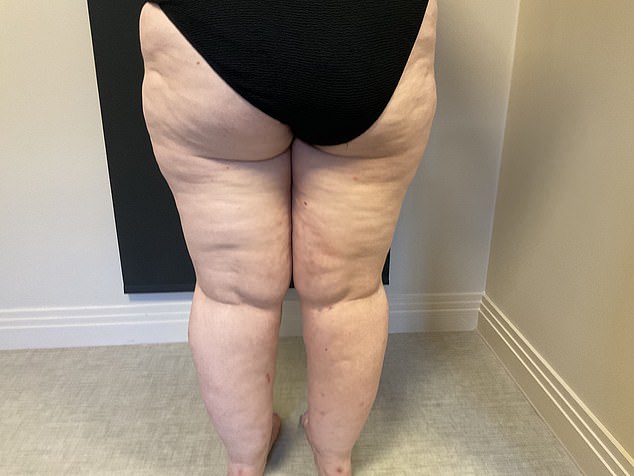
Lipoedema is a condition that causes an abnormal distribution of fat
How common is lipoedema and why are so many women misdiagnosed?
For a condition that can affect up to 1 in 10 women, awareness remains surprisingly low.
‘It is far more common than many realise, with some estimates suggesting it impacts up to 11% of the female population, yet it remains frequently misdiagnosed as standard obesity or lymphedema, which has similar appearance but is a distinct medical disorder,’ Mr Mouzakis says.
He explains that this misdiagnosis isn’t accidental. ‘This oversight often stems from a lack of clinical awareness and the systemic bias that assumes weight gain is always a result of lifestyle choices rather than a complex medical pathology.’
The result? Women are often told to simply lose weight – advice that can feel both ineffective and deeply frustrating, given it won’t work in resolving the underlying issue.
What are the key symptoms women should be looking out for?
While lipoedema can look different from person to person, there are several common signs. ‘Key symptoms to watch for include a distinct heaviness or tenderness in the limbs, easy bruising, and a noticeable disproportion between a narrow waist and larger lower body,’ Mr Mouzakis explains.
It’s not just about appearance, either. ‘Patients often describe the fat as appearing and feeling painful, spongy or nodular under the skin.’ This combination of physical discomfort and visible change is often what leads women to seek answers – even if it takes years to get a diagnosis.
What causes lipoedema and why does it almost exclusively affect women?
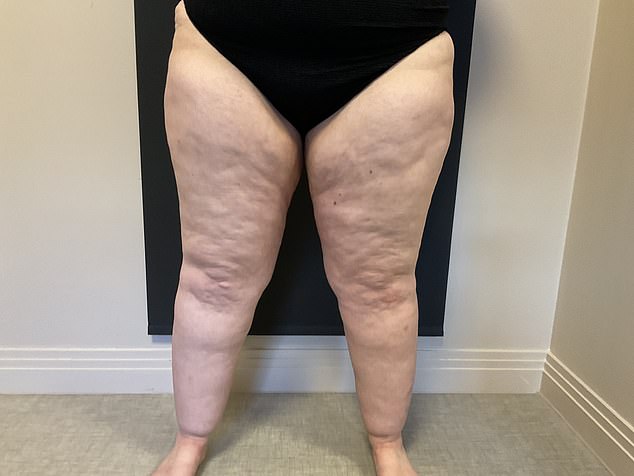
Patients often describe the fat as appearing and feeling painful, spongey or nodular
The exact cause is still being studied, but hormones appear to play a central role.
‘While the exact cause remains under investigation, there is a strong genetic component, and the condition is almost always triggered or exacerbated by hormonal shifts like puberty, pregnancy, or menopause,’ he says.
‘This hormonal link explains why it almost exclusively affects women, as the female endocrine system plays a primary role in how this specific type of fat is stored and regulated.’
What impact can lipoedema have on physical and mental health?
For those living with the condition, it can be life-altering. ‘The impact of lipoedema is profound, spanning both physical mobility issues and significant mental health challenges, including body dysmorphia and chronic frustration,’ Mr Mouzakis says.
Beyond the physical discomfort, many women report feeling dismissed or misunderstood – particularly when their symptoms are attributed solely to weight. Over time, this can take a toll on confidence, self-image and overall wellbeing.
What is it like to live with lipoedema?
For one patient at The Private Clinic, 21-year-old Ellie, the signs of her condition were present from a young age. ‘I first struggled with lipoedema when I was in school. I didn’t know I had it, but I knew I had legs that were different from all my friends,’ she says.
It was only after a chance comment during a massage treatment that she began to investigate further.
‘I had a massage lymphatic drainage, and the woman there said, you need to get your legs checked out. She said, “There’s something wrong.”’
After researching online, she sought a diagnosis. ‘I saw Mr Mouzakis, and he said, straight away, you definitely have it.’ Following treatment, she says the difference has been transformative. ‘I just feel so much better… the quality of my life now has improved so much.’

Ellie’s lipoedema was significantly improved by a three-stage treatment
What treatment options are available in the UK?
While there is currently no simple cure, treatment options are becoming more advanced.
‘As Mr Michael Mouzakis, I have dedicated my practice to providing a specialised surgical solution through my unique CORE pathway: Clinical diagnosis optimisation, radical fat harvesting with Vaser Microaire and RF (radiofrequency energy) for skin tightening and Endure maintenance,’ he explains.
In simple terms, he’s describing a multi-step, highly specialised approach to treating lipoedema – rather than a one-size-fits-all procedure. ‘Clinical diagnosis optimisation’ means taking the time to properly assess and confirm the condition, ensuring patients are correctly diagnosed before any treatment begins.
‘Radical fat harvesting’, meanwhile, refers to the surgical removal of the diseased fat tissue associated with lipoedema – not just standard fat, but the painful, fibrous fat that defines the condition.
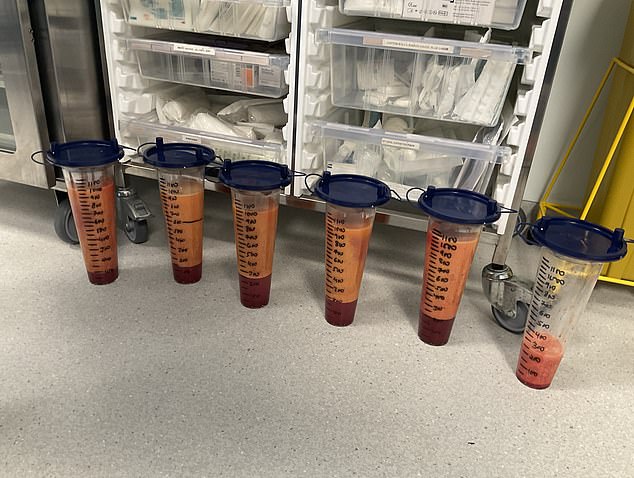
The painful fat removed during Ellie’s procedure
‘Vaser uses ultrasonic energy to gently shake the fat cells loose while preserving the vital lymphatics and blood vessels, while Microaire involves power-assisted cannulas that allow for the precise, “radical” removal of the fibrous, painful lipoedema tissue.’
And importantly, it also considers the final result. ‘When we combine this with RF, or radiofrequency energy, we can tighten the skin internally to ensure the limbs look as healthy as they feel.’
What are the biggest myths about lipoedema?
Perhaps the most damaging misconception is also the most persistent. ‘We need to move beyond common myths, such as the idea that lipoedema is the patient’s fault or that it can be “cured” with simple weight loss,’ Mr Mouzakis says. He says his message to women affected by the disorder is: ‘It’s not your fault, but it’s your journey, and we are here for you.’
It’s also important because if left untreated, lipoedema can lead to significant pain, reduced mobility and a secondary condition, lipo-lymphedema. This is when fat can block lymphatic vessels, which leads to increased swelling, skin hardening, and higher risk of infections.
First Appeared on
Source link






