


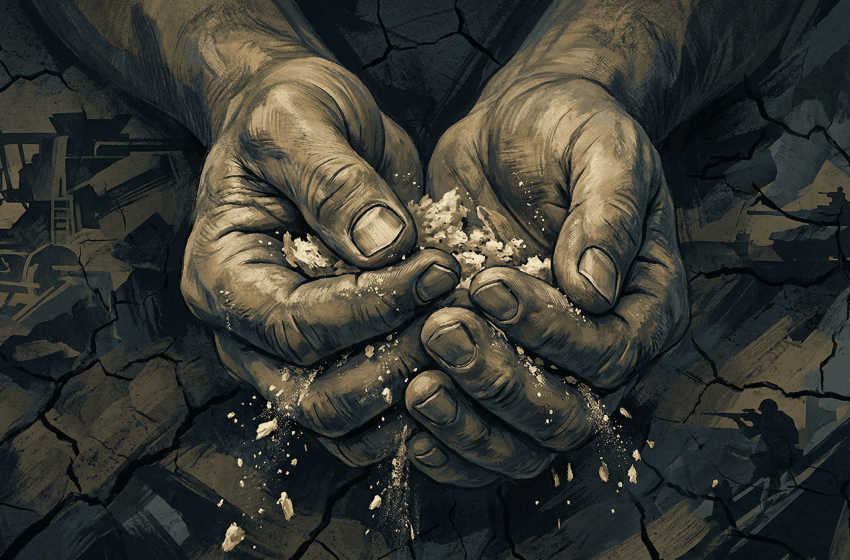
Why The War in Iran Could Trigger the Worst Global Food Crisis Since the 1970s
The rockets falling in the Middle East are sending shockwaves straight to your dinner plate. When the U.S.-led military intervention in Iran escalated, most expected an energy crisis. They watched the oil markets and the gasoline pumps. And indeed prices have soared, with the Brent barrel hovering at around $105 and U.S. gas prices topping $4 for the first time since 2022.
But the real casualty of this war may be far more insidious, and it starts in the soil.
Our modern food system is based on a foundation of natural gas, and now that foundation is cracking. It’s becoming clearer as the war drags on that the world is bound to face a historic global fertiliser shortage. With the Strait of Hormuz restricted by the Iranian military, shipments of critical agricultural chemicals have effectively stopped.
The result is a cascading failure across the global supply chain. This bottleneck is pushing food prices toward record highs not seen since the 1970s energy crisis, threatening millions of people with severe food insecurity.
“The potential is there for this to develop into a major crisis for poor and hungry people,” says Matin Qaim at the University of Bonn in Germany, speaking to New Scientist.
The Fertilizer Global Bottleneck
Why does a war in the Persian Gulf dictate the price of bread in London or corn in Iowa? To feed eight billion people, we rely on nitrogen fertilizers. Manufacturers forge these fertilizers by reacting atmospheric nitrogen with hydrogen. They get that hydrogen, and the massive amounts of power required for the reaction, directly from natural gas.
Although the region is not famous for its fertile fields, the energy-rich Middle East is a kingmaker in global agriculture. Nearly a third of the world’s fertilizer ships through the Strait of Hormuz. Qatar alone produces 15% of the global supply of urea — a solid, easily transportable nitrogen fertilizer — and controls a staggering 50% of internationally traded urea.

Today, almost none of that urea is moving. In fact, the Iran conflict has destabilised major trade flows during a time when many countries were already under major geopolitical strain, particularly amplified by the Trump Administration’s trade wars.
“It is no secret that the world trading system is experiencing the worst disruptions in the past 80 years,” Ngozi Okonjo-Iweala, the director-general of the World Trade Organization, told the New York Times.
The disruptions are halting production elsewhere, sometimes thousands of miles away from Tehran. Countries like India, Bangladesh, and Pakistan normally produce their own fertilizer using imported Gulf gas. Without that gas, their factories are going dark.
The stakes of this chemical bottleneck are existential, especially for the world’s poor.
“If we stopped using mineral fertiliser completely worldwide, we would probably see half of the world starving,” Anthony Ryan at the University of Sheffield, UK, explained to New Scientist.
Priced Out of the Market
The crisis is hitting agricultural heartlands with brutal speed. During the crucial spring planting season, farmers have suddenly found themselves priced out of the materials they need to grow our food.
Since the war began, the price of urea has spiked by 50%, and ammonia by 20%. Diesel fuel, which powers the tractors and transport trucks moving food to market, has surged by 60%.
In the United States, the pain is acute. The U.S. relies on imports for about half of its domestic urea consumption. Overall, the US imports about 25% of its total fertilizer use, including 18% of its nitrogen use, says the American Farm Bureau.
Farmers in the Midwest’s Corn Belt — who grow nitrogen-hungry corn — are absorbing devastating costs. That’s after they had to suffer major fertilizer price hikes in the past five years.
“With crop economics as bad as they are right now, it doesn’t take much to destroy (a farmer’s) income statement,” said Philip Coffin, independent grain industry analyst, according to The Guardian.
An Impossible Choice
Chris Abbott, chief executive of agricultural product maker Pivot Bio, told the New York Times that this crisis is striking at the worst possible moment. “This is hitting at an already difficult time,” he said, noting that the ratio of fertilizer costs to grain prices sits at a level unseen in generations.
Even before the bombs started falling, American farmers were bleeding cash. Agricultural bankruptcies surged by 46% in 2025. Before the recent price shocks, soybean farmers were already facing losses of $138 per acre, and corn farmers were losing $230 per acre.
Now, with input costs skyrocketing, farmers face an impossible choice: plant at a massive loss, switch to less nutrient-intensive crops, or plant nothing at all.
Deepika Thapliyal, a fertilizer specialist at Independent Commodity Intelligence Services, warned about the inevitable outcome. “It’s inevitable that food prices will go up,” she said.
Speaking to New Scientist, Qaim offered more specific forecasts: “If fertiliser prices double, then it could easily be that food prices increase by 20 to 30 percent.”
A New Geopolitical Weapon
We saw a preview of this disaster four years ago. When Russia invaded Ukraine in 2022, global agriculture suffered a massive shock. The war in Eastern Europe pushed global food prices to all-time nominal highs that year, delaying the recovery of global agriculture markets from shocks brought by the Covid-19 pandemic in 2020 and increasing food prices in many countries around the world, putting the cost of staple foods and more nutritious foods out of reach.
But that conflict largely caused bottlenecks in the outputs, such as Ukrainian wheat, corn, and sunflower oil. The Iran war is trapping the inputs. It is destroying the ability to grow crops in the first place, shifting more power into the hands of a few autocratic nations.
With the Middle East paralyzed, Russia and Belarus now hold immense leverage over global agriculture. Russia remains the world’s largest exporter of fertilizer, though Ukrainian drone strikes last week on facilities like the Ust-Luga port have hampered its production.
Meanwhile, China, another major producer, has severely restricted its fertilizer exports to protect its own domestic food security.
The Trump administration has scrambled to alleviate the pressure, even lifting sanctions on fertilizer sales from Belarus and Venezuela. But Venezuela’s neglected infrastructure makes rapid production impossible.
The Biofuel Trap and Climate Chaos
If fertilizer is scarce, shouldn’t we prioritize every calorie we grow to feed human beings? We aren’t. In fact, we are literally burning some of our food.
More than 5% of all food calories grown globally are transformed into biofuels to power vehicles. In the United States, roughly one-third of the entire corn crop becomes bioethanol.
“We’re burning about 15 million loaves of bread in Europe every day for biofuels,” Paul Behrens at the University of Oxford told New Scientist. “This is a crazy way to produce energy.”
Instead of releasing this food into the market to stabilize grocery bills, governments are moving in the exact opposite direction. The U.S. and Australia are pushing to increase the proportion of bioethanol in gasoline, hoping to bring down the cost of driving.
However, burning more food into fuel barely dents the price of gas, and has a disproportionate effect on the grocery store.
Looming over this entire logistical nightmare is the ultimate threat multiplier: climate change. Global warming is already suppressing crop yields through extreme heat, supercharged storms, and historic floods.
“There’s a lot of potential for this to spin out of control and lead to a just as severe, if not a worse, crisis,” Jennifer Clapp at the University of Waterloo told New Scientist. “If we have major climate events, it could definitely spiral into something much more severe.”
Engineering a More Resilient Food System
History provides a dark warning about what happens next. A poor harvest in 1788 in France dramatically increased food prices, generating unrest and contributing to the outbreak of the French Revolution. The wave of social unrest that hit Europe in 1848 was certainly linked to ideas which laid the foundations for the upheavals, but the simultaneous and regional spread of events seems rather to be attributable to the failed harvests of 1845–1846 and the potato blight of 1847 that triggered a general eruption of discontent.
More recently, empirical studies indicate that between January 1990 and January 2011, food price increases have led to increased political unrest, whereas food price volatility has been associated with decreases in political unrest.
“Every time that we’ve seen a food price spike in the past, you see this instability,” Behrens said, pointing to the very real threat of social unrest as populations go hungry.
Engineering ourselves out of this crisis, in the event the war prolongs, is possible but rather implausible at this point. For instance, it’s possible to make “green” ammonia by creating hydrogen via water electrolysis powered by renewables, then combining it with nitrogen from the air using the Haber-Bosch process. However, such a tech reconfiguration requires a lot of time, capital, and political will. But perhaps this is a good time to get the ball rolling so the next fossil fuel energy crisis doesn’t catch us with our pants down again.
The same could be said about the way we farm. Modern agriculture wastes staggering amounts of fertilizer, letting it wash into rivers or vaporize into nitrous oxide, a potent greenhouse gas. Shifting our diets away from grain-fed meat and toward legumes and beans, which fix their own nitrogen straight off the roots.
First Appeared on
Source link







