


Why you must sign up NOW for Trump’s $1,000 kids accounts even if you don’t have a penny to put in them
Washington doesn’t usually give away money with no strings attached – but that is what the new ‘Trump Accounts’ created under July’s tax overhaul are offering American families.
Buried inside the One Big Beautiful Bill is a provision that gives eligible children a $1,000 government-funded investment account.
But families do not receive it automatically. Parents must opt in when filing their federal tax return. If they do not make the election during tax season, the $1,000 will not be deposited.
An online portal is expected to launch by summer 2026, but for now tax season is the key moment to act.
The government sends the $1,000 directly to a participating provider – which could be a bank like Chase or Wells Fargo, or a brokerage such as Fidelity and ETrade – which then opens an account in the child’s name.
And for some families, that initial deposit may be just the beginning of the free money. Several mega-wealthy donors have pledged billions to support the program.
Michael Dell – the founder of the computer giant that bears his name – promised $6.25billion to fund accounts for 25 million under 10s. Ray Dalio – founder of Bridgewater, the world’s biggest head fund – pledged $75 million to support more than 300,000 children in Connecticut.
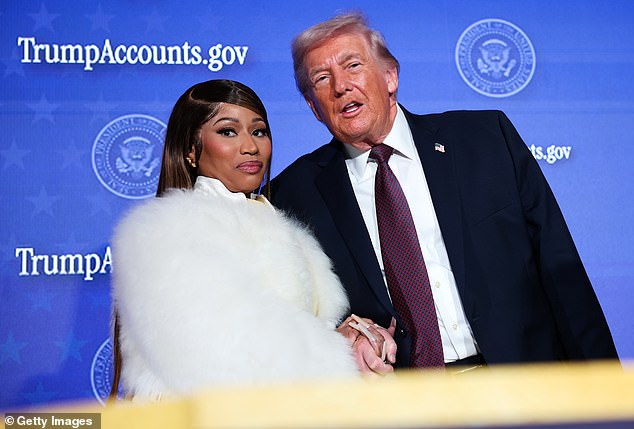
Rapper Nicki Minaj appeared with President Donald Trump during the program’s launch and said she would offer hundreds of thousands of dollars for the children of her fans.
President Trump was joined on stage by Nicki Minaj who pledged to provide contributions for the children of her fans.

Parents must opt in when filing their federal tax return. If they do not make the election during tax season, the $1,000 will not be deposited (stock image)
In addition, dozens of big businesses, including Bank of America and IBM, have pledged matching contributions for staff who enroll their children.
Families can also add their own money – up to $5,000 per year – until the child turns 18.
At that point, the child takes control of the account. They can withdraw the funds or keep them invested on a tax-deferred basis, similar to a retirement savings account.
‘I think this is a great vehicle,’ Derek Reisfield, co-founder and original chairman of MarketWatch, told the Daily Mail. ‘When you start investing at birth, you are giving that money decades to grow. That is incredibly valuable.’
He added that families who can afford to contribute should strongly consider doing so – especially if their employer offers matching funds.
The Trump Accounts website promotes eye-catching projections about what long-term investing could achieve.
Under its most aggressive example, a family contributing the maximum $5,000 a year, on top of the initial $1,000, could see the balance swell to as much as $13 million by age 55.
The website points out: ‘Estimates are for illustration only, and are based on an account opening at birth with $1,000 opening deposit and are derived from historical S&P 500 averages. Actual results may differ and are not guaranteed.’
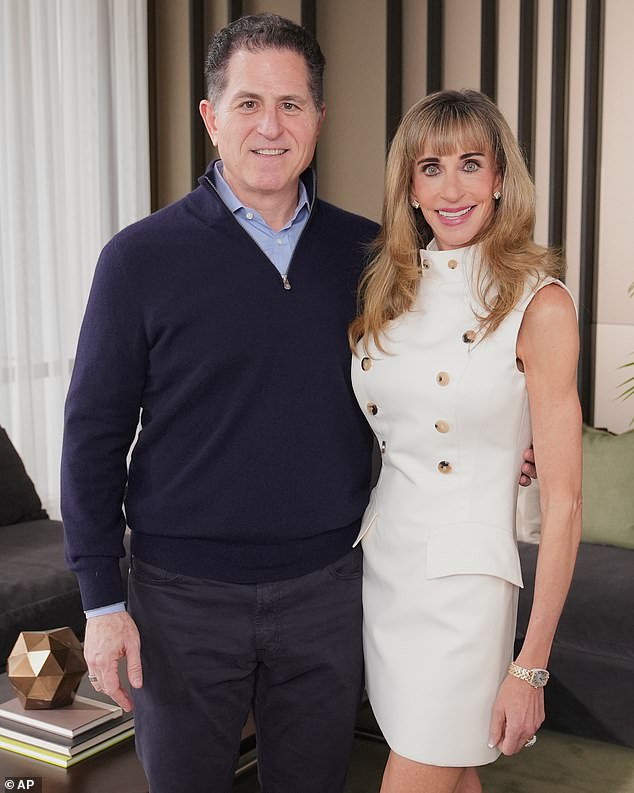
Michael Dell (left) – the founder of the computer giant that bears his name – promised $6.25billion to fund accounts for 25 million under 10s. Dell is pictured alongside his wife Susan
But it is not far-fetched. It relies on a powerful force in finance: compound interest. It also counts on the US stock market continuing its stellar performance.
Daily Mail analysis shows the example assumes annual returns of roughly 10.5 per cent, close to the S&P 500’s average over the past 50 years.
There is no guarantee markets will deliver that performance over the next half century.
Reisfield ran a more conservative scenario and still found the results compelling, thanks to what he called ‘the miracle of compound interest’.
‘If you contribute $5,000 a year and it grows at 6 per cent, by age 55 I get about $1.36million,’ he said.
In simple terms, compound interest means you earn returns not just on the money you put in, but on the growth from previous years as well. Over time, those gains begin generating gains of their own.
In the early years, growth appears modest. But as decades pass, the compounding effect accelerates.
By middle age, the account can snowball far beyond the original contributions.
Even families who never add another dollar after the initial $1,000 deposit would still benefit from decades of compounding.
Coming back to the projections on the official website, the original $1,000 could grow to about $6,000 by age 18, $15,000 by age 27 and roughly $242,000 by age 55.
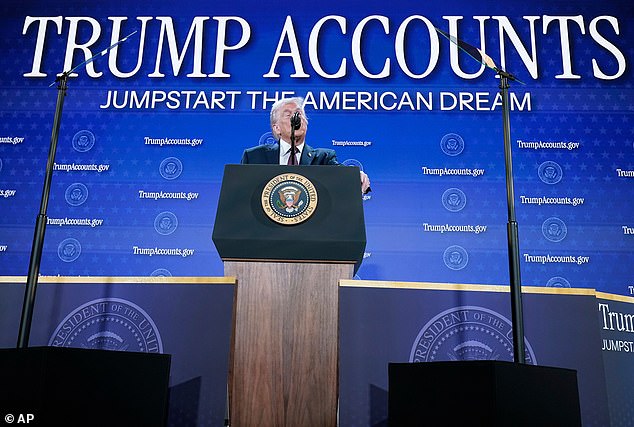
President Donald Trump launched the Trump Accounts campaign on Wednesday, January 28, 2026
Experts say the most important step is enrolling in the first place – and that moment comes when filing your tax return.
In the frequently asked questions for kids, the website notes: ‘Once you start earning income, you can make contributions to your own account. This is a great way to develop good savings habits early in life.’
Experts are clear that any amount of saving is better than nothing, especially as Americans increasingly carry credit card debts rather than assets.
‘We need to emphasize saving more and more in America,’ Reisfield said. ‘So, I think this is fantastic – especially if companies are going to contribute as part of an employee benefit.’
First Appeared on
Source link






