


Windows 11 KB5077241 update improves BitLocker, adds Sysmon tool
Microsoft has released the KB5077241 optional cumulative update for Windows 11, which comes with 29 changes, including improvements to BitLocker, a new network speed test tool, and native System Monitor (Sysmon) functionality.
KB5077241 is a preview update delivered at the end of each month that allows admins to test Windows bug fixes, new features, and improvements before they’re generally available during next month’s Patch Tuesday release. However, unlike Patch Tuesday cumulative updates, monthly non-security preview updates do not include security fixes and only roll out quality improvements.
With the February 2026 optional update, Microsoft has improved BitLocker reliability, ensuring devices no longer freeze after entering the recovery key, and introduced a built‑in network speed test for Ethernet, Wi‑Fi, and cellular connections in the Windows taskbar, which can be opened from the Wi‑Fi or Cellular Quick Settings, or by right-clicking the network icon in the system tray.

It also added an option to open a new File Explorer instance by holding down the Shift key or the middle mouse button, improved reliability when PCs wake from sleep, and reduced the time it takes for a PC to resume from sleep, especially under heavy load.
Additionally, this month’s optional update introduces native System Monitor (Sysmon) functionality (disabled by default) and automatically turns on Quick Machine Recovery (QMR) on Windows Professional devices that aren’t domain‑joined and aren’t enrolled in enterprise endpoint management.
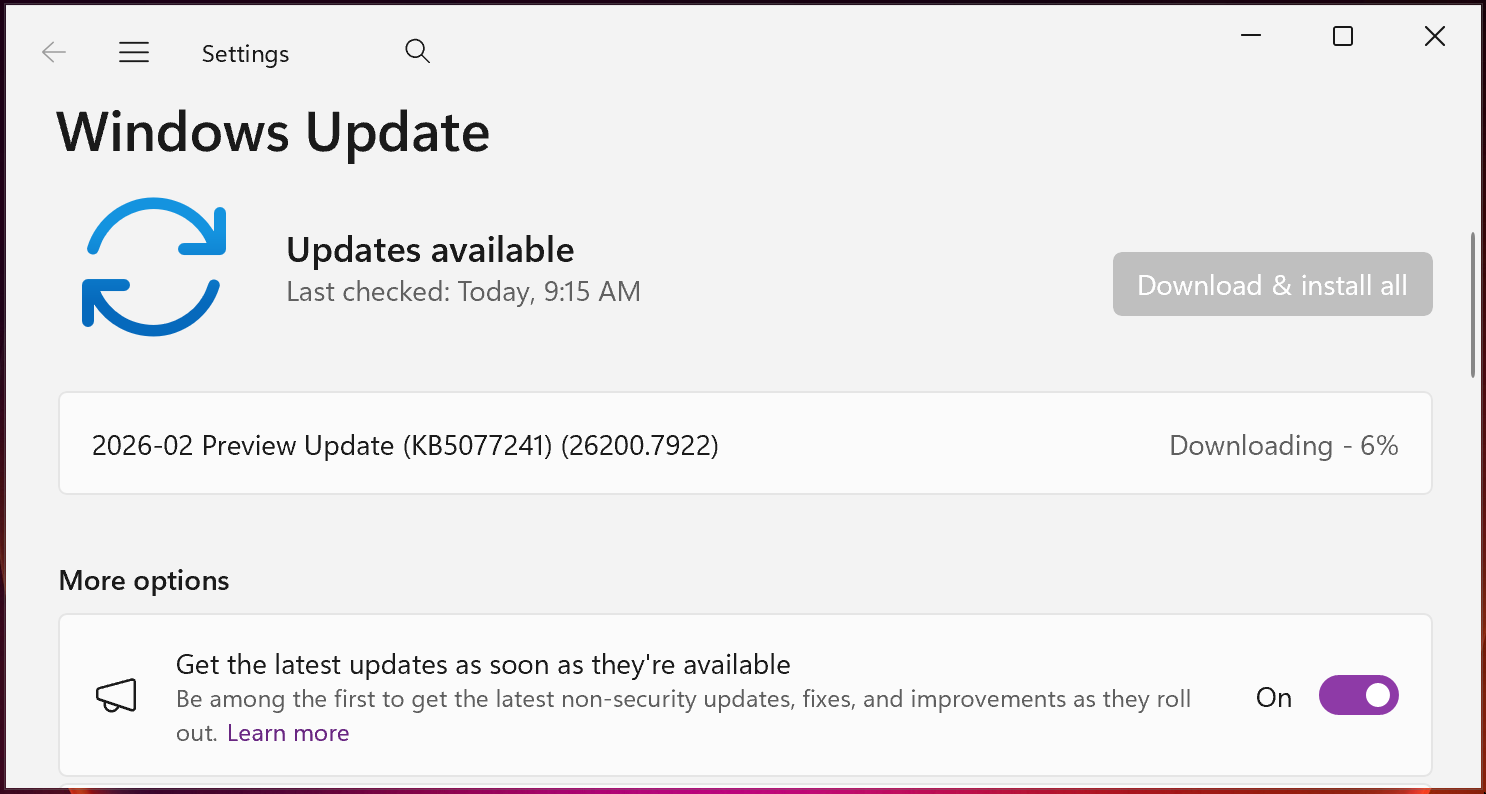
You can install KB5077241 by opening Windows Settings, clicking on Windows Update, and then on ‘Check for Updates.’ Since this is a preview update, you will be prompted to install it by clicking the ‘Download and install’ link. However, you can also manually install this update after downloading it from the Microsoft Update Catalog.
Windows 11 KB5077241 highlights
Once installed, this optional non-security update will update Windows 11 25H2 and 24H2 devices to builds 26200.7922 and 26100.7922, respectively.
The February 2026 preview update comes with further improvements, some of the more important ones highlighted below:
- Improved: When the taskbar is set to uncombined, and you have an app open with multiple windows, they no longer all move as a set to the overflow area when there is not enough space on the taskbar. Only the windows that don’t fit move to the overflow menu. This change prevents the overflow menu from appearing with a large unused space.
- [Desktop Background] New! You can set WebP (.webp) images as your desktop background from Settings > Personalization > Background, or by right‑clicking the image in File Explorer.
- [Remote Server Administration Tools (RSAT)] New! This update adds support for Remote Server Administration Tools (RSAT) on Windows 11 Arm64 devices. IT administrators can now install and use tools such as Active Directory Domain Services and Lightweight Directory Services Tools, Active Directory Certificate Services Tools, Server Manager, Group Policy Management Tools, DNS Server Tools, and DHCP Server Tools. These tools are available as optional features and can be installed through Settings > System > Optional Features or from Control Panel > Programs > Turn Windows features on or off.
- [Windows Update Settings] Improved: Responsiveness of the Windows Update settings page.
Microsoft also added that a redesigned Start menu introduced with the October 2025 non-security update (KB5067036) is gradually rolling out to Windows devices, with more PCs receiving this updated Start menu experience over time.
The company is also still pushing updated battery icons to more Windows devices to make it easier to see the current battery status at a glance, a feature that also started rolling out in October 2025.
It also noted that updated Secure Boot certificates are rolling out to replace the original 2011 certificates that will expire in late June 2026. Microsoft first revealed in January that it plans to refresh expiring Secure Boot certificates on eligible Windows 11 systems, following a November alert that warned admins to update the security certificates before they expire.

Modern IT infrastructure moves faster than manual workflows can handle.
In this new Tines guide, learn how your team can reduce hidden manual delays, improve reliability through automated response, and build and scale intelligent workflows on top of tools you already use.
First Appeared on
Source link






