


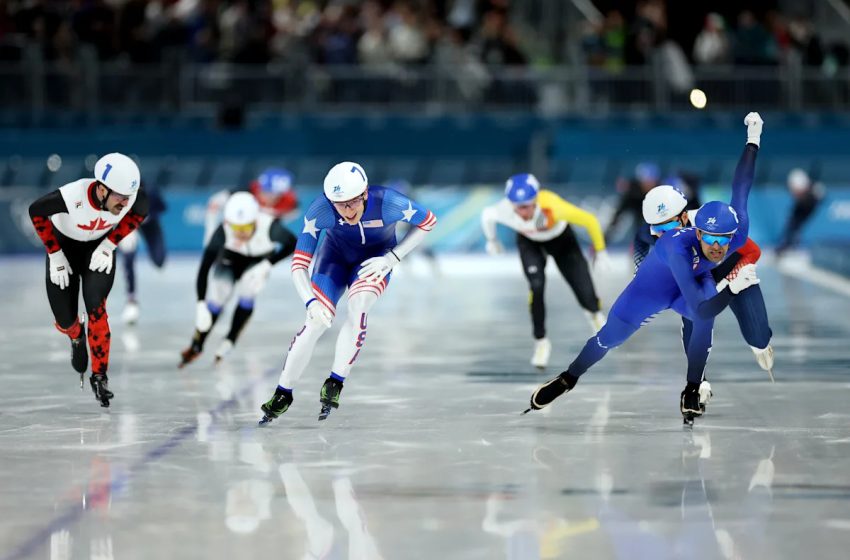
Winter Olympics 2026: Jordan Stolz barely misses podium in chaotic mass start
MILAN — The final race of Jordan Stolz’s Olympics did not play out the way he hoped it would.
It wasn’t even just that Stolz came up empty in his bid for a fourth medal at these Olympics. The American speedskating phenom never even really had the chance to race for gold in the mass start — the most chaotic, unpredictable race in speed skating.
Advertisement
Jorrit Bergsma of the Netherlands took gold and Viktor Hald Thorup of Denmark grabbed silver after they broke away from the rest of the pack early in the 16-lap race. They extended their lead to as much as 20 seconds, taking advantage of the other skaters trying to conserve energy for a furious finish.
By the time Stolz attacked with less than three laps to go, the gap between him and the leaders was so massive that he was essentially racing for third place. Bergsma clocked a winning time of 7:55.50, nearly five seconds ahead of Thorup. Italy’s Andrea Giovannini outsprinted Stolz for third, both of them finishing about nine seconds after Bergsma.
When asked why he didn’t attack sooner, Stolz explained, “If I would have done that, I would have had no legs left at the end of the race.”
Stolz spent much of the middle third of the race idling near the front of the chase group, waiting for others to help pursue the leaders. When other medal contenders didn’t take the initiative to accelerate and pass him, he felt as though they were trying to neutralize his explosive finishing kick and were unwilling to share in the work.
Advertisement
“I actually didn’t expect this to happen,” Stolz said. “I felt like the gold-medal favorites in the mass start were going to be more hungry to get a medal, but they all were just expecting me to go for it.
“If they’re all sitting behind me at four laps to go and I’m not really building the pace and the two guys in front just keep getting further and further ahead, that’s clear to me that they were just kind of settling for third.”
Had he won Saturday’s mass start event, Stolz would have become the first man since Norway’s Johann Olav Koss 32 years ago to leave an Olympics with three long-track speedskating gold medals. Entering the mass start, Stolz had already taken gold in the 500 and 1,000 meters before settling for silver in the 1,500.
Advertisement
Whereas long-track speedskaters are accustomed to racing against the clock, unencumbered by other competitors in their lane, the mass start is the outlier. The 16 athletes who qualified for Sunday’s men’s final started shoulder-to-shoulder and raced head-to-head for 16 laps around Milan’s 400-meter oval.
Race strategy during the mass start is most similar to a cycling track or road race. Athletes conserve energy early in the race and draft off each other to reduce wind resistance, but they must be prepared to unleash a lethal finishing sprint over the final lap or two to have any hope of winning a medal.
When asked to look ahead to the mass start earlier this week, Stolz acknowledged the threat of getting taken out by another competitor jockeying for position around a turn. He said he hoped to “try and defend myself in the group” because “there will be a lot of shoving.”
Winning three medals on an Olympic stage is Stolz’s most remarkable accomplishment yet on a journey that began with watching the charismatic Apolo Anton Ohno at the Vancouver Games 16 years ago. Stolz has chased Olympic glory ever since, going from learning to skate on his family’s backyard pond at age 5, to winning his first U.S. title at 16, to snapping at the heels of the world’s fastest speedskaters soon after that.
Advertisement
Is Stolz happy with his Olympics despite falling short of his goal of four medals? He considers it to be “pretty successful.”
“There’s things that could have gone better,” Stolz said, “but two golds and a silver? You’ve gotta be pretty happy with that.”
First Appeared on
Source link






