


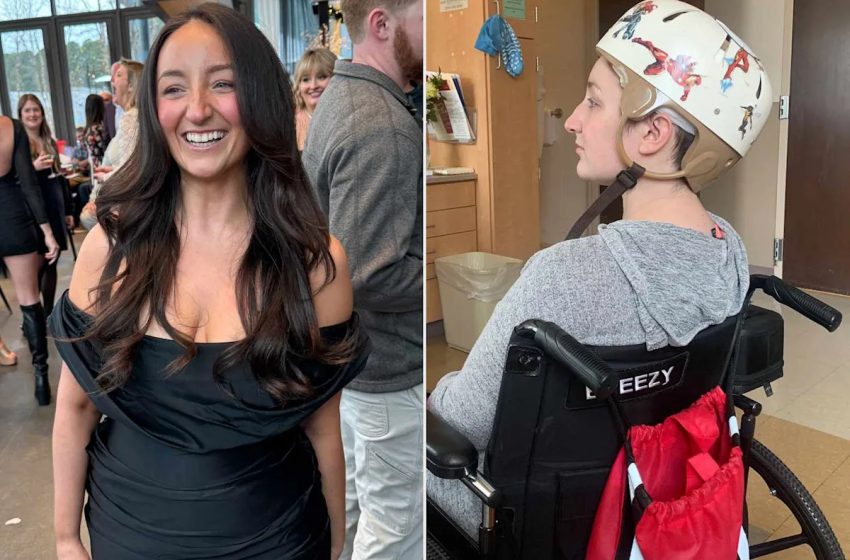
Woman, 25, Suffers ‘Heartbreaking’ Stroke One Month After Giving Birth, Had to Relearn How to Talk and Hold Her Baby (Exclusive)
NEED TO KNOW
-
Leen Lorig suffered a stroke at age 25 shortly after giving birth to her daughter, Lincoln
-
She underwent brain surgery, extensive rehab and had to relearn how to walk, talk and care for her children
-
Lorig, now 32, recently shared her story on TikTok and now hopes to raise awareness about strokes in young women and new mothers
In May 2019, then-25-year-old Leen Lorig gave birth to her daughter following what she would consider a pretty normal pregnancy.
Three weeks later, however, Lorig noticed rashes on her ankles and wrists, and says she had a hard time moving her joints.
“Everything became really stiff. I couldn’t hold my daughter, and I started getting these headaches,” she exclusively tells PEOPLE. “I went to the emergency room, and the doctor said, ‘I really think it’s Rocky Mountain spotted fever.’ “
According to the CDC, Rocky Mountain spotted fever (RMSF) is a severe, potentially fatal bacterial disease spread through the bite of an infected tick, often leading to a fever, headache and rash, among other symptoms.
The mother of two was given medication to treat RMSF on a Friday, and says she started to feel a bit better. However, that Monday, she woke up at 5 a.m. with what she describes as the worst migraine she had ever experienced. Despite taking medication, it wouldn’t go away.
Credit: Leen Lorig
At 7 a.m. that morning, after her then-husband left for work, Lorig went to her neighbor’s house and asked them to watch her kids while she called an ambulance. Instead, her neighbor’s mom watched her kids, and the neighbor drove her to the hospital.
When Lorig arrived at the hospital in North Carolina, a CT scan showed no abnormalities. She had a blood pressure of 178 and, as told to her by doctors, a resting heart rate of “an Olympic swimmer.”
“The cardiologist was like, ‘I really am not sure what’s going on right now. I see that you are being treated for Rocky Mountain spotted fever,'” she recalls.
While a specialist at the hospital agreed that she had all the symptoms of RMSF, they decided to run a few more tests. She tells PEOPLE that she had been there for a few hours before one of the nurses gave her some morphine for her migraine pain.
“At this point, my right arm was waving all over the place, and I didn’t have control of it,” she says. “I was reaching for my can of Sprite from the nurse, but I couldn’t touch it. I couldn’t grab it.”
It was then that she heard the nurse calling out what she now knows is the hospital’s code for a stroke.
“We’re going to have some friends come in and figure out what’s going on,” she remembers the nurse saying.
“A lot of doctors rush in, crash carts, so you get nervous. On the left side of my body, the phlebotomist was trying to take blood. They couldn’t find blood in my arm,” she says, remembering several doctors huddled in an “intense” conversation.
“The ER doctor looked at me and said, ‘Could you tell me your name?'” she recalls. “I said, ‘Caitlin.’ They got really quiet; that’s my sister’s name.”
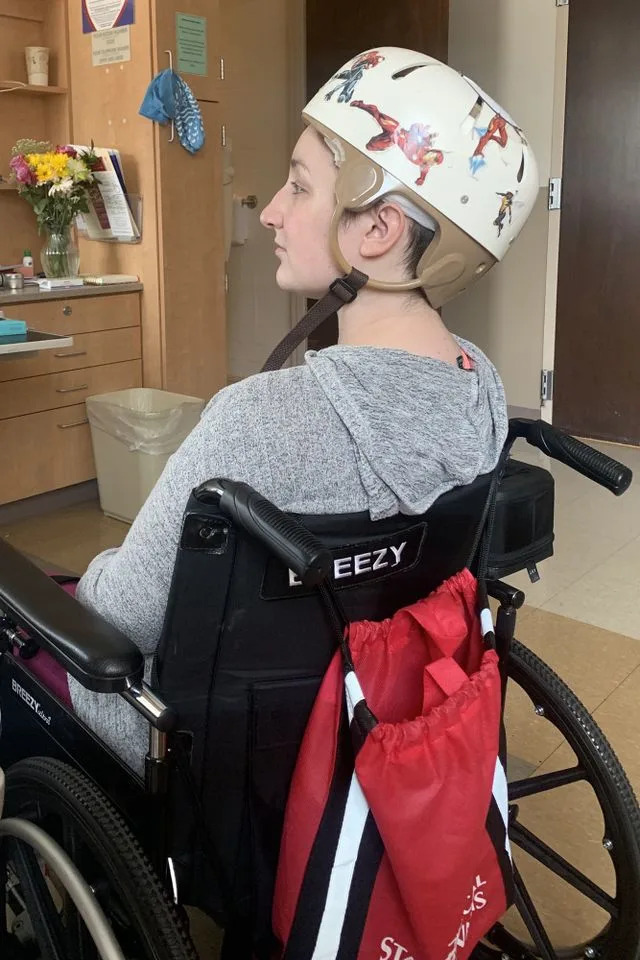
Credit: Leen Lorig
When the doctors asked Lorig if she knew where she was, she had no response.
“My face had completely drooped. When he asked me my name, the whole right side of my body went ice cold, and that was the moment I was having a stroke,” she says. “They took me to do another CT scan. I started getting really nauseous, and they pulled me into the CT scan. I was in there for about 20 seconds, and I started projectile vomiting, and they pulled me out. I woke up a week later.”
Doctors kept her “medically sedated” for a week and, during that time, they “did brain surgery to take out the AVM that they found.”
An arteriovenous malformation, also known as an AVM, “is a tangle of blood vessels that creates irregular connections between arteries and veins. This disrupts blood flow and prevents tissues from receiving oxygen,” per the Mayo Clinic. If an AVM in the brain bursts, “it can cause bleeding in the brain, which can lead to a stroke or brain damage.”
“That was finally on the CT scan, so there was a good amount of blood. It was a good amount of blood in my brain,” she says.
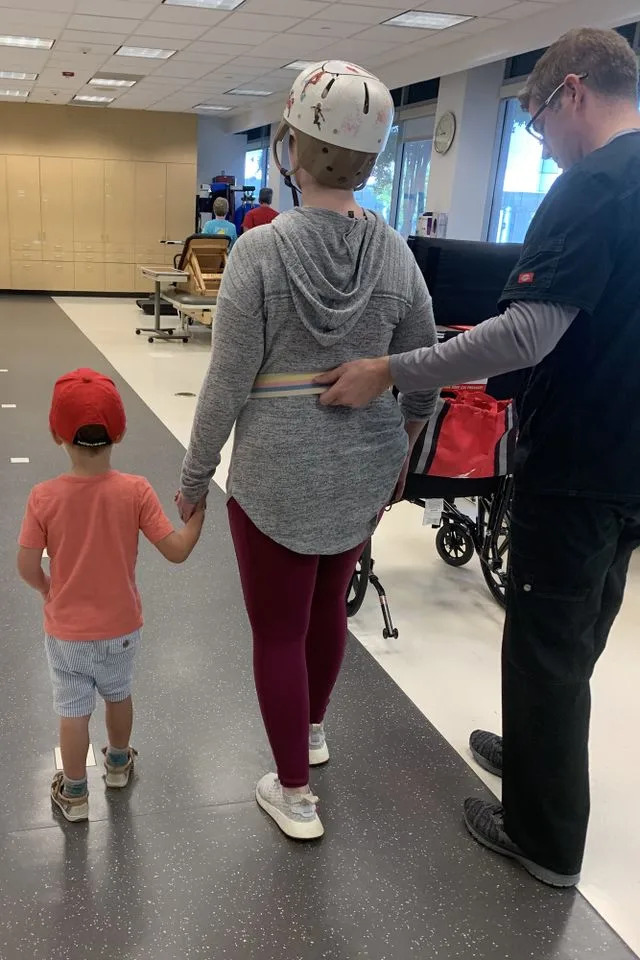
Credit: Leen Lorig
Lorig says doctors tried to wake her up to check on her functions several times, but she “would freak out every time.”
“When I finally woke up, I was medically cuffed to bed. I was intubated, and if you rip that out, that’s dangerous,” she shares.
“One time, I woke up to find no one around, and I was very confused, very scared. I was slapping my bed, and nurses came in and just buzzed out again. I was very confused,” she continues. “My neurosurgeon was yelling, ‘Leen, can you hear me?’ They don’t know which functions you lost or whether you can hear. The swelling was so bad from the surgery that it was assumed I was gonna have aphasia. They had taken all my left bone flap, so my skull was just in the freezer in the hospital for months.”
When they took out the intubation tube, the doctors told Lorig that her voice was going to sound different. When she tried to talk, she “sounded exactly like ET.” When she tried to form sentences, the only thing she could say was “I am, I am, I am, I am.”
“It was so frustrating. It was so confusing. The doctors said, ‘Okay, she has aphasia,'” she says. “Then I was able to say my daughter’s name, which is Lincoln, but I was only able to say Lincoln, and I felt like a toddler,” she continues.
“I had to relearn how to talk and write completely, and I could only see one side of a keyboard at a time. The right side of my body was paralyzed. I remember just being really frustrated in the ICU when I found out that I couldn’t move it.”
She was in the ICU for two weeks before she was moved to the rehab center attached to the hospital in July 2019. From there, she did rehabilitation therapy multiple times a day, with physical and occupational therapy and speech therapy. The whole process, she shares, was “heartbreaking.”
“It’s weird to go from a 25-year-old girl to your body just not working anymore,” she tells PEOPLE.
The doctors used a lift to carry her from her mattress to a chair beside her bed so she could have a “vacation” from being in bed all day, which she felt was the “most dehumanizing part,” as she was “crumpled up in a ball in this crane to take me to and from my bed.”
She also couldn’t shower for a month and one side of her hair was completely matted, as the other half had been shaved off for her skull removal surgery.
“I was so dirty and stinky. It was a dehumanizing experience, and it was no fault of anybody. I was a 25-year-old girl who had to wear this helmet, and I really hated it,” she says. “I remember my mom taking me to brunch, and I thought, ‘I’m in a helmet, in a wheelchair and these are all people that are my age, brunching, and I’m bald.’ “
While she notes that “it sounds so ridiculous that that’s what I was worried about,” she couldn’t help but look back on her seemingly normal life just months prior.
Lorig continued doing outpatient rehab throughout August 2019 before going “back to the hospital in late September” to “get my skull back.”
While she started “feeling like a human” again, there was “a regression because you’re dealing with swelling again.”
“In mid-October, I got to go home because I got to walk around with my kids,” Lorig shares.
The first time Lorig felt normal was on Halloween in 2019, when she dressed up as Dopey from Snow White and the Seven Dwarves and her daughter dressed as the titular princess.
“No one looked at me weird,” she shares.
Lorig kept going to rehab until 2021, around the same time she started sharing her story on TikTok.
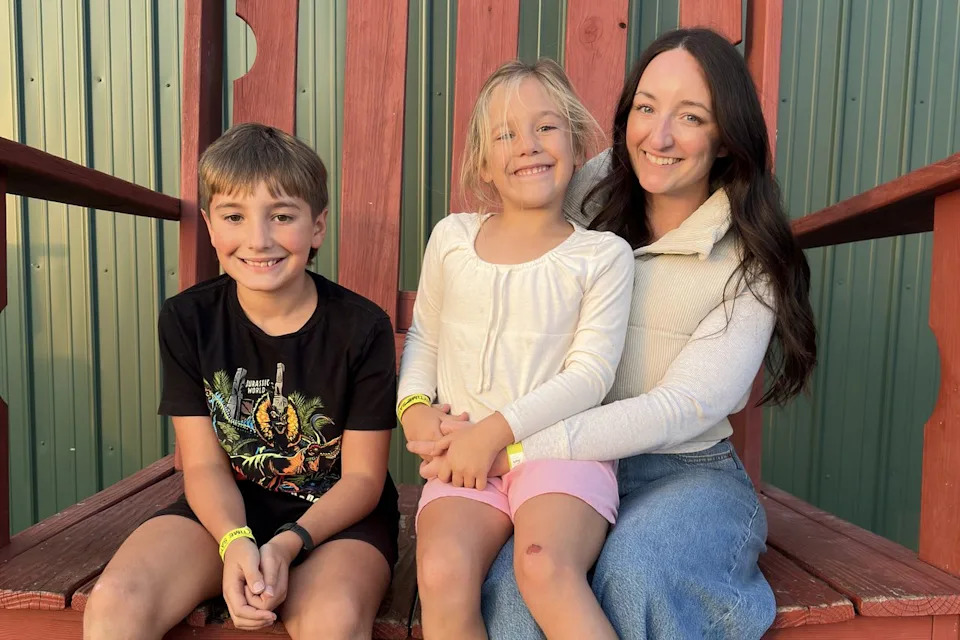
Leen Lorig and her family
Credit: Leen Lorig
“I could find a lot of people who were going through similar things that I was because I never really heard of strokes. I knew old people had them, but that was it,” she shares. “Through TikTok, I found people who had the same story I did, especially women at birth or right after the baby was born.”
Even as she physically progressed, however, the traumatic experience had a lasting impact.
“I fell into a depression and immediately recognized it, got into therapy and started to really heal the PTSD that I was going through nightly,” Lorig shares.
In 2022, she got divorced, and the new phase of life pushed her even more.
“That made me realize, I have to ensure I’m able to do everything. It’s a do-or-die situation,” Lorig shares. “When you have two little kids looking to you for everything, it’s a real blessing. There’s not much of a choice.”
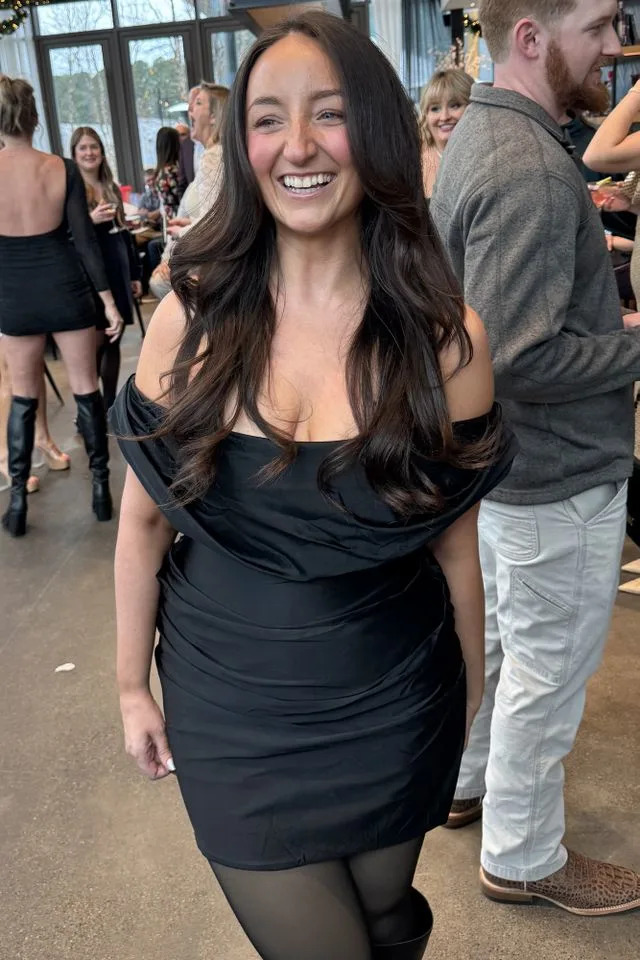
She continues to share her story online, and in the comments of almost every video, she has other people, mainly women, sharing their experience of having strokes in their 20s and 30s, too.
Credit: Leen Lorig
“My goal is for more people to understand and look out for all those things and all those indicators that you might be having a stroke,” she says, noting that a lot of other stroke survivors come to her looking for guidance, “desperate to know when it got better.”
Ultimately, she shares, “You’ll never be 100%, but you’ll be 100% this new person.”
The person she has become, she shares, is a “more caring individual.”
“It’s made me less selfish, which sounds weird because I wouldn’t have classified myself as selfish before,” she tells PEOPLE. “You realize that everyone’s in a battle every day, and sometimes you can see it when someone’s in a wheelchair, and sometimes the happiest person is struggling.”
Lorig, who is expecting her third child, notes that when she was going through the worst, she leaned on humor from those around her and from her own experiences, and hopes to encourage others to do the same.
“I want people to find humor in these dark parts because I’m not a doctor. I can’t tell you why you’re going through this, why this is happening to you specifically, but I can make you laugh, and I can talk to you about the time that you fell off the toilet for the first time because your butt doesn’t have the muscle to stay on,” she says. “I want people to be able to have something to relate to.”
Read the original article on People
First Appeared on
Source link






