


Worse Than the 1970s
Donald Trump, it seems, has managed to outdo his first term’s mismanagement of COVID-19 with an economic crisis of extraordinary scope and scale, entirely of his making. In a recent interview, International Energy Agency (IEA) Chief Fatih Birol asserted the present energy crisis was already on track to be “worse than the 1970s.” How bad is that exactly? The answer, unfortunately, is that this has the potential to be the worst economic downturn since the Great Depression.
The main reason this is the case is the past five decades of globalization following the very 1973-74 and 1978-79 oil shocks referenced by the IEA. Unlike the 1970s, the world’s growing economic interdependence as well as the diversification of the economies of the Persian Gulf mean even more sectors are directly impacted by the present crisis than was the case during the original oil shocks. While it is easy to focus on the immediate, obvious consequences of rising energy costs, like gas and diesel prices soaring nationwide, these may only be the beginning of a much larger, uglier economic mess that will inflict lasting harm on a global scale.
The best place to start in understanding the scope and scale of our present crisis is with the world of energy. As has rapidly become common knowledge since the outset of the war, approximately 20% of the world’s oil and natural gas flow from the Persian Gulf to global markets through the narrow Strait of Hormuz. Iran’s blockade, in conjunction with attacks on oil and gas infrastructure throughout the region, have effectively choked out this vital supply chain and created a supply disruption that is more than twice as large as the 9% global reduction experienced during the 1973 Oil Embargo. What has energy experts predicting this crisis will be “worse than COVID-19” and surpass the disruptions of 1973 is the risk that attacks on critical infrastructure could permanently reduce global supply. This is a stark contrast to the 1970s when capacity reductions were voluntary and relatively easy to resolve.
Rising prices at the pump are the first and most obvious consequence, but some regions are facing the impact more heavily than others. Across East Asia, economic planners have been battening down the hatches in preparation for the storm ahead. The government of the Philippines has cut back the workweek for public sector workers to four days while the Vietnamese government has urged anyone who can work from home to do so. Thai workers are being asked to turn off air conditioning, swap suits for t-shirts, and avoid using elevators as much as possible while unnecessary overseas trips have been canceled. United Airlines announced on Friday, March 20th, that it expected the price of oil to remain elevated at around $175 per barrel until 2027 and it was curtailing less commonly-used air routes in a bid to reduce fuel costs. These cutbacks are some of the more immediate consequences of the energy crisis, as rising prices and declining supplies translate into genuine shortages and energy rationing. Economically speaking, this means less is available to be spent while disposable income is increasingly consumed by rising fuel prices.
Unfortunately, this crisis will not be confined to the energy sector. Ever since the 1973 Oil Shock, the rulers of the Persian Gulf have actively diversified their economies by moving into sectors such as energy-intensive commodity production, including phosphates and helium, as well as high-value service industries like tech and finance. Though experts on the region have long debated the effectiveness of these policies at home, there is no question they succeeded in making global markets highly dependent on the Persian Gulf for these additional critical materials. The disruption of the Strait of Hormuz has sent industries that depended on these products scrambling.
Helium, for example, is necessary for producing computer chips and medical technologies like MRI systems, and the loss of Qatar’s helium industry, responsible for roughly one-third of global production, has created something of a production crisis for both sectors. Computer chips are an especially significant supply disruption because many consumer goods, like cars, mobile phones, and many home appliances, rely on them for basic functions. The same is true of phosphates, which are necessary for making fertilizer. Saudi Arabia is the sixth-largest producer in the world. The disruption of their commerce, along with the halt in natural gas exports which are also essential for fertilizer production, has triggered a similar crisis in one of the most critical inputs for modern agriculture on a global scale.
The services side of the coin is equally grim. The relationship among oil, wealth, and finance goes back to the 1970s, and petrocapital—the financial resources generated by oil profits—has long been essential for lubricating global markets. Contractions in these same resources, as is already underway with the growing flow of capital flight, have led to financial crises in the past and are shaping up to do so again. Tech, by contrast, is a more recent bet by the Gulf with the region’s wealthy having invested over a trillion dollars in the booming AI industry and AI infrastructure. This industry is also, as tech journalist Ed Zitron has demonstrated, highly dependent on fresh infusions of capital to remain solvent, capital that is unlikely to be forthcoming at scale from the war-torn Persian Gulf anytime soon.
No matter how you slice it, there is no question the immediate consequences of this economic shock will be dire and if these were only temporary problems, then it would be one of the most severe downturns of the 21st century and comparable to 2020 or 1973 if all of the above was temporary. Unfortunately, this may not be the case. Ever since the war began, the once unthinkable closure of the Strait of Hormuz—and the long term, potentially permanent destruction of oil and gas capacity throughout the region—has become a reality on a scale not seen since Saddam Hussein burned Kuwait’s oil fields during the first Persian Gulf War.
Qatar, for example, expects it will take three to five years to repair the damage done to some of the world’s most productive gas fields. The sea mines in the Strait of Hormuz will take months, potentially longer, to clear especially if the war escalates further. These capacity losses are also based on the assumption that present conditions are the worst it is going to get. Donald Trump, as he often does, may accomplish this if the United States follows through with the threatened assault on Kharg Island, the home to 90% of Iran’s oil export capacity.
The destruction of this facility could result in significantly more damage to Gulf infrastructure, as the loss of so much export capacity would incentivize a similar response from Iranian forces against key facilities like Saudi Aramco’s massive and critical Ras Tanura port & refinery complex. Such destruction would guarantee prolonged restrictions to the world’s energy supply, escalate ongoing capital flight from the Persian Gulf, and further disrupt the oil and gas revenues needed for making the Gulf’s financial system function. All of the above does not address the likely political instability in an already volatile region which would follow such developments, but it is safe to say any negative political developments would discourage the outside investments needed to rebuild the region’s fossil fuel infrastructure.
While many advocates of energy transition have, rightly, argued this may be a great opportunity for accelerating a much-needed transformation of society, such a shift will be happening under grim conditions. Even though renewable energy is faster, cheaper, and easier to build out at scale than carbon power, it will not be fast enough to stop some very immediate pain for people across the planet, some of whom are least able to effectively respond to such a crisis. We also face the problem of Trump’s intractable opposition to the best, most effective possible solutions to the present energy crisis.
Make no mistake: the big crash that everyone fears is coming, and it is a product of Trump’s unconstitutional war. It will be worse than COVID-19 and the consequences will endure for generations. That same crisis could also, however, be an opportunity to reshape our economy and society for the better. Oil and gas may have just run out of road just as wind, solar power, and batteries became ready to replace them.
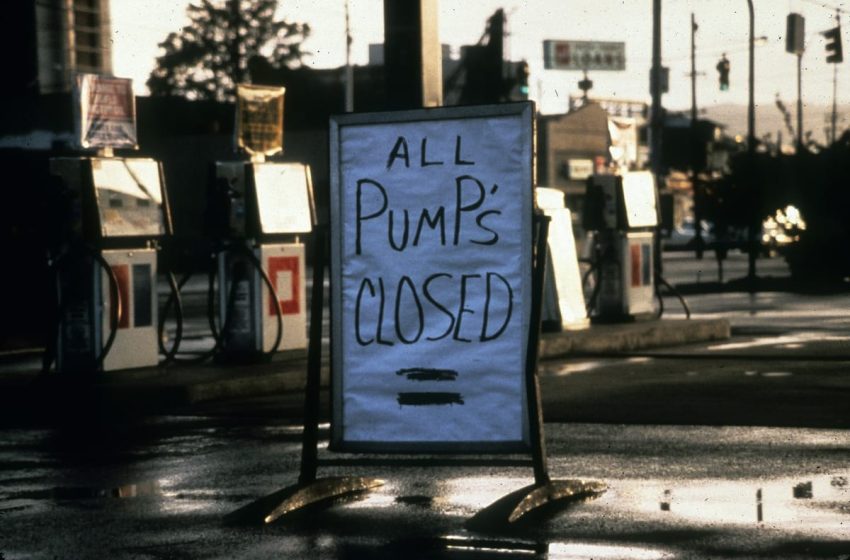
Featured image is Closed gas station during energy crisis, from the Seattle Municipal Archives
First Appeared on
Source link






