


I went back to Linux and it was a mistake
It’s a complete coincidence that I installed Linux around the same time as my colleagues Nathan Edwards and Stevie Bonifield. A few months ago, I decided to breathe new life into a 2019 Dell XPS 15 that had been collecting dust for a couple of years.
Despite its (at the time) high-end Core i7 CPU and 32GB of RAM, Windows was frustratingly slow on it. The fan was constantly at full throttle even when the machine was idle, and it regularly failed to install updates. So in early 2024, I gave up and switched to an M1 MacBook Pro.
But I wanted to give my oldest child something to practice typing on. Plus, I’d been trying to find a suitable distraction-free writing solution. (Spoiler: this laptop was not the solution I was looking for.) So I installed Ubuntu. Again.
See, before the MacBook and before the Dell XPS, I was a Linux user. I first installed Ubuntu in 2006 on a ThinkPad X40. And it remained my primary OS across three different laptops and 13 years.
Despite some… let’s call them quirks (Wi-Fi didn’t work out of the box on that X40), I was happy with Linux for a long time. I dual-booted Windows out of necessity, and often had a work-issued MacBook on hand. But those were for testing apps or specific tasks, like editing video. 99 percent of my life was spent in Ubuntu.
That is, until about 2017. As I got older, tinkering with my laptop changed from a hobby to something that got in the way of me pursuing my other hobbies. I had rediscovered my love of making music, and, try as it might, Ubuntu Studio just wasn’t cutting it. I was spending more time in Ableton Live, which meant more time in Windows, until in 2019, I bought the aforementioned XPS and switched over completely.
A lot has changed in the 20 years since I first installed Linux, and even in the seven years since I last used it. It’s now arguably the best platform for PC gaming. There are genuinely great photo-editing apps, such as Darktable, which was introduced in 2009. And there are even viable, commercial options for making music in Bitwig and Reaper, all of which have improved dramatically since 2019.

The Ubuntu installation process hasn’t changed much, but the interface is prettier. I put the ISO on a thumb drive and briefly considered wiping the XPS completely. I chickened out at the last minute and decided to dual-boot, which meant repartitioning my hard drive.
Right off the bat, I was reminded that Linux hasn’t completely overcome its fiddly nature. The fingerprint reader didn’t work. A minor annoyance I decided to ignore.
More concerning was that Ubuntu failed to install updates because of an EFI partition issue specific to the XPS 15 that was also causing problems under Windows. I managed to get them installed, but I’m not convinced I didn’t create a ticking time bomb by deleting essential files.
Ubuntu also refused to mount my Windows partition for the first month or so, before suddenly working for unknown reasons. Stevie similarly admitted to “rage quitting and going to bed” when they couldn’t get Ubuntu to connect to a second SSD.
Nathan had his own bizarre problems where his CachyOS refused to acknowledge his mouse clicks. He was also hit with option paralysis, trying to choose between four bootloaders and thirteen desktop environments. For some, this is part of the appeal, the infinite customizability, the power to bend your computer to your every whim and make it truly yours. Ubuntu doesn’t throw its customizability in your face, the way Cachy does, but it’s still there if you want it.
The problem, as I encountered during my days of meticulously tweaking desktops and crafting my dream note-taking tool using Obsidian, is that you’re building a house of cards. One tiny thing in some seemingly inconsequential library or plugin could cause the whole system to come crumbling down. I don’t want to be wasting my time tweaking and troubleshooting when I already have things that work.
Even if you keep it simple, as I did on my XPS, you’re hardly guaranteed smooth sailing. Ubuntu is one of the best-supported Linux distros. And, while my specific XPS 15 isn’t one of them, Dell has sold many Ubuntu-certified laptops over the years, so I figured I was in the clear — wrong.
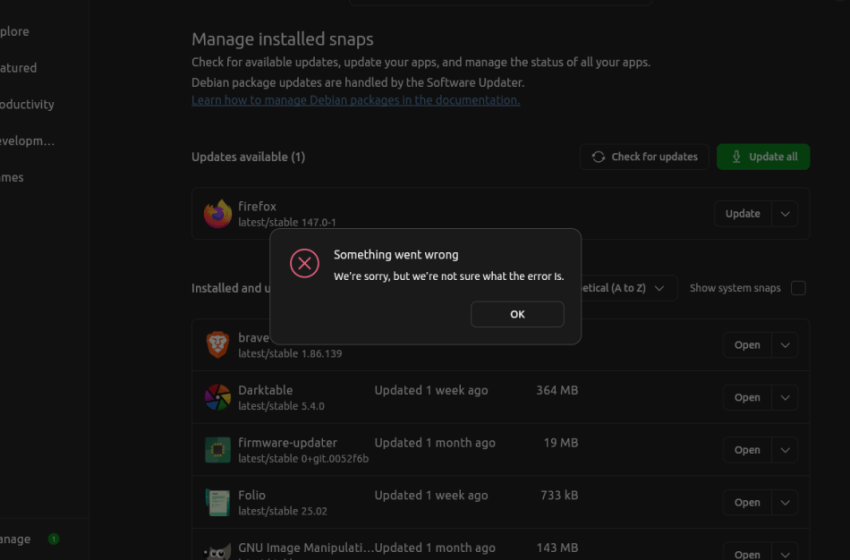
Several apps, whether from the official Ubuntu App Center, downloaded snaps, or .deb packages, quietly failed to install. No obvious error, no nothing. I had to open the terminal and install them from there to see what went wrong. Installing software on Linux is somehow even more confusing than it was 20 years ago.

Even the things that worked weren’t seamless. I got Steam up and running, but it took hours, required installing outdated 32-bit libraries, and it crashed along the way. Oh, and Steam games refused to recognize my audio interface; they would only play through the laptop’s speakers. CachyOS or Bazzite would have provided a smoother Steam experience. But it’s also illustrative of the problem. Saying you use Linux is almost meaningless because there are so many different flavors.
Thankfully, Bitwig recognized my audio interface, but it was fickle about which MIDI controllers it wanted to work with (an issue I’d never had on the Mac version), and crashed when I first tried to run it. Also, while the native Bitwig instruments are solid, I missed my favorite soft synths and effects, like Arturia’s Pigments, which is Windows- and Mac-only.
There were a handful of other minor annoyances. If my laptop went to sleep (which it only seems to do when it’s plugged in, go figure), it refused to reconnect to the external hard drive I have hooked up, and it stopped recognizing the SD card reader. To get them working again, I have to reboot. It also doesn’t wake on input from a Bluetooth mouse or keyboard. I have to open the lid to wake it when it’s hooked up to my dock and an external monitor.
If I just need a web browser, Ubuntu works like a charm. I had no issues with my Wi-Fi or with Firefox. My XPS now runs faster and quieter than it did with Windows. And I got Obsidian up and running with minimal fuss. I used Ubuntu as my primary work machine for a few days, and everything was fine. But I can do most of my job from the confines of a web browser.
It’s everything else. I can game on my Linux machine, but the experience is smoother on my Switch or PS4. I can make music in Bitwig or Reaper on Ubuntu, but Ableton on macOS is easier to use and supports all my VSTs. GIMP and Darktable offer solid image editing, but let’s be honest, they’re nowhere near as powerful as Lightroom and Photoshop. Linux can do all the things now — sometimes better than Windows. But for all it does, it always feels like there’s a better option.
First Appeared on
Source link






