


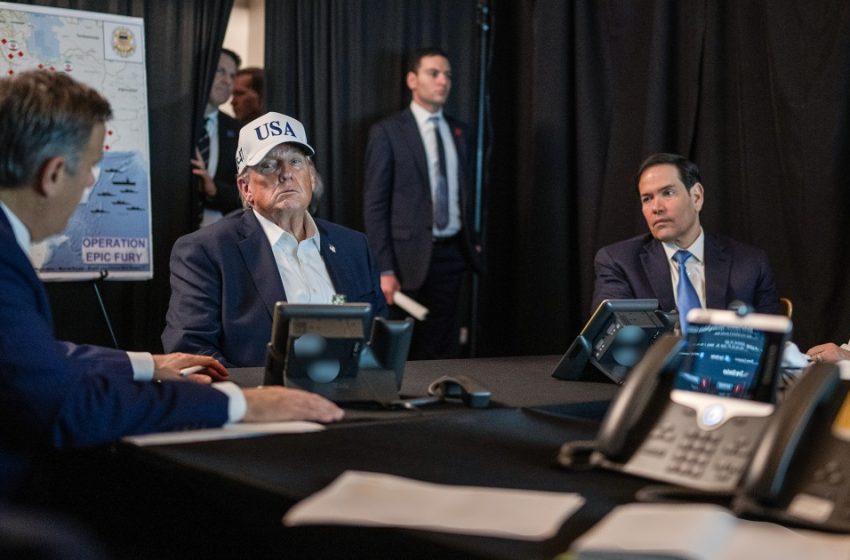
Inside Trump’s daily video montage briefing on the Iran war
WASHINGTON — Each day since the start of the war in Iran, U.S. military officials compile a video update for President Donald Trump that shows video of the biggest, most successful strikes on Iranian targets over the previous 48 hours, three current U.S. officials and a former U.S. official said.
The daily montage typically runs for about two minutes, sometimes longer, the officials said. One described each daily video as a series of clips of “stuff blowing up.”
The highlight reel of U.S. Central Command bombing Iranian equipment and military sites isn’t the only briefing Trump gets about the war. He’s also updated through conversations with top military and intelligence advisers, foreign leaders and news reports, the officials said.
But the video briefing is fueling concerns among some of Trump’s allies that he may not be receiving — or absorbing — the complete picture of the war, now in its fourth week, two of the current officials and the former official said.
They said the videos are also driving Trump’s increasing frustration with news coverage of the war. Trump has pointed to the success depicted in the daily videos to privately question why his administration can’t better influence the public narrative, asking aides why the news media doesn’t emphasize what he’s seeing, one of the current U.S. officials and the former U.S. official said.
White House press secretary Karoline Leavitt rejected the notion that Trump doesn’t receive information about the full range of developments in the war, both successes and setbacks.
“That’s an absolutely false assertion coming from someone who has not been present in the room,” Leavitt said in a statement. “Anyone who has been present for conversations with President Trump knows he actively seeks and solicits the opinions of everyone in the room and expects full throated honesty from all of his top advisors.”
Chief Defense Department spokesperson Sean Parnell said in a statement: “Operation Epic Fury has been an overwhelming success, with our forces executing the mission with unmatched precision and achieving every objective set out from the beginning. Secretary of War Pete Hegseth is in constant communication with President Trump regarding every aspect of Operation Epic Fury. We are proud of the exceptional performance by our warfighters and remain fully confident in the commander-in-chief’s decisions.”
One of the U.S. officials said that while discussions about sensitive military operations are limited to a smaller group, Trump continues to solicit input broadly and encourages every participant to weigh in candidly. The official added that Trump frequently takes calls from a broad range of outside advisers, regularly hearing how they feel and getting their perspectives on public opinion.
Public opinion about the war remains sharply divided along partisan lines, according to NBC News polling this month, though a majority of voters oppose Trump’s handling of it.
Within Trump’s Make America Great Again movement, however, support is overwhelming: Self-identified MAGA respondents gave a 100% approval rating for Trump, with 90% supporting his military action in Iran.
The question of how a president consumes information, particularly negative developments, and what details are shared by aides can be particularly acute during wartime. For any president, aides have historically had to balance providing a full picture of events and emphasizing successes on core objectives.
During previous wars — from Vietnam to Iraq to Afghanistan — administrations were accused of succumbing to “groupthink” when they briefed the president, with officials and military commanders downplaying or omitting inconvenient facts and refusing to recognize signs that their strategy was failing. President Lyndon Johnson complained that American television news coverage of the Vietnam conflict was misleading and overly negative, and George W. Bush’s administration accuse journalists of focusing on car bombs instead of on progress in rebuilding Iraq.
The current and former U.S. officials said the military can’t brief Trump on every strike — there are hundreds every day — and so the curated video, while it showcases U.S. capabilities, doesn’t reflect the full scope of the conflict.
“We can’t tell him every single thing that happens,” a current U.S. official said. The official noted that Trump’s briefings tend to draw better feedback from his aides when they focus on U.S. victories.
Overall, the official said, the information Trump gets about the war tends to emphasize U.S. successes, with comparatively little detail about Iranian actions.
One example came this month when five U.S. Air Force refueling planes were hit in an Iranian strike at Prince Sultan Air Base in Saudi Arabia, according to one of the current U.S. officials. Trump wasn’t briefed about the strikes, and he learned what had happened from media reports, the official said. When Trump inquired, he was told the planes weren’t badly damaged, the official said.
The official said Trump reacted angrily behind the scenes to the news coverage. Publicly he posted on Truth Social calling coverage of the strike misleading and accusing media organizations of wanting the U.S. “to lose the War.”
Leavitt defended Trump’s criticism of the media.
“Trust in the mainstream media is at an all-time low and their overwhelming negative and biased coverage of Operation Fury, which has been a massive success, proves why the president is rightfully frustrated,” Leavitt said in a statement. “The media spends more time using fake anonymous sources to sow chaos than focus on the successes and victories of our great United States military against the Iranian regime.”
Some of Trump’s allies view his frustration as a sign of a constrained flow of information, two of the current U.S. officials and the former U.S. official said.
Among their concerns is that Trump may not be equipped to make critical decisions about options he’s presented with for possible next steps in the war if he’s not receiving a full scope of information about the status of the conflict, the former official and a person familiar with the concerns said.
Some of Trump’s allies have sought to provide him with additional context, including possible scenarios for how the conflict could evolve and options for winding it down, to broaden the range of perspectives reaching him, according to the former official and the person familiar with the concerns. Recently, some of them tried to bring new polling to Trump’s attention, showing his approval rating sinking several points since the war began, according to the person familiar with the concerns.
Since the war began Feb. 28, Trump has been both shaping and consuming a steady stream of news about it. He has taken dozens of phone calls from journalists, explaining his positions and hinting at next steps. He maintains regular contact with foreign leaders, including holding near-daily conversations with Israeli Prime Minister Benjamin Netanyahu, and he has frequent discussions with leaders of Persian Gulf states, officials said.
And he has publicly acknowledged seeking information independently.
Last week Trump said that he called a top military general after he saw video of the USS Abraham Lincoln in flames and that the general told him Iran fabricated the video using artificial intelligence.
“I called the general. I said, ‘General, what’s with the Abraham Lincoln, it looks like it’s burning down?’” Trump said at a lunch for Kennedy Center board members. He said the general told him: “‘No, it’s not burning down. Not a bullet was ever fired at it, sir. They know better.’”
One of the U.S. officials said that the USS Abraham Lincoln has been targeted multiple times since the war began but that the strikes have either failed to reach the ship or have been intercepted.
Trump also said he had seen fabricated video of “buildings in Tel Aviv burning to the ground,” as well as in Qatar and Saudi Arabia. “And they weren’t burning,” he said. “They weren’t hit. It was all AI.”
Asked for comment on the briefings Trump receives about the war, National Intelligence Director Tulsi Gabbard’s office pointed to her testimony to Congress last week, when she told lawmakers that she and other intelligence officials “continue to provide the president with all of the best objective intelligence available to inform his decisions.”
The director of public affairs at the CIA, Liz Lyons, summarized in a statement congressional testimony from CIA Director John Ratcliffe last week, saying he told lawmakers, “President Trump is constantly briefed by his national security advisors and provided with the best intelligence available to provide a decisive strategic advantage in making policy decisions.”
Ratcliffe said at a congressional hearing last week that he briefs Trump about 10 to 15 times a week on important national security issues.
Gabbard and Ratcliffe also testified that the White House received intelligence assessments before the war that, if it was struck, Iran would be likely to retaliate with attacks on energy sites in the Middle East and threaten commercial shipping in the Strait of Hormuz, with possible fallout for oil prices and the global economy. But Trump suggested last week that Iran’s reaction came as a surprise and that “no expert” predicted such a response.
Concerns about the war among some Trump supporters surfaced publicly last week when Joe Kent, who until recently led the National Counterterrorism Center, said internal gatekeeping had limited Trump’s access to a wider range of dissenting views during the war. “A good deal of key decision-makers were not allowed to come express their opinion to the president,” Kent told Tucker Carlson in an interview after he left the administration. “There wasn’t a robust debate.”
Leavitt wrote on social media at the time that Trump “had strong and compelling evidence” that led to his decision to strike Iran.
Days earlier, Trump was asked about comments by his former AI czar, David Sacks, who said on a podcast that the U.S. “should try to find the off ramp” and that “this is a good time to declare victory and get out.” Trump told reporters that Sacks hadn’t shared his views with him.
First Appeared on
Source link






