


A 307-Million-Year-Old Creature Found in a Fossilized Tree Is Turning Early Animal History on Its Head
A chunky, four-legged creature the size of a football has forced a reconsideration of one of evolution’s more practical questions: when did land animals first develop a taste for plants.
The answer, based on a 307 million year old skull found inside a fossilized tree stump in Nova Scotia, appears to be much earlier than textbooks suggest. The specimen preserves dental equipment unlike anything paleontologists expected to find in such an ancient terrestrial vertebrate.
What emerges from the bone is not merely a new species, but a revision to the timeline of how ecosystems on land assembled themselves. The creature belonged to a lineage that predates the split between reptiles and mammals, yet its mouth contained tools designed for grinding vegetation.
Teeth That Ground the First Greens
Researchers led by Dr. Arjan Mann of the Field Museum in Chicago and Zifang Xiong of the University of Toronto subjected the skull to high resolution micro CT scanning. The images showed rows of robust teeth on both the lower jaw and the palate, or roof of the mouth. When the animal closed its mouth, these surfaces interlocked like puzzle pieces.
Analysis of tooth wear patterns revealed facets consistent with shearing and grinding motions typical of plant processing. The findings, detailed in a study published February 10 in the journal Nature Ecology & Evolution, identified the species as Tyrannoroter heberti. The complete research paper in Nature Ecology & Evolution provides extensive data on the dental morphology and phylogenetic analysis supporting the identification.
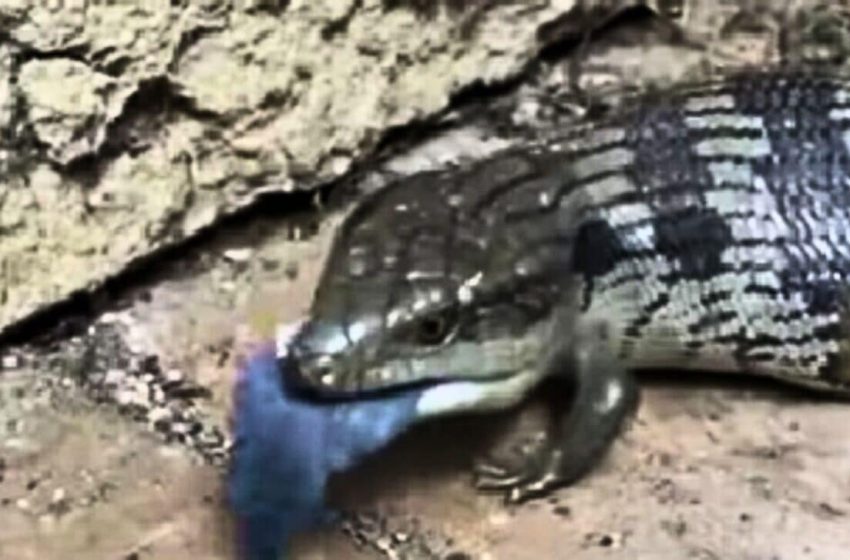
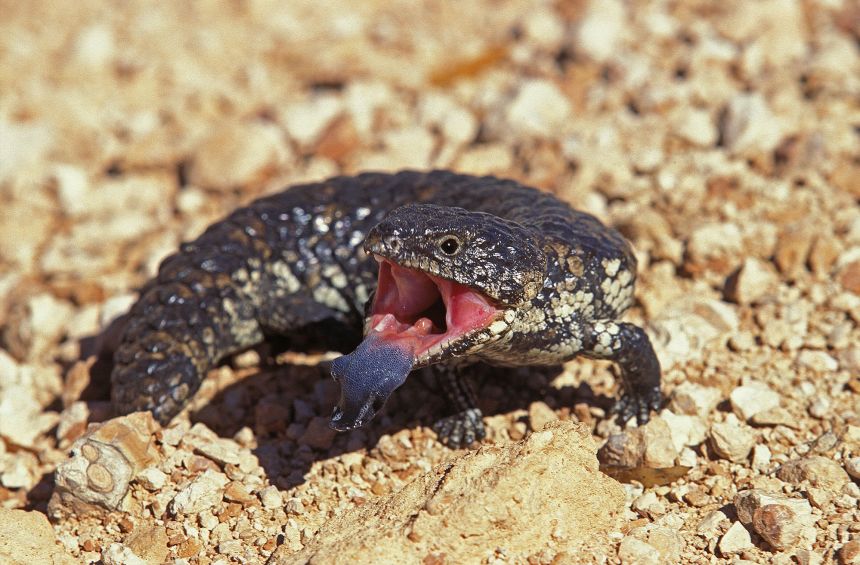
The name honors Brian Hebert, the avocational paleontologist who found the fossil, while referencing the animal’s probable use of its snout for digging. The creature measured roughly one foot in length with a stocky build resembling modern shingleback skinks. It lived during the Late Carboniferous Period, approximately 307 million years ago, in what is now Cape Breton Island.
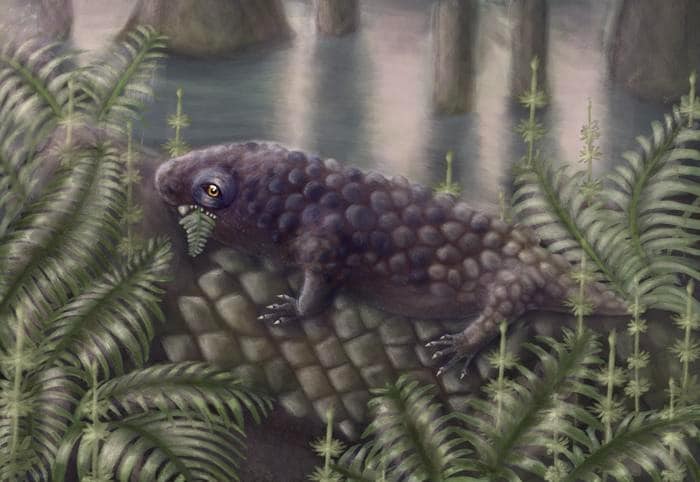
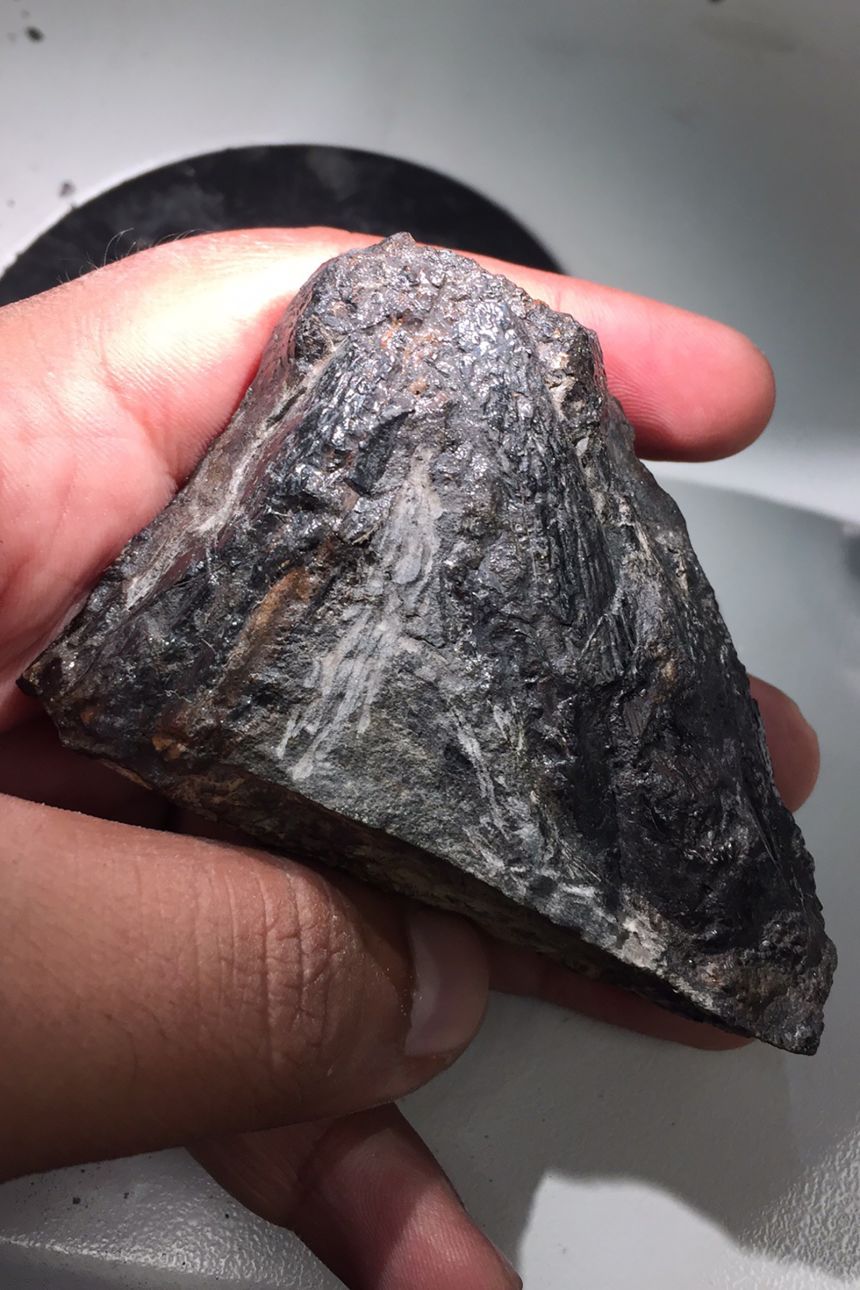
The specimen was recovered from cliffs exposed to extreme tidal shifts, conditions that Mann described as requiring paleontologists to race against incoming tides. A report from the Field Museum via EurekAlert details the challenging fieldwork conditions and the role of Brian Hebert in spotting the small skull within a fossilized tree stump.
When Vertebrates First Learned to Graze
The discovery pushes back the established timeline for herbivory among land vertebrates. Previous fossil evidence suggested that specialized plant eating emerged primarily among amniotes, the group that includes reptiles, birds, and mammals. Tyrannoroter belongs to a broader category called stem amniotes, animals closely related to the ancestors of all modern land vertebrates but predating the evolutionary split between reptile and mammal lineages.
“This shows that experimentation with herbivory goes all the way back to the earliest terrestrial tetrapods,” Mann said in materials accompanying the publication. The researchers note that Tyrannoroter likely maintained an omnivorous diet that included insects.
Hans Sues, senior research geologist at the Smithsonian National Museum of Natural History and study co author, has previously observed that nearly all modern herbivores consume some animal protein. The mechanical demands of processing hard insect exoskeletons may have preadapted the dentition for handling tough plant material. As CNN’s coverage of the discovery notes, this dietary shift would have required more than specialized teeth, likely including larger guts and robust microbial communities to break down fibrous plants.
The study also examined historical fossils of related pantylid species, finding evidence that similar dental adaptations existed as far back as 318 million years ago. This suggests herbivory became established among these groups relatively quickly after vertebrates became fully terrestrial.
A Menu That Rewrote Evolution
The findings indicate that plant eating evolved independently in multiple groups of early land vertebrates rather than arising once in a common ancestor. The tooth structure in Tyrannoroter differs from that seen in other ancient herbivores, suggesting separate evolutionary trajectories toward the same ecological strategy.
The Carboniferous Period marked a significant transition in Earth’s history. Plants had colonized land roughly 475 million years ago, but vertebrate herbivores appeared much later. The interval between full terrestrial adaptation and the emergence of herbivory now appears substantially shorter than previously estimated.
“We were most excited to see what was hidden inside the mouth of this animal once it was scanned,” said Hillary Maddin, a professor of paleontology at Carleton University and the study’s senior author, in a statement. She described the mouth as “jam packed with a whole additional set of teeth for crushing and grinding food, like plants.”
What Vanished With the Rainforests
Tyrannoroter lived near the end of the Carboniferous Period, a time of shifting climate when extensive rainforest ecosystems began collapsing. The researchers note that the lineage containing this species ultimately disappeared, potentially due to inability to adapt as plant communities changed.
The transition from the Carboniferous to the subsequent Permian Period involved significant global warming and restructuring of terrestrial ecosystems. Many early herbivores specialized on particular plant groups, leaving them vulnerable when those food sources declined. The study authors suggest this pattern offers a data point for understanding how plant-eating animals respond to rapid environmental change.
Questions remain about the precise phylogenetic position of Tyrannoroter and its relatives within the tetrapod family tree. Scientists continue to debate the relationships among early land vertebrates, and the authors acknowledge that alternative phylogenetic interpretations remain possible. The fossil material consists primarily of a skull, leaving aspects of the animal’s biology subject to ongoing investigation.
First Appeared on
Source link






