


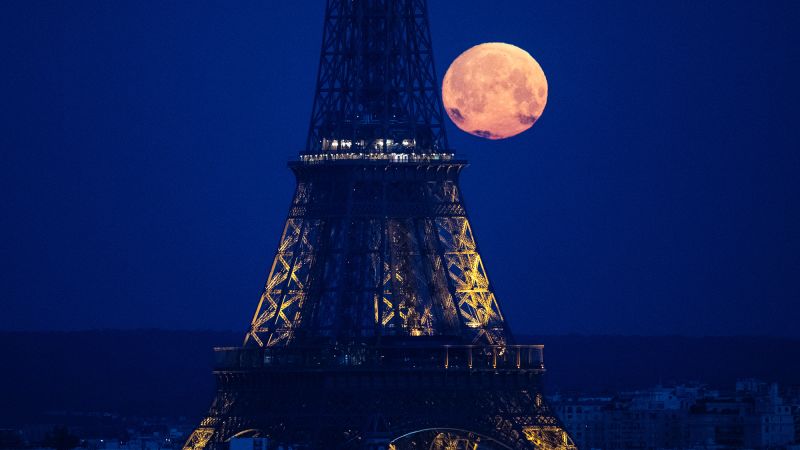
April’s full pink moon will rise in spring skies
Sky watchers can soon catch the spring season’s first full moon rising in the night sky.
April’s full pink moon will peak at 10:11 p.m. ET Wednesday, according to Time and Date. Despite the moniker, the silvery orb will appear in its usual brilliant gray hue.
The lunar event’s rosy name instead pays tribute to the early spring bloom of Phlox subulata. A wildflower species native to eastern North America, it’s often called “moss pink,” which typically flowers around April’s full moon, according to The Old Farmer’s Almanac.
The moon may still appear full Tuesday and Thursday, said Noah Petro, chief of NASA’s planetary geology, geophysics and geochemistry laboratory at Goddard Space Flight Center in Greenbelt, Maryland. Full moons are visible to those in the Northern and Southern hemispheres, as they are considered to be in the full moon phase up to 12 hours before and after their peak, according to EarthSky.
For the best view, local weather conditions allowing, Petro suggests finding clear skies and an unobstructed spot away from trees or buildings. The darker the environment, the more you can enjoy the event, he added.
Across Indigenous communities, April’s full moon has a range of names including “kawohni,” meaning flower moon to the Cherokee; “kwiyamuyaw,” meaning moon of windbreak to the Hopi, and “tabehatawi,” meaning frog moon to the Assiniboine.
Full pink moon and start of April’s launch window for Artemis II
April’s full pink moon also marks the first potential launch date in April for Artemis II, the first human mission to journey to the moon’s vicinity in over 50 years. Four astronauts are aiming to travel farther than any human has previously gone into deep space, flying around the moon and beyond its far side.
This early April launch period runs from April 1 to 6, with a two-hour window each day, according to NASA. On Wednesday, the launch window opens 1.28 hours before sunset; the next day, it opens 0.32 hours before sunset; and on the remaining dates, it opens progressively later after sunset.
“When you look at this full moon, the crew may be on their way. They may have just launched,” said Petro, who also leads the planetary science team for an upcoming Artemis mission planned for early 2028 that will return humans to the lunar surface. “This will be the last full moon in the pre-Artemis II era, and it will look different not only to the four crew members but to all of us who journey along with them,” Petro added.
Upcoming meteor showers and full moons
Between full moons and meteor showers, observers have a variety of events to anticipate in April and May.
One of the oldest known meteor showers, the Lyrids, will peak between April 21 and April 22, when sky-gazers can see 10 to 20 meteors per hour during their peak, with the best views in the Northern Hemisphere, according to NASA.
Originating from leftover particles from Comet Thatcher, this annual shower is best viewed away from city lights after moonset and before dawn. With minimal interference from moonlight, enthusiasts can expect to see a good show with clear skies.
The next shower to peak is the Eta Aquariids on May 5-6, when sky-gazers can expect to see less than 10 meteors per hour because of the interfering moonlight, according to the American Meteor Society. Originating from Comet Halley, this annual shower is known for the speed of its meteors, traveling at about 40 miles (about 65 kilometers) per second into Earth’s atmosphere, leaving a glowing “train,” according to NASA.
May also brings two full moons — one on May 1 and another on May 31. One common use of the term “blue moon” refers to the second full moon in a single calendar month, a phenomenon that happens roughly every 30 months on average, according to The Old Farmer’s Almanac.
NASA’s Artemis program is sending humans into deep space for the first time in more than five decades. Sign up for Countdown newsletter and get updates from CNN Science on out-of-this-world expeditions as they unfold.
First Appeared on
Source link






