


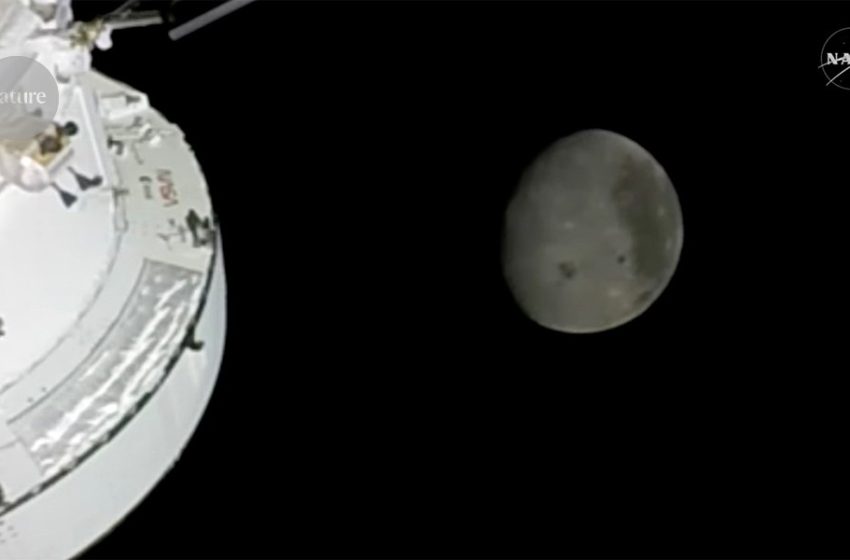
Artemis crew see intriguing colours on lunar surface
View of the Moon from the Orion capsule as the crew set the record for the farthest distance humans have travelled from Earth.Credit: NASA
Updated 6 April 2026, 4.03 p.m. CDT (Houston time)
The astronauts have been switching spots at the capsule windows. Reid Wiseman and Jeremy Hansen were the first to do observations and take photos. Then it was Christina Koch and Victor Glover’s turn Now, they’re about to switch back.
The astronauts have three cameras on board: two Nikon D5 DSLRs, which are the workhorses of spaceflight photography, and one Nikon Z9, a newer mirrorless camera that was added at nearly the last moment. These automatically take three exposures for every press of the button. The first is an exposure that the Artemis II team members think is correct for the lighting conditions in that moment, the second is one that they think will be underexposed and the third is one that they think will be overexposed — to be sure one of the images will turn out well.
They are using a 400-millimetre lens to get as much detail as possible of the lunar disk. The astronauts observe the Moon in pairs, one photographing the surface while the other observes with the naked eye. They have trained to recognize basic geological features of the Moon, including the massive Orientale impact basin that is a major focus of today’s studies because it has never been observed fully by the human eye before. — Alexandra Witze
Updated 6 April 2026, 3.18 p.m. CDT (Houston time)
Reader question: Do the astronauts have science in their backgrounds?
Some of them do, yes. Mission specialist Christina Koch is an engineer who worked at scientific field stations in Greenland and Antarctica. Mission specialist Jeremy Hansen has a master’s degree in physics and worked at the underwater Aquarius laboratory off the coast of Florida, which is meant to emulate deep-space flight. (Incidentally, although this is Hansen’s first flight to space, Koch holds a number of spaceflight records.)
Reid Wiseman, the commander, set a record for science in orbit when he and a colleague performed 82 hours of research on the International Space Station during a single week in 2014.
The fourth astronaut, pilot Victor Glover, is a Navy aviator and test pilot. — Alexandra Witze
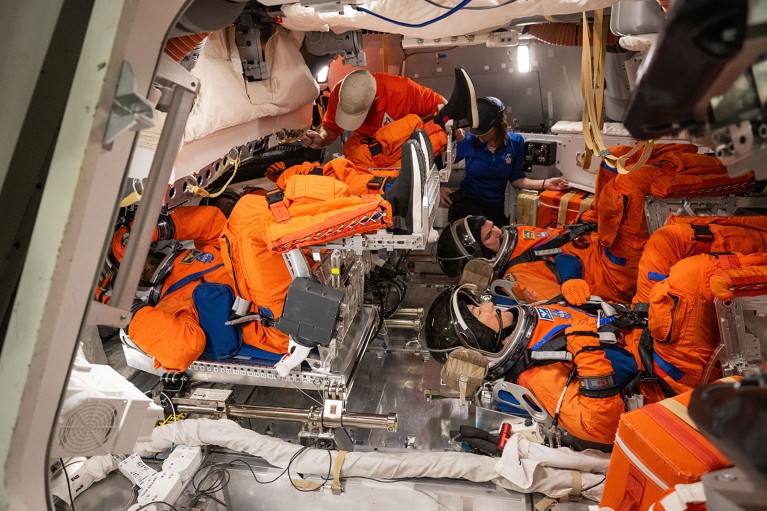
The Artemis II crew during a training session at Johnson Space Center in Houston.Credit: NASA/James Blair
Updated 6 April 2026, 2.51 p.m. CDT (Houston time)
The Artemis II lunar science team is getting what they were hoping for. On board the Orion capsule, the astronauts have observed craters at the north and south poles. Colour differences continue to be a theme: “The more I look at the Moon, the browner and browner it looks,” one of the astronauts said.
Astronaut and pilot Victor Glover is describing some challenges in looking from his dim laptop to the bright Moon and back down again, all while juggling logistics to capture the grandeur of the moment. — Alexandra Witze
Updated 6 April 2026, 2.34 p.m. CDT (Houston time)
I’ve been fortunate enough to gain access to the ‘science evaluation room’, a brand-new workspace in the main mission control building at Johnson Space Center in Houston. This is the kind of thing that sounds really bureaucratic, but in the extremely hierarchical world of NASA human spaceflight, it’s a big deal for science to have its own space. There’s a cluster of science specialists working together here to feed information and research to a top ‘science officer’ — planetary scientist Kelsey Young — who has a seat in the primary mission control room. (They don’t let reporters in that room generally.)
The mood here is quiet, tense and full of anticipation. There was no celebratory moment to mark the start of the lunar fly-by — just a bunch of scientists focusing on their display screens with visualizations of the lunar surface and the capsule trajectory.
Christina Koch, one of the astronauts, told mission control that they were comparing the brightnesses of Earth and the Moon. Young noted that as the astronauts’ eyes adjust, more features might become visible. The crew has turned down lights in the capsule to help their eyes adapt to darkness.
The astronauts have reported seeing green and brown colours in the Aristarchus region of the Moon’s near side. That’s a part of the Moon that astronomers can see from Earth, but the report of colour variations caused an excited murmur in the room. The scientists are keen to have any colour reports like this from up close at the lunar surface. — Alexandra Witze

Science officer Kelsey Young monitors Artemis II operations from a console inside NASA’s mission control in Houston.Credit: NASA/Bill Stafford
Updated 6 April 2026, 2.16 p.m. CDT (Houston time)
This morning, reporters — including yours truly — visited mission control at the Johnson Space Center in Houston. This is the nerve centre of the Artemis II mission. And it’s the room where the flight director and the capcom (the astronaut designated to communicate with the Orion capsule) sit, as well as the room that holds all those consoles you’ve seen in film documentaries. Huge display screens showed the countdown to various mission milestones, including splashdown on 10 April.
We were there when mission control broadcast a message from legendary Apollo astronaut Jim Lovell to the Artemis II crew, as they woke this morning, the day of their lunar fly-by. “Welcome to my old neighbourhood,” said Lovell, who piloted the 1968 Apollo 8 mission that was the first to fly humans around the Moon, just as Artemis II is doing today. “Don’t forget to enjoy the view,” he said. “Good luck, godspeed, from all of us here on the good Earth.” Lovell recorded the message before he died on 7 August last year. — Alexandra Witze
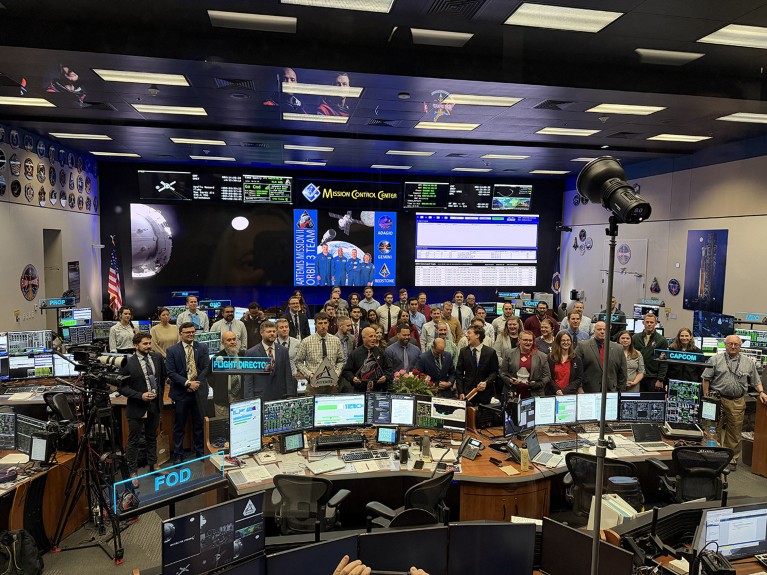
NASA staff members were posing for a photo this morning as Nature correspondent Alexandra Witze visited mission control.Credit: Alexandra Witze/Nature
Updated 6 April 2026, 2.07 p.m. CDT (Houston time)
As the Artemis II crew set their distance record from Earth, they made a request: to name some “relatively fresh craters on the Moon that have not been previously named”. In particular, they suggested names for two craters that they observed from Orion’s windows this morning and that were originally pointed out to them by the science team. They suggested naming the first, north of the massive Orientale basin on the Moon’s far side, Integrity, after their spacecraft. The second, on the Moon’s near side–far side border, they asked to name Carroll, after commander Reid Wiseman’s wife, who passed away in 2020. During certain times of transit, Carroll would be visible on Earth.
Updated 6 April 2026, 1.51 p.m. CDT (Houston time)
The lunar fly-by has begun. I’m in the science evaluation room for the Artemis II mission, where flowers just got delivered for science officer Kelsey Young, from her mother. NASA science head Nicola Fox is also in the house.
Team leader Marie Henderson just told the assembled scientists that they needed to focus on getting their work done while also appreciating the historic nature of the moment. “There’s going to be a lot of excitement today,” she said.
Then she went around asking the group leaders in the room to give her a ‘go’ for fly-by. One by one, they all polled ‘go’.
“We are go for lunar flyby,” Henderson said.— Alexandra Witze
Updated 6 April 2026, 1.05 p.m. CDT (Houston time)
Artemis astronauts set record for distance travelled from Earth by humans
The Artemis II crew has just set a record for the farthest humans have ever travelled from Earth. They have surpassed the record of Apollo 13, set in 1970, of 248,655 statute miles (400,171 kilometres) from our home planet. (Apollo 13 set that record after it suffered an explosion on the way to the Moon, which forced the crew to abort their planned landing and instead slingshot around the far side of the Moon.)
Some scientists and NASA folks will tell you that the distance record doesn’t really matter. It is, after all, something of an artifice — there is nothing fundamentally different about the environment that the Artemis II astronauts will be passing through, thousands of kilometres above the Moon’s surface, to the one that Apollo astronauts did, tens to hundreds of kilometres above the surface. But it is a moment to mark in human history, in which people travel farther from planet Earth than ever before.
“We will continue our journey even farther into space before Mother Earth succeeds in pulling us back to everything that we hold dear,” said astronaut Reid Wiseman as the crew set the record. “But we most importantly choose this moment to challenge this generation and the next to make sure this record is not long lived.”
Later today, the Artemis II crew will reach their farthest distance from Earth, of 252,760 statute miles (406,778 kilometres) — before their trajectory takes them back towards our home planet. — Alexandra Witze
Updated 6 April 2026, 12.37 p.m. CDT (Houston time)
Today’s science activities will unfold according to a ‘lunar targeting plan’ drawn up by mission scientists. Essentially, the astronauts trained to be able to recognize major geological features on the surface of the Moon from many angles. Once Orion set its final course to the Moon, over the past few days, team scientists have updated predictions for what the astronauts will see. The lunar targeting plan lists the features the scientists want the astronauts to observe.
As Orion approaches the Moon, the astronauts will first see features on the lunar near side, which faces Earth and is familiar to amateur astronomers. Those include the bright Aristarchus crater, one of the most brilliant features on the Moon. As the capsule flies around the back of the Moon, the crew will get better views of features on the little-seen far side, such as the magnificent multi-ringed Orientale impact basin.
The astronauts have a checklist of science observations to make, such as comparing the appearance of two craters (named Glushko and Ohm) to assess their difference in brightness to the human eye. On the far side, they’ve been asked to compare and contrast the colours of various regions, in hopes they will add additional information to orbiter data already gathered on these regions. — Alexandra Witze
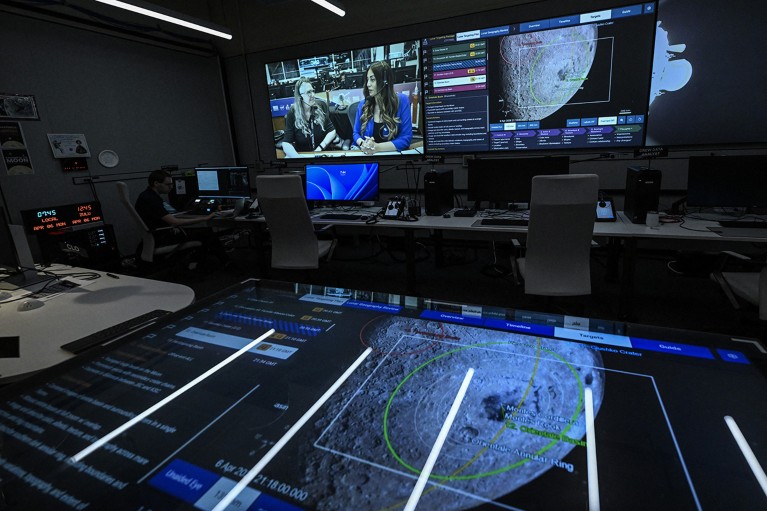
The lunar targeting plan appears on a screen inside the Science Mission Operations Room at Johnson Space Center in Houston on 6 April.Credit: Ronaldo Schemidt/AFP via Getty
Updated 6 April 2026, 12.10 p.m. CDT (Houston time)
Although this is a NASA mission, other countries beyond the United States are also involved. The European Space Agency, for instance, contributed the ‘service module’ ( see ‘Orion spacecraft’ graphic below) that provides power and propulsion to Orion as it coasts through deep space. The Canadian Space Agency lent their astronaut Jeremy Hansen (the other three astronauts on board are from NASA). And the German Aerospace Center contributed radiation-monitoring sensors to Orion, to better track the astronauts’ exposure to energetic particles in deep space.
Four countries also contributed small satellites, or cubesats, that launched alongside Orion on 1 April. Two of those cubesats, from Argentina and Saudia Arabia, have been communicating with their operators; two others, from Germany and South Korea, have been silent. Ad astra, little cubesats. — Alexandra Witze
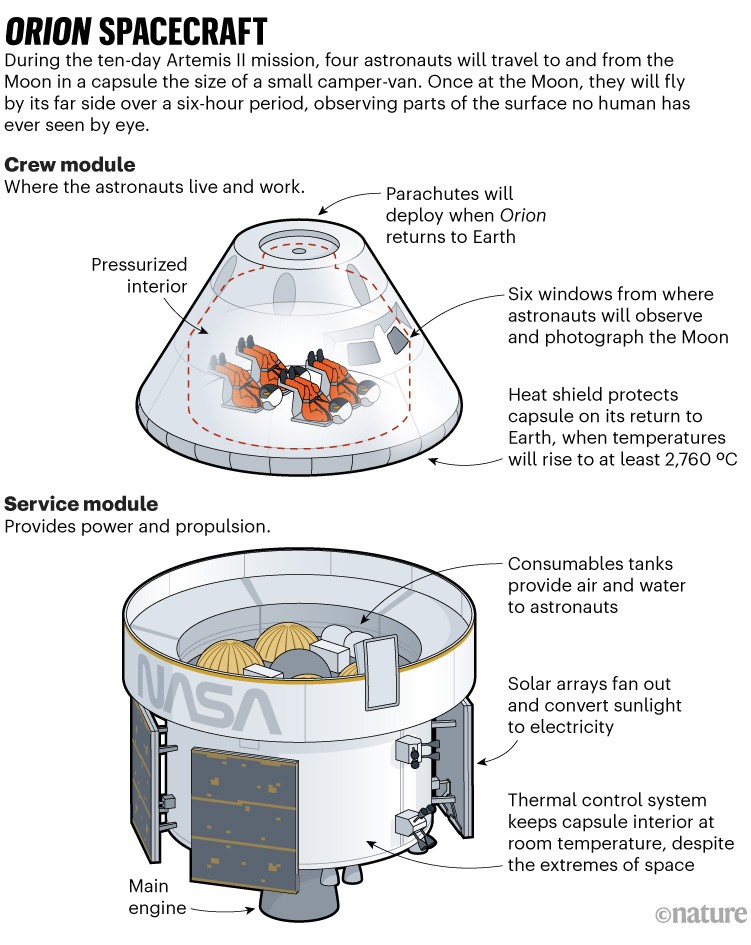
Credit: Jasiek Krzysztofiak/Nature
Updated 6 April 2026, 11.21 a.m. CDT (Houston time)
Reader question: Will the astronauts scout a site today for a future Moon landing?
No. It’s true that Artemis II is meant to be a stepping stone in NASA’s plans to land astronauts back on the lunar surface. The agency is planning for that to happen somewhere near the Moon’s south pole, where there are shadowy craters rarely touched by sunlight that might contain water ice. This ice could be a precious resource for future astronauts to use for sustenance and to break down into fuel (hydrogen and oxygen); it might also hold clues about the early Solar System for scientists.
The Artemis II astronauts will be able to view the north and south polar regions of the Moon’s far side for the first time by eye today (the Apollo astroanuts didn’t do this). But at closest approach, the Moon will appear to the Artemis II crew to be the size of a basketball held at arm’s length. That view will simply not be detailed enough to scout future landing sites.
First Appeared on
Source link






