


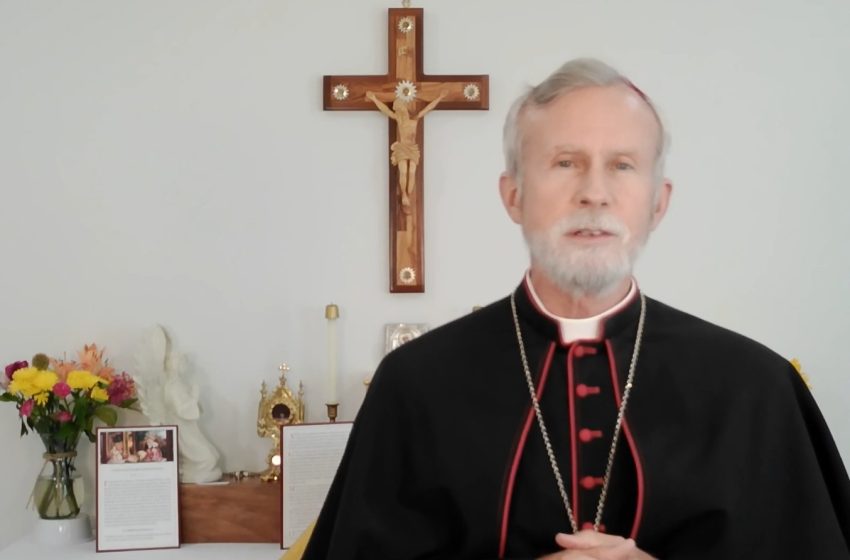
Bishop Strickland and the Consecrations: A Plea for “Apostolic Continuity”
The traditionalist Catholic world is in turmoil. Fr. Davide Pagliarani, Superior General of the Society of Saint Pius X, has officially confirmed that the society founded by Archbishop Marcel Lefebvre will soon proceed with the consecration of new bishops. It is in this tense context that Bishop Joseph Strickland published an opinion piece analyzing the legitimacy of this action in light of the current crisis in the Church.
Bishop Strickland: A Free Voice in the Turmoil
But who exactly is Bishop Joseph Strickland? Appointed Bishop of Tyler, Texas, by Benedict XVI in 2012, the prelate quickly established himself as one of the most conservative and outspoken voices in the American episcopate. An ardent defender of the “deposit of faith” and a regular critic of the direction of Pope Francis’ pontificate—particularly regarding the Synod on Synodality and moral issues—he has become a leading figure for many bewildered faithful.
This outspokenness led to his abrupt dismissal. In November 2023, after an apostolic visitation, Pope Francis officially removed him from his pastoral office. Although the Vatican did not detail the specific reasons, this removal is widely perceived as a sanction against his public opposition to the policies of the Roman Curia.
The State of Necessity and Apostolic Continuity
In his analysis of the SSPX situation, Bishop Strickland does not limit himself to a legal commentary. He places the debate on the grounds of “apostolic continuity.” For him, the announcement by the Superior General of the SSPX should not be interpreted as an act of rebellion, but as a response to a spiritual “state of necessity.”
Bishop Strickland emphasizes that the primary mission of the Church is the transmission of the unchanging faith. However, the prelate believes that the current hierarchy, through its doctrinal ambiguities, is creating a rupture. Therefore, resorting to ordinations without Roman authorization is not intended to create a parallel Church, but to ensure that the traditional priesthood and sacraments do not disappear.
“The Church exists for the salvation of souls,” he stresses, suggesting that when the administrative structure seems to be failing in this mission, the preservation of Tradition becomes an absolute priority.
An Implicit Critique
Bishop Strickland’s position is all the more significant given that the prelate is not a member of the SSPX and remains, in the eyes of Rome, a bishop “in full communion.” By arguing that the SSPX is acting to preserve the “continuity” that Rome seems to be abandoning, the Bishop Emeritus of Tyler highlights a major ecclesiological fracture.
For him, the question is not so much whether the new bishops will be “legal” in the eyes of canon law, but whether they will be the authentic guardians of Catholic truth. He thus calls on the faithful to understand that the true schism, in his view, lies more in the abandonment of dogmas than in an apparent disciplinary irregularity.
In an increasingly fragmented ecclesial landscape, Bishop Strickland’s voice resonates as a warning and a significant source of moral support for those who consider Tradition the ultimate bulwark against modern confusion.
First Appeared on
Source link






