


ChatGPT-powered AI assistant to help Massachusetts state workers
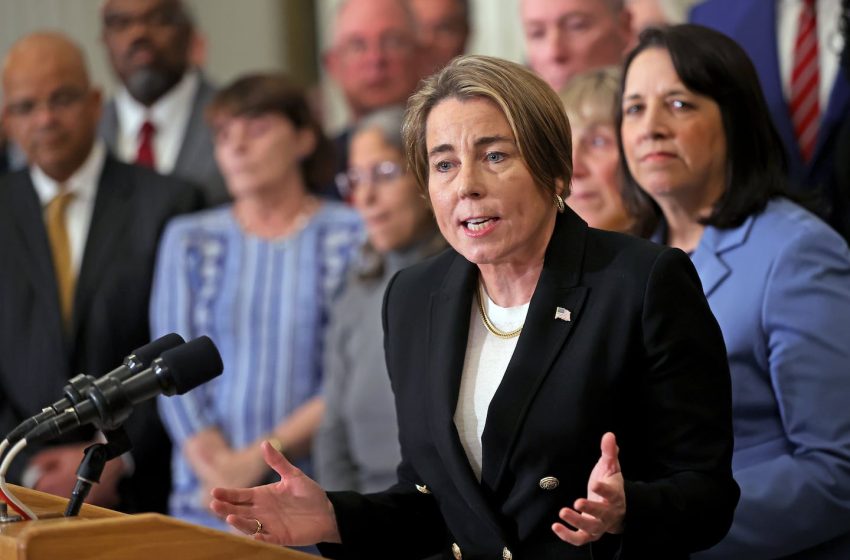
Massachusetts is rolling out a ChatGPT-powered AI assistant for state workers, and will eventually make the digital tool available to all 40,000 workers in the state’s executive branch, Governor Maura Healey announced Thursday evening.
“We’re at a moment where things can get much better quickly,” Healey said at an event at the headquarters of wearable-tech company Whoop in Boston. “Getting governments to lead the way and show how to use this technology, and where this technology is going to do things better, faster, more effectively, that seems really important. I’d love it if this can be an example to the rest of the world.”
Healey was speaking at a gathering of about 250 people for a new private-sector effort supporting AI development, called the Massachusetts AI Coalition, that Whoop helped found.
The state’s announcement comes as governments and big employers are still figuring out how best to use artificial intelligence in the workplace.
While some states such as New York have moved to limit the use of AI by government workers, Massachusetts has moved in the opposite direction, holding a competitive procurement process to find an AI company willing to tailor a chatbot for the state’s workforce.
AI assistants could be used, for example, to help state workers answer questions from citizens by finding relevant information scattered across many web sites and documents. The assistants could also help write emails and presentations or organize data into spreadsheets. Still, ChatGPT and its rival AI bots can make up incorrect information, or “hallucinate,” at times.
OpenAI chief executive Sam Altman appeared at the Whoop event remotely. Speaking with Healey, he offered several examples of how the AI assistant could be useful for government workers.
“It’ll be everything from small things, like dealing with communications with state residents, writing things, reviewing proposals to new things, where people will be using Codex and new versions of ChatGPT that can take actions to create entirely new workflows,” Altman said.
Under a three-year contract, Massachusetts will pay OpenAI based on how many workers use the assistant. The rate will start at $13 per month per worker, decreasing to $9 per month as more agencies start using the assistant.
The new app in Massachusetts will be powered by OpenAI’s ChatGPT but will have additional privacy protections, the state said. The app will be walled off from state data, and input from state workers will not be used for training public AI models.
Healey’s Economic Development Secretary Eric Paley said in a statement that Massachusetts is the first state to offer an AI app broadly across state government, which could encourage other government and private-sector groups to adopt the technology.
“Our hope is that institutions across the state will make the same commitment — to support their talent, move faster, and ensure Massachusetts continues to lead in AI innovation,” Paley said.
States such as California and Pennsylvania have announced pilot programs giving some state workers access to AI assistants, but not at the same broad scale as the Massachusetts program, state officials said.
Under a phased rollout, the state’s Executive Office of Technology Services and Security, which oversees IT infrastructure, will be the first agency to start using the new assistant on Friday. Other agencies will start using it in “coming months,” the state said. The program also includes training state workers how to use the AI app.
The announcement comes just days after Massachusetts legislators moved forward with bills to crack down on some less positive uses of AI. One bill would ban political campaigns from disseminating misleading AI-created media productions. Another would require disclosure of campaigns using AI in their communications.
State Senator Barry Finegold, who chairs the legislature’s Joint Committee on Economic Development and Emerging Technologies, attended Thursday’s event. Massachusetts lawmakers will seek to encourage positive uses of AI while also regulating negative uses, he said.
“We will step in when we need to regulate AI, but to be wholesale against it is a massive mistake,” he said.
Healey has tried to stimulate the AI industry in Massachusetts using a similar strategy of incentives and state funding that helped build the state’s life sciences sector.
In 2024, Healey created a state task force to guide AI policy and encourage economic development. The same year, the legislature approved $100 million to fund an “AI hub” in the state to back a variety of AI efforts.
But in the private sector, Massachusetts has lagged other states — particularly California —in developing and funding AI-related startups. Still, the state can claim a few major AI startups, including music generator Suno and AI model developer Liquid AI.
Aaron Pressman can be reached at [email protected]. Follow him @ampressman.
First Appeared on
Source link






