


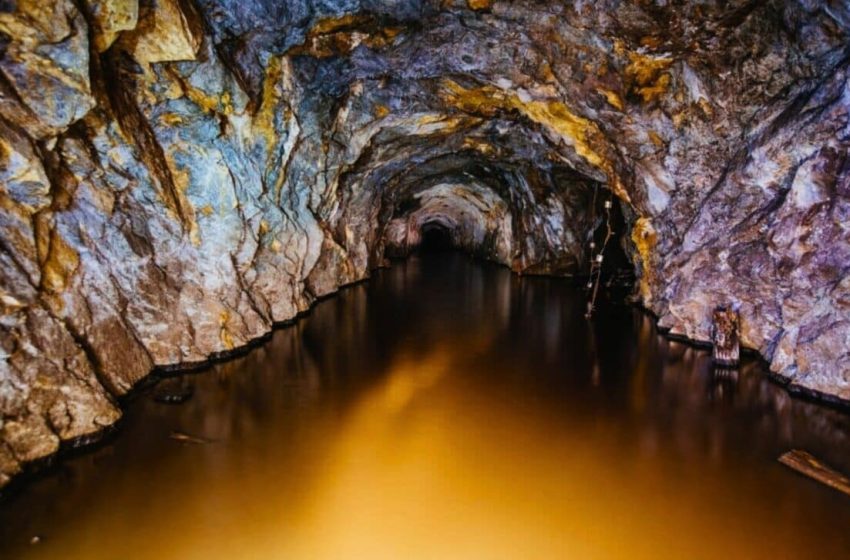
Deep Below Earth, Scientists Uncover 1.2 Billion-Year-Old Water From Before Life Colonized the Land
Deep below the Canadian Shield, in a mine that cuts through some of the oldest rock on Earth, researchers stumbled upon something that had been hiding in plain sight. The water came from a fracture in the rock, seeping out from a place where nothing was supposed to flow. It was found during an investigation into deep microbial life, a search that had taken scientists nearly two kilometers beneath the surface.
The site was a working mine near Timmins, Ontario, an area known more for its gold deposits than for hidden hydrological time capsules. When the water emerged, it carried with it a chemical signature that did not match anything near the surface. The team collecting it knew immediately they were dealing with something ancient. What they did not know was just how ancient.
The discovery would eventually lead to a paper published in Nature Communications, but the work itself traces back to a broader effort to understand how life—if any—can persist in isolation. For Dr. Oliver Warr, a researcher now at the University of Ottawa, the water represented a rare opportunity to measure a system that had been sealed off for a staggering length of time.
The Clock Hidden in Noble Gases
To date the water, the team analyzed a suite of noble gases, including helium, neon, argon, and xenon. These elements act like natural clocks because they accumulate in predictable ways over geologic timescales. When water becomes trapped in a fracture, it stops exchanging gases with the outside world. The isotopes inside begin to tell a story.
Dr. Warr and his colleagues measured the ratios of these gases and found concentrations that pointed to a single, startling conclusion. The water had been isolated for a minimum of 1.1 billion years. In some of the samples, the residence time stretched even further, making it among the oldest free-flowing water ever discovered on Earth.
The mine itself provided the necessary access. Deep underground workings often intersect fractures that remain hydrologically disconnected from the surface. For the mining operations, these zones are obstacles. For geochemists, they are windows into a past most rock formations have long since forgotten.
Life Without the Sun
The water did not arrive alone. When the team analyzed its chemistry, they found evidence of a chemical environment sustained entirely by radiolysis—the splitting of water molecules by radiation from the surrounding rock. Uranium, thorium, and potassium in the granite and quartz veins create a steady, slow-motion breakdown of water into hydrogen and sulfate.
That hydrogen, in turn, provides energy for microbial communities that have never seen sunlight. The discovery suggested that a deep, slow-motion biosphere exists in places where life was not previously expected. It also offered a model for how organisms might survive on other planets, buried beneath ice or rock, shielded from surface conditions.
“We actually found a whole microbial ecosystem living in these fluids,” Dr. Warr said in an interview with the University of Ottawa. “It shows that even in isolated fractures, life finds a way to persist using chemical energy.”
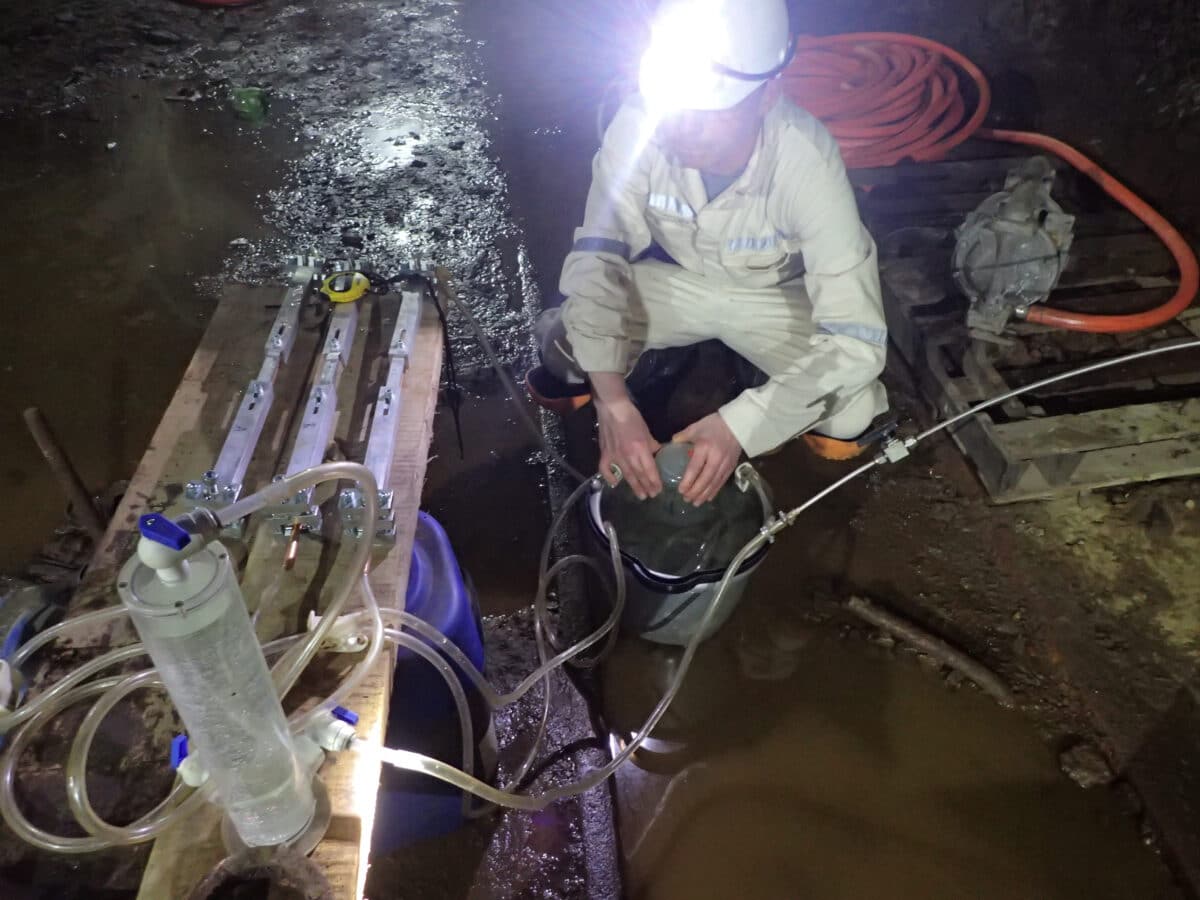
The research did not set out to find billion-year-old water. It set out to map the deep subsurface, a frontier that remains less explored than the surface of Mars in some respects. The fractures in the Timmins mine turned out to be sealed so tightly that the fluids inside retained their original composition from a time when multicellular life on Earth was just beginning to emerge.
What the Numbers Reveal
The noble gas analysis gave the team a specific range: 1.1 billion years to approximately 2.6 billion years, depending on the fracture. The sulfate concentrations in the water provided a separate line of evidence, confirming that radiolysis had been fueling chemical reactions for the entire duration of isolation.
One of the more precise measurements came from the accumulation of argon-40, a decay product of potassium. The amount present in the water matched what would be expected if the fluid had been sealed in place since the Paleoproterozoic era, a period when the atmosphere still lacked free oxygen at levels comparable to today.
For comparison, the previous record for ancient water was found in a South African gold mine in 2013, dated to several tens of millions of years. The Canadian discovery pushed that timeline back by more than an order of magnitude.
A Window Into Deep Time
The implications extend beyond Earth. NASA and other space agencies have long considered subsurface environments on Mars and the icy moons of Jupiter as prime targets for astrobiology. The Timmins discovery demonstrated that water can remain liquid, chemically active, and capable of supporting life for more than a billion years in a stable rock environment.
Dr. Warr’s ongoing work at the University of Ottawa focuses on mapping similar fracture systems across the Canadian Shield, a massive geological formation that covers much of eastern and central Canada. Each new sampling effort adds another data point to the understanding of how deep, isolated systems evolve over deep time.
The water from the Timmins mine continues to be studied. Its chemistry records the history of the surrounding rock, the movement of gases, and the slow, radiation-driven chemistry that sustained whatever microbes once lived in that dark, pressurized space. For more than a billion years, it moved through no river, touched no atmosphere, and saw no daylight.
First Appeared on
Source link






