



Dogs Were Humans’ Best Friends Far Earlier Than Anyone Believed
A 15,800-year-old canine from central Türkiye and a 14,300-year-old jawbone from Gough’s Cave in Somerset have provided the oldest genetic evidence of domestic dogs identified so far. The findings push the confirmed record of dogs back by more than 5,000 years and show they were already living closely with human groups across western Eurasia during the Late Upper Palaeolithic.
The research, published in Nature, centers on ancient DNA taken from prehistoric canid remains found in the UK, Türkiye, and several sites in continental Europe, including a jawbone long overlooked in museum collections.
That matters because the earliest unequivocal genetic evidence for dogs had previously come from remains about 10,900 years old. The new work also links those early dogs to culturally distinct human groups, including Magdalenian, Epigravettian and Anatolian hunter-gatherer populations, suggesting dogs were already part of human life long before the rise of farming.
Ancient DNA Rewrites the Timeline of Early Dogs
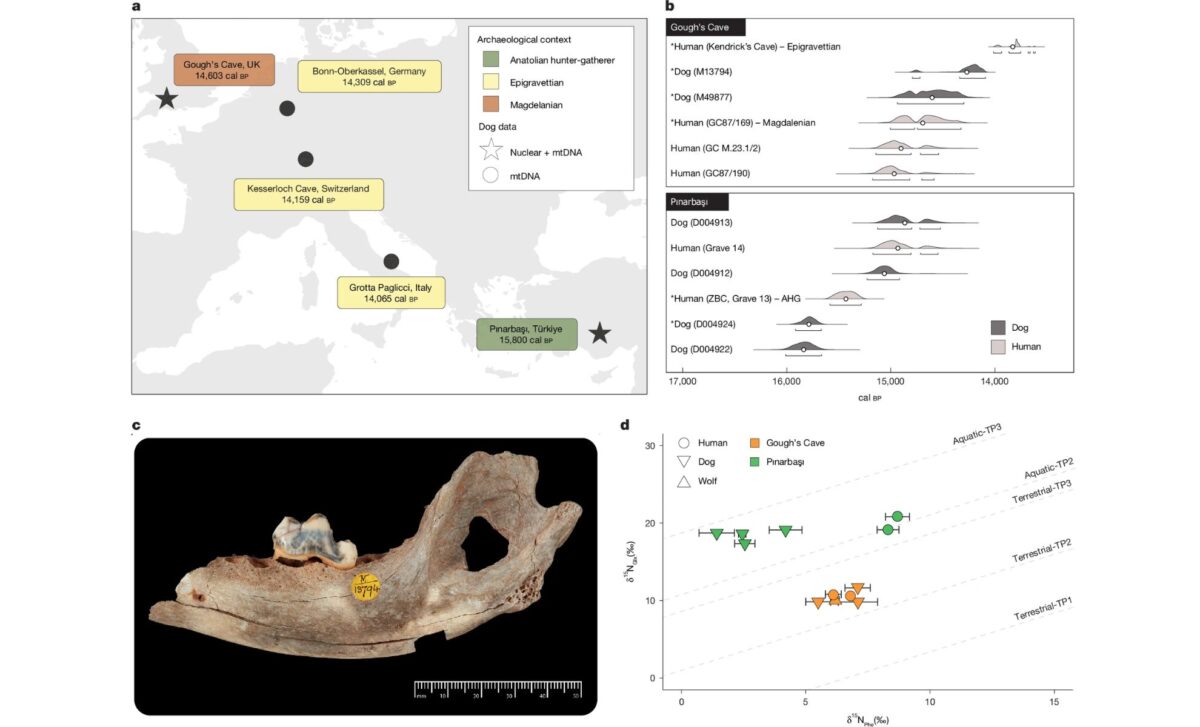
The key shift in the story came from genetics rather than bone shape alone. The Nature paper reports nuclear and mitochondrial genome data from canid remains at Pınarbaşı in Türkiye dated to about 15,800 years ago and from Gough’s Cave in the UK dated to about 14,300 years ago. Both were identified as dogs, not wolves.
According to the Natural History Museum’s account of the study, researcher Dr William Marsh and colleagues first tested several fossil specimens from Gough’s Cave and found that one was “genetically closer to a dog than a wolf.” Marsh said, “We found that one of them was genetically closer to a dog than a wolf. This was a fantastic finding that, at the time, represented the oldest empirical evidence of dogs.”
That result then helped researchers identify additional ancient dogs from sites in Germany, Italy and Switzerland. In the words quoted by the museum, Marsh said, “These specimens allowed us to identify additional ancient dogs from sites in Germany, Italy and Switzerland, which clearly show that dogs were already widely dispersed across Europe and Türkiye by at least 14,000 years ago.” The Nature paper places those directly dated Late Upper Palaeolithic dogs between roughly 15,800 and 14,200 years ago.
The Animals Appear to Have Lived in Close Contact with People
The study does not stop at classification. It also examines how closely these dogs may have been tied to human communities. Chemical analysis of bone collagen showed dietary overlap between humans and canids at both Gough’s Cave and Pınarbaşı.
According to BBC News, Dr Selina Brace said the dietary results showed that the animals “either shared fish in Turkey or the same meat and plant diet in Gough’s Cave.” She added, “So what this would suggest is an incredibly close relationship between humans and dogs.”
The Nature paper goes further on the archaeological context. At Gough’s Cave, the dog remains show postmortem modification comparable to treatment seen on human remains at the site. At Pınarbaşı, neonatal and juvenile dogs were buried in the same area as human burials. That does not read like a loose association, or not only that. It points to dogs being integrated into human groups across very different settings.
Early Dogs Spread across Distinct Human Cultures
One of the paper’s central findings is that these early dogs were genetically very similar even though they were linked to different human populations. The Gough’s Cave dog was associated with a Magdalenian context, while other early dogs were tied to Epigravettian and Anatolian hunter-gatherer groups.
According to the Natural History Museum, Marsh said, “Remarkably, we found that all these dogs were genetically very similar, even though they were discovered thousands of miles apart and associated with humans who were culturally, genetically and behaviourally very different.” The researchers suggest this pattern may reflect interaction and exchange between human groups.
A companion study in Nature, covered by BBC News, also analyzed DNA from more than 200 ancient dog and wolf remains from Europe and the Near East. Dr Anders Bergström said, “Wherever dogs were first domesticated, they had already reached Europe by at least 14,000 years ago and they go on to contribute quite substantially to the dogs we see today.” That leaves the origin point unresolved, but it firmly places domestic dogs in human worlds much earlier than the confirmed record had shown.
First Appeared on
Source link






