



‘Eternal Sunshine’ therapy could ‘wipe’ bad memories and replace them with better ones, according to top neuroscientist
Memories of past trauma could soon be ‘dialed down’ in the brain so they no longer haunt us, a leading neuroscientist has suggested.
The same techniques could offer tools so that addicts don’t crave the drugs that are destroying them – and even reclaim memories lost to Alzheimer’s disease or amnesia.
In his new book, How to Change a Memory, Professor Steve Ramirez explored a realm of science so advanced that, until now, it has only existed in sci-fi movies like Eternal Sunshine of the Spotless Mind and Total Recall.
And, as he chronicled both his breakthroughs experimenting on the brains of rodents at Boston University, as well as his grief over the death of his lab partner, Xu Liu, he revealed that rewriting human memories could one day become a common part of modern medicine.
Ramirez told Daily Mail he has been able to locate memories in mice using brain cells activated by light.
His team has then manipulated them by implanting false memories and reclaiming ‘lost’ ones.
The results, he said, have been ‘pretty amazing,’ suggesting the same might be possible in humans.
He explained: ‘Researchers have been able to successfully restore a memory that was thought to be forever lost, so that really begins shaking the foundations of what we think of when we think of memory.’
In a new book, How to Change a Memory, Professor Steve Ramirez explores how emerging science may make it possible to ‘rewrite memories’
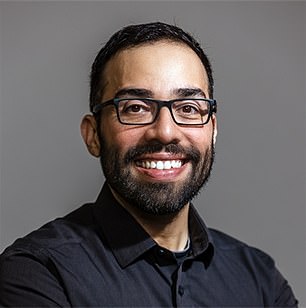
Professor Steve Ramirez had memory breakthroughs in mouse experiments (Janice Checchio)
Key to understanding the science is the fact that remembering something is ‘not like hitting “Save” in Microsoft Word,’ he pointed out. Rather, every time you remember something, that memory changes slightly.
‘We know that when we recall the memory, it’s not a video of the past, but it’s a reconstructive process where we pull the book of memory out of the library, and when it’s at the forefront of our mind, we inadvertently start sketching details into that memory.’
The next step to manipulate those memories through science, he claimed, is ‘pretty simple.’
Drugs could be used to target cells holding specific memories, he said. Cognitive behavioral therapy or positive cues could also help make the desired changes.
‘None of that breaks any law of physics. There’s just more research we need to get to that point.’
He stressed that science will not erase memories.
‘It’s more than we can start to toggle down the emotional components, which perhaps are the debilitating components.
‘Or we could even toggle up some of the components, if we wanted to boost the positivity associated with a memory.’
He did, however, admit that science has the potential to be abused by malicious parties.
‘One potential problem is that people might manipulate memories to sell products, just like how, today, that five-second ad you see on social media grows in your head like a seed until it becomes a decision.
‘If we know all that information is encoded in the brain,’ he added, ‘even to the point of guiding behavior, we should hope that this knowledge is used for the greater good – as opposed to for selling products or for marketing.’

In a new book, How to Change a Memory, Professor Steve Ramirez explores how emerging science may make it possible to ‘rewrite memories’
The experiments of his and other labs are still some way off from understanding exactly what patterns of brain cells are involved.
But he said: ‘If we can study how a traumatic memory is recalled, and we know the nuts and bolts of how it works, then we should be able to intervene with it in a more targeted manner in humans.’
Scientists in Geneva have already shown it’s possible to deal with addiction in this fashion, and Ramirez believes similar methods could be used to ‘reset’ the brain back to a healthy baseline.
But the most powerful benefit, he said, will be the means to reclaim ‘lost’ memories in Alzheimer’s and other conditions.
Ramirez said: ‘I think that’s a kind of mini Holy Grail of this all, to be able to really restore what we once thought was lost, especially something as near and dear as memory.
‘There are tremendous amounts of more research we need to get there, but I think that would be what the path forward would look like.’
Ramirez’s own understanding of the fluidity of memory helped him deal with the untimely death of his lab partner, Xu Liu.
He said: ‘For me, I’ve come to terms with memory being the thing that shaped who I am today, for better and for worse.
‘There are certainly difficult aspects of my past, whether it’s loss and grief or addiction for that matter, but I wouldn’t change it because I’ve learned to grow my life around it.’
After Xu Liu’s death, Ramirez began obsessively lucid dreaming about him – dreams where the dreamer can control events – and now he believes those dreams were his brain’s attempt to offer him hope.
He said: ‘It’s simultaneously my goal to honor my friend, who is the beating heart of the book, and to do justice to the memories we had together.’
How to Change a Memory: One Neuroscientist’s Quest to Alter the Past by Steve Ramirez is published by Princeton University Press
First Appeared on
Source link






