


Grassroots Organizers in Wisconsin Offer Blueprint for Beating Back Data Centers
By Derek Seidman
This article was originally published by Truthout
Private equity firms are investing heavily in new AI data centers, but local communities are finding ways to fight back.
Data centers are big business. Around 3,000 new data centers — huge buildings that house the computing power that props up the growing use of artificial intelligence (AI) — are currently being built or planned across the U.S. Some speculate that global spending on data centers could hit $3 trillion by 2029.
Corporate interests — from energy firms and construction companies, to real estate businesses and utilities — are looking to cash in. But private equity — that powerful and opaque slice of Wall Street, run by mega-billionaire founders, focused on private investment and outsized profits — is an especially outsized force driving the data center boom, pouring billions into construction deals while also positioning itself to profit from supplying AI’s insatiable energy demands.
AI profiteers, however, have come up against a major obstacle: a growing, vibrant, locally rooted resistance movement, stretching across the U.S., against the data center boom.
Communities across geographic divides are protesting the intrusion of data center projects backed by Wall Street and Big Tech that they fear will bring everything from noise and pollution to higher electric bills and depletion of water sources.
“A Whole Grassroots Movement”
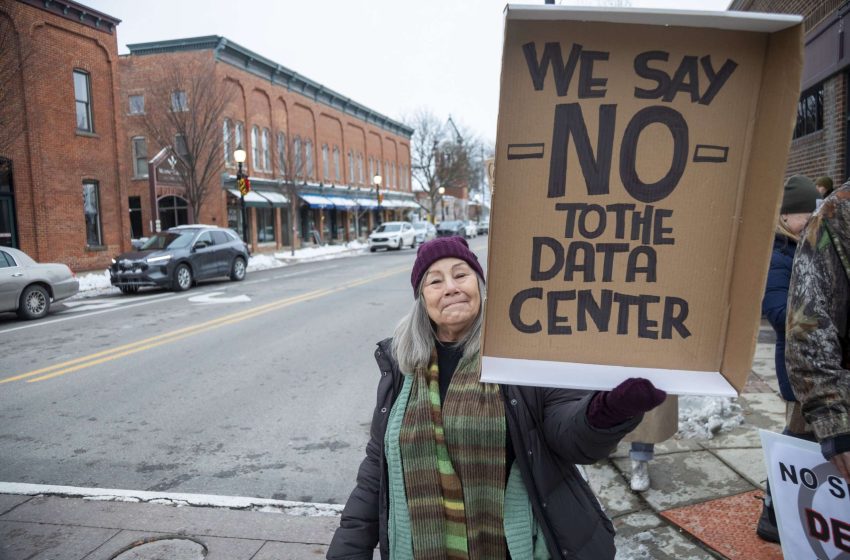
One of those places is DeForest, Wisconsin, a small village outside Madison. Residents grew concerned last year when they learned that QTS — a unit of Blackstone, the world’s largest private equity firm — was proposing a 1,600-acre data center on land that would be annexed into DeForest from a neighboring town.
A group of community members started attending village board meetings and encouraging locals to speak out. They formed a Facebook group, No Data Center in DeForest, in October 2025.
“It really became a whole grassroots movement,” DeForest resident Tricia Boehlke told Truthout.
Community members feared the data center would devour water and jack up electricity rates. Many were concerned about the smell and noise. The physical intrusion of the facility — set to be built literally outside the front yard of one organizer — would taint the village’s beautiful natural surroundings. Boehlke, who works in the mental health field, also worried the din and pollution could trigger sensory issues.
“The risk of what they could do is irreversible,” she said. “If I didn’t do everything in my power possible to stop this, I would regret that for the rest of my life.”
Organizer Winona Storms said QTS-owner Blackstone “didn’t really show their face,” and that “if we brought up Blackstone, it would get ignored” by the village board. Some questioned whether Blackstone, far off in its New York headquarters, led by its mega-billionaire CEO, even knew about what was happening in DeForest.
“You can’t just come into a community and expect yourself to be welcomed with open arms when you have no clue what’s going on here,” Boehlke said. “It was really shocking to me.”
Organizers against the data center believe that the Madison-based electric utility Alliant Energy, which has partnered with QTS, was the major local force set to benefit from the data center.
The campaign quickly gained traction. It obtained documents showing that village staff were in discussions with QTS and Alliant representatives months before the proposal was announced. Opposition to the data center crossed political divides. The No Data Center in DeForest Facebook group now has over 4,000 followers in a village of just over 10,000.
The resistance to the data center won a victory on February 3 when DeForest’s village board voted unanimously against the land annexation involving the data center, leading a disappointed QTS to withdraw its application.
Local organizers are thrilled with the win, but worry that QTS will look for another way to build the data center. For now, they’re strengthening their alliances with other campaigns in Wisconsin, where $57.6 billion worth of new data center projects are being proposed.
“We need to celebrate every win, but we also need to remember that this is far from over,” said Storms. “Until regulations are put in place for building and operating data centers, as well as regulations placed on privatized electricity companies, this isn’t over.”
“We won the battle,” said Storms. “I wouldn’t say we won the war.”
“A Global Construction Frenzy”
Meanwhile, across the country, from Arizona to Georgia and from Minnesota to Tennessee, communities are rising up against the onslaught of proposed data center projects in their areas. Data centers promise few permanent jobs but portend plenty of noise, pollution, massive water usage, and rising electric bills, all while gobbling up tax subsidies.
Because of this, there’s a rising movement in localities across the U.S. against the data center construction boom — including against data center projects being backed by powerful private equity giants.
“Private equity firms are getting involved in multiple spots across the whole value chain of AI infrastructure and the data center boom,” Amanda Mendoza, senior research and campaign coordinator on climate at the Private Equity Stakeholder Project, told Truthout.
The AI boom hinges upon the proliferation of data centers — “giant buildings [that] house the backbone of the internet” and “more recently artificial intelligence systems — using technology and heating and cooling systems to keep the computers inside the centers humming,” as The New York Times wrote.
The past few years have seen an explosion in data centers in the U.S. and globally, with thousandsbeing constructed or planned. While specific numbers vary, investors are pouring tens of billions into data center deals annually as “demand for AI” has triggered “a global construction frenzy that shows no signs of slowing,” according to S&P Global.
Beyond gargantuan buildings, the data center boom entails a vast ecosystem that includes “powered shells and facility infrastructure (such as power systems, cooling, and connectivity)” and “network, storage, and compute resources, each creating distinct supply-chain and capital needs,” notes the corporate law firm Morgan Lewis.
A key driver behind the data center boom is private equity. According to one March 2025 report, private equity firms have invested in “over 450 data center companies since January 2022” and “have spent nearly $200 billion on data center deals and have been behind 80 to 90 percent of completed mergers and acquisitions in the data center-related industries in the past three years.”
“Bedrock of Modern Infrastructure Portfolios”
Diversified private equity firms — the giants like Blackstone, KKR, Macquarie, and Carlyle that invest in nearly everything — dominate the industry’s data center business, alongside more tech-focused firms.
Whereas data centers used to be “niche alternative assets” for private equity investors, they’ve now become “the bedrock of modern infrastructure portfolios,” writes Data Centre Magazine, with investors “increasingly drawn to the sector’s predictable cash flows, long-term leases and the sheer scale of capital required to meet future capacity demands.”
Tech giants like Meta, Google, Facebook, and Amazon are issuing more debt to splurge on data centers, but they need help propelling the vast and fast hyper-scaling efforts demanded by the insatiable computing demand of artificial intelligence. Private equity is viewed as an available and eager partner sitting on hundreds of billions of investor dollars.
Private equity’s massive business in commercial real estate positions it well to strike data center deals. “The data center industry is basically just glorified commercial real estate that happens to feature insanely expensive computer microprocessors that need a hell of a lot of expensive utility infrastructure,” Tyson Slocum, the director of Public Citizen’s Energy Program, told Truthout.
A recent Americans for Financial Reform report also notes that private equity has “established a foothold in all parts of the data center lifecycle,” which includes everything from “assembling land where future data center campuses will be built” to “direct data center operation.”
Private equity also supported lobbying efforts for data center development while its industry groups are boosting private equity’s role in the AI and data center boom.
Blackstone and BlackRock
Private equity’s grab on the data center boom is encapsulated by the industry’s top firm, Blackstone, which manages over $1.2 trillion in assets, and whose co-founder and CEO is billionaire Stephen Schwarzman, a close Donald Trump ally.
In 2021, Blackstone acquired the data center giant QTS — again, the company behind the proposed data center in DeForest — for $10 billion. Today, QTS is a top-three U.S. data center provider with dozens of data centers operating or planned across the country.
Talks of an AI bubble don’t appear to worry firms like Blackstone, which is seeing “strong demand from tech companies” willing to sign “airtight leases for 15 to 20 years to rent out data center space,” according to The New York Times.
Blackstone’s AI bet also goes well beyond data centers. In 2025, Blackstone acquired Potomac Energy Center — a massive natural gas power plant that supplies “Data Center Alley” in Northern Virginia, home to around a quarter of all U.S. data center capacity — and also announced a $1.2 billion investment to build the huge Wolf Summit Energy gas plant in West Virginia to power data centers.
Blackstone also recently announced major investment plans in data centers and fracked-gas power generation in Pennsylvania alongside its billion-dollar acquisition of the Hill Top Energy Center in Western Pennsylvania, “situated in an area of the country that is well suited to serve as a strategic hub to power America’s AI future,” according to a press release.
Meanwhile, asset management giant BlackRock — not to be confused with Blackstone — is also coming for the data center market, leading a consortium of tech giants in a $40 billion acquisition of Aligned Data Centers, a global data center power house with nearly 80 locations, in October 2025.
“The Whole AI Supply Chain”
Private equity has also positioned itself to profit from AI through its stakes in fossil fuels, power generation, and utilities.
As Truthout has reported, BlackRock’s acquisition of Allete, an electric utility, and its subsidiary Minnesota Power, was approved by state regulators in late 2025 despite major community opposition. As many feared, new reports indicate that Minnesota Power has been in talks, which were not disclosed during the proceedings over the BlackRock acquisition, to supply a nearby proposed data center in Hermantown, Minnesota, that has faced intense local resistance.
“Private equity firms are investing heavily along the whole AI supply chain,” said Mendoza.
Analysts warn that private equity takeovers of utilities serving data centers will generate higher electric bills for consumers. “They’re going to raise rates on ordinary people who need electricity,” said Mendoza. “They’ll profit off them while raking in more money supplying data centers as well.”
BlackRock is now gunning for utility giant AES while Blackstone is seeking final approval to swallow up TXNM Energy.
On top of this, private equity is positioning its vast portfolio of fossil fuel assets — drilling operations, pipeline companies, power generation — to feed data centers.
According to the Private Equity Climate Risks, 20 top private equity firms own nearly 250 fossil fuel assets, from oil pipelines and power plants to coal terminals and liquified natural gas export facilities. Many of these private-equity owned assets — such as Greylock Energy, owned by ArcLight Capital, or Antero Resources, backed by Quantum Capital — are orienting toward data centers.
Resistance to Data Centers Is Not Futile
For those taking on data center proposals in their own areas, movements like those in DeForest offer many lessons, from the importance of connecting and organizing with your neighbors, to establishing online groups to connect people and share information, to mobilizing the community to turn out en masse to pressure officials.
Organizers with No Data Center in DeForest have advice for other communities facing on the same issue.
“Show up for all the events,” such as town or city board meetings and planning and zoning meetings, says Storms, and file public records requests to uncover what authorities are doing away from the public eye.
Most of all, says Boehlke, connect with others.
“Get together with your neighbor,” she says. “You just have to open your eyes, pay attention, and start a grassroots movement.”
This article was originally published by Truthout and is licensed under Creative Commons (CC BY-NC-ND 4.0). Please maintain all links and credits in accordance with our republishing guidelines.
First Appeared on
Source link






