


Inside the demise of Syria’s Kurdish autonomy
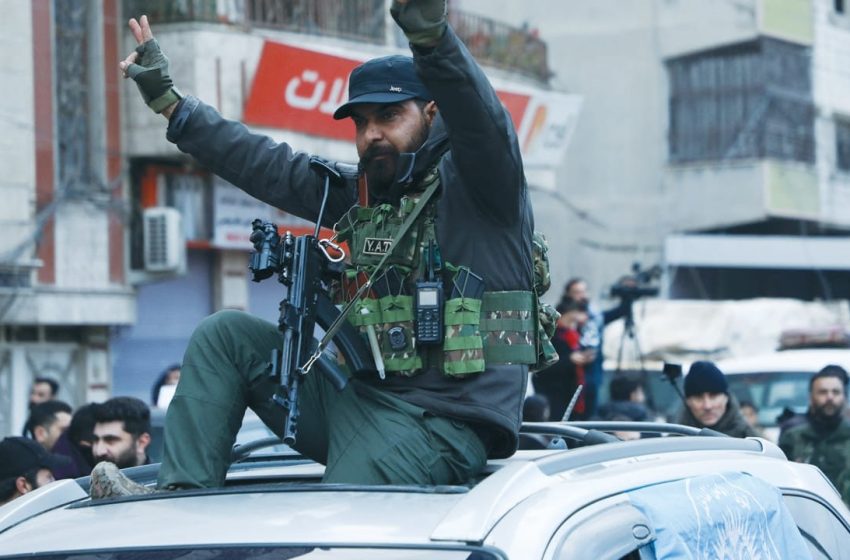
Elements of the Syrian Interior Ministry this week entered the city of Qamishli, in the country’s embattled northeast.
The arrival of these forces sets the seal on the effective demise of the Kurdish-led Autonomous Administration of North and East Syria (AANES), which governed Syria east of the Euphrates for the greater part of the last decade.
It represents a signal achievement for the Islamist authorities in Damascus, in their efforts to build a centralized, Sunni Arab Syria.
A month ago, Syria’s Kurds possessed a de facto area of control comprising a third of Syria, with its own armed forces, oil and gas resources, access to foreign territory through the control of border crossings, and independent political authorities in direct contact and coordination with external powers. As of this week, this entity effectively no longer exists.
The demise of the Autonomous Administration does not represent, exactly, an unconditional surrender by Syria’s Kurds. The January 30 agreement, which appears to have averted a direct confrontation between the Syrian Democratic Forces and Damascus’s forces, is, rather, a blueprint for the gradual integration of the institutions of the AANES under the authority of the Damascus government.
All out assault prevented
Evidently, Kurdish mobilization of forces in the heartland of the northeast, after the rapid loss of the Arab-majority provinces of Raqqa and Deir al-Zor further south, plus representations by Kurds and their allies to the US administration and other Western governments, most importantly France, prevented, for now at least, an effort by the Damascus authorities to attempt an all-out assault on the Kurdish areas.
This is in contrast to the behavior of the authorities in their pacification of the Alawite population in Syria’s western coastal area last March, and against the Druze in April and then in July (at least until Israeli airpower shifted the dynamic in the southwest).
It reflects the patience and tactical flexibility of the Islamist authorities in Damascus, and the formidable strength on the ground and commitment that the Syrian Kurds had built up over the preceding decade.
Nevertheless, the direction of events is clear, as is who has won and who has lost. The key point to bear in mind with regard to the recent events in Syria is that the advance of the new regime in Damascus will not lead to an alteration in the core dynamics of the country. Nor will it draw a line under the ethnic and sectarian tensions which led to the rise of a separate Kurdish organization in Syria in the first place. Rather, what has taken place in Syria over the last year is a historic changing of the sectarian balance of power in Syria, without a change in the nature of the contest in the country.
A half-century of rule by members of the Alawite minority in Syria was replaced in December 2024 by a return to the dominance of Syria’s Sunni Arab majority.
The Alawite-dominated Ba’ath regimes, which held power in Syria from 1966 to 2024, did not succeed in knitting Syrians together into a single, unified population. Rather, they held power in their own interest, behind a veneer of Pan-Arab sloganizing.
The increasing incompetence of their rule eventually triggered a Sunni Arab uprising against them, in which other minorities (Kurds, Druze, to an extent Christians) sought mainly to stand aside and defend their own security.
This Sunni uprising, which rapidly became dominated by Islamist and jihadi forces, achieved victory in December 2024, as a result of the weakening by Israel of forces aligned with the Assad regime, whose protection had underwritten its survival.
The new regime is currently engaged in building a Sunni Islamist Syria, in alliance with other Sunni regional forces, most significantly Turkey and Qatar, and to a lesser extent Saudi Arabia.
The Kurdish-dominated Autonomous Administration, with its commitment to decentralized government and to secular norms of rule, constituted an obvious obstacle to this project. With active Turkish backing and Western acquiescence, this obstacle has now been removed.
So what has changed is the balance of power between Syria’s sects. After a period in which the Alawite ascendancy was pushed back, leading to a kind of de facto partition and uneasy equilibrium, what is now taking place is that a new and dynamic Sunni Islamist regime is driving forward, consolidating its power.
The available evidence suggests that the regime under construction is dominated by a clique of former leaders of the Hayat Tahrir al-Sham organization, led, of course, by President Ahmed al-Sharaa. These leaders share a common background in Salafi jihadi armed organizations and have a shared Islamist outlook.
As of now, the system they are establishing includes nominal representation for forces other than the HTS clique (in, for example, the toothless “parliament”), while in practice ensuring the dominance of the ruling clique.
The HTS clique cannot afford to ignore all other voices. Specifically, it is important to remember that HTS was a small organization of around 30,000 fighters when it took power. Its new regime is being built in a necessary alliance with other Sunni Islamist forces, which were also part of the victory against Assad.
Thus, we see the re-badging of local jihadi commanders such as Mohammed al-Jassim and Saif Abu Bakr as division commanders in the Syrian Arab Army, and the use made by the regime of tribal fighters in their campaigns in the Alawite, Druze, and now Kurdish areas over the last year. But what is emerging is not a new and inclusive Syria. Rather, unsurprisingly, the new Sunni ascendancy appears to resemble in many ways the Alawite ascendancy that it destroyed and replaced.
For the Syrian Kurds and other minorities, this promises nothing good. These communities in the period opening up will be seeking three main objectives: to maintain as far as possible their separate armed and political structures; to maintain links to their supporters outside the country; and to preserve the visibility of their cause and interests among their co-ethnics and in the chancelleries of foreign governments. Both Syrian Kurds and Syrian Druze have assets and advantages in these areas, Syrian Alawites less so.

What the end of Syria’s Kurdish autonomy means for Israel
For Israel and other neighboring states, the concerns are less immediate but notable.
It’s not entirely clear why the US administration and other Western governments elected so quickly to back the current Sunni Islamist regime in Damascus, and to jettison long-standing partnerships with other forces. This decision, above all else, has made possible subsequent developments.
In any case, both Middle Eastern and Western governments would be advised to note that the aggressive and sometimes murderous tactics employed in the past by Syrian regimes to subjugate those elements of the population not belonging to the particular ethno-sectarian grouping in power usually ended up employed also against external enemies, once the internal dissent was crushed.
This was the case with the Alawite/Baathist/Assad regimes, which directed their attentions to Lebanon and Israel, once the regimes had pacified their internal enemies.
The current regime in Damascus appears to be following the playbook of its predecessor in its treatment of those Syrians not forming part of the new dominant group.
Regional and Western policy should bear in mind the probability that this similarity will in time extend beyond the borders of Syria.
First Appeared on
Source link






