


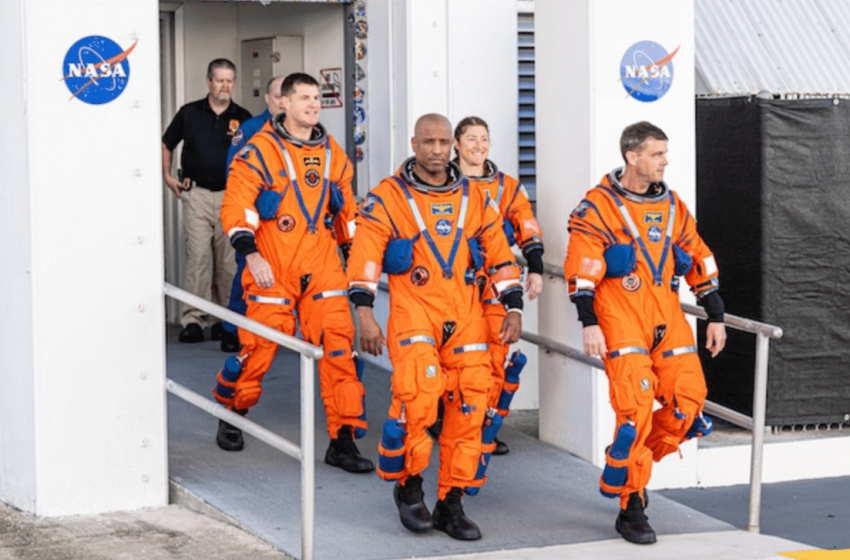
Is Artemis 2 Too Risky for Astronauts? NASA Won’t Give a Clear Answer
NASA’s Artemis 2 mission, set to launch in April 2026, is a monumental step forward in human space exploration, yet it comes with inherent risks. As the first crewed mission of the Artemis program, it will send astronauts on a daring journey around the moon, marking humanity’s return to lunar exploration. But just how risky is this mission? With little data to go on, NASA remains cautious in its assessment, leaving the question of safety open to interpretation.
Assessing the Risk of Artemis 2: NASA’s Cautious Approach
The Artemis 2 mission, aiming to send four astronauts on a 10-day lunar orbit, marks a new era in space exploration. However, NASA’s reluctance to release specific risk assessments highlights the uncertainty surrounding the mission. During a recent briefing, key figures in the Artemis program, including John Honeycutt, chair of the Artemis 2 mission management team, and Lori Glaze, acting associate administrator for NASA’s Exploration Systems Development Mission Directorate, expressed caution regarding the probability of mission failure.
NASA’s hesitation to provide definitive numbers is largely due to the lack of sufficient data to accurately assess risk. Glaze and John Honeycutt, chair of the Artemis 2 mission management team noted,
“That basically means we’re probably not 1 in 50 on the mission going exactly like we want to, but we’re probably not 1 in 2 like we were on the first flight.”
This comparison to the Space Launch System (SLS) rocket’s first flight under Artemis 1 indicates that while the risks have been mitigated since the inaugural launch, they have not been eliminated.
When pressed further, Honeycutt explained,
“That’s what I would tell you. I think we’re being really careful not to really lay probabilistic numbers on the table for this mission, just given the small amount of data.”
His words underscore the inherent difficulty in predicting the success of a mission like Artemis 2, given the unpredictable nature of space travel and the limited number of test flights leading up to this one.
The Artemis Program and NASA’s Historical Context
The risk assessment for Artemis 2 doesn’t exist in a vacuum. It draws parallels to past human spaceflight programs, particularly the Apollo missions and the Space Shuttle program. According to Space.com, the risks associated with crewed space missions have always been a delicate subject. NASA’s Office of Inspector General (OIG) recently estimated that Artemis missions to the lunar surface could face a 1 in 30 risk of failure, with a 1 in 40 risk during the moon operations phase.
This figure places Artemis 2’s risk at a much lower level than that of the Apollo missions, which faced a terrifying 1 in 10 risk of crew loss. The OIG report also highlights the early risks associated with the space shuttle program, which operated from 1981 to 2011. Initially, shuttle managers estimated the risk of crew loss at 1 in 100, but, in retrospect, they discovered that the actual risk was closer to 1 in 10 for the early flights. This historical perspective on spaceflight safety helps to put current Artemis 2 assessments into context and raises important questions about how NASA handles risk.
The Challenge of Estimating Risks in Space Exploration
One of the key challenges in evaluating the risk of Artemis 2 is the diversity and unpredictability of potential dangers. NASA has identified micrometeoroids and orbital debris (MMOD) as one of the most significant risks to the mission. These objects, which float in space at high velocities, pose a threat to spacecraft and astronauts. However, Honeycutt acknowledged the difficulty of fully understanding this risk, stating,
“We have pursued loss of mission, loss of crew-type number assessments, but I’m not sure we understand what they mean.”
In discussing the MMOD risk, Honeycutt pointed out the complexities involved: “It’s real, right? But when have the last two bad events occurred? Going uphill, in that highly energetic event.” He was likely referring to the devastating Challenger and Columbia accidents, which killed 14 astronauts over the course of NASA’s space shuttle missions. These events, which resulted from catastrophic failures during launch and re-entry, are a stark reminder of the dangers that lurk in space exploration.
Despite these challenges, Honeycutt emphasized that the Artemis 2 mission is carefully planned, with the aim of minimizing risks. However, he also noted the tendency to downplay certain dangers, such as MMOD, until they manifest. His words illustrate the complexity of human spaceflight, where the risks are always present, but not always fully understood.
First Appeared on
Source link






