


NASA Orbiter Just Discovered a 225-Meter Crater That Formed on the Moon in a Rare Once-in-a-Century Impact
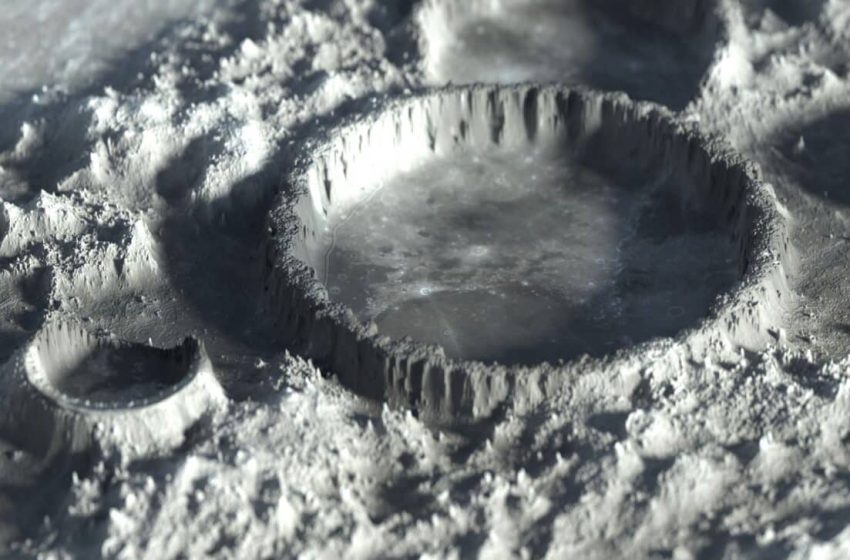
A 225-meter-wide crater quietly formed on the moon in 2024, only to be discovered months later in orbital images. The event, rare on a human timescale, is now drawing attention for what it reveals about ongoing impact risks on the lunar surface.
The finding emerged from routine image comparisons conducted with the NASA Lunar Reconnaissance Orbiter, a spacecraft that has been mapping the moon since 2009. Scientists did not witness the impact itself. Instead, they identified the fresh scar after it had already reshaped part of the lunar terrain.
Such discoveries matter beyond pure observation. The moon is often described as geologically inactive, yet impacts like this continue to modify its surface. According to planetary scientist Mark Robinson, the scale and effects of this crater highlight hazards that future lunar missions cannot ignore.
A Rare Crater Discovered After Formation
The newly identified crater spans approximately 225 meters, making it significantly larger than others documented in recent years. As explained by Mark Robinson, who presented the finding on March 17 at the Lunar and Planetary Sciences Meeting in Texas, impacts of this size are expected only once every 139 years.
This makes the event exceptional in the context of modern observation. Earlier in the orbiter’s mission, one of the first fresh collision marks detected measured about 70 meters across. Robinson noted that even locating a 100-meter crater once seemed ambitious, yet this latest discovery more than doubles that benchmark.
Its Structure Holds Hidden Secrets
The lunar pit lies at the boundary between two distinct lunar regions: the rugged highlands and the smoother mare plains formed by ancient lava flows. This location helps explain its physical characteristics.
Its depth averages around 43 meters, with steep edges suggesting formation in strong, solidified material such as cooled lava. At the same time, its slightly elongated shape points to uneven subsurface layers. This combination indicates that the ground beneath the impact site is not uniform, adding complexity to how it formed.
A Wider Impact Than Expected
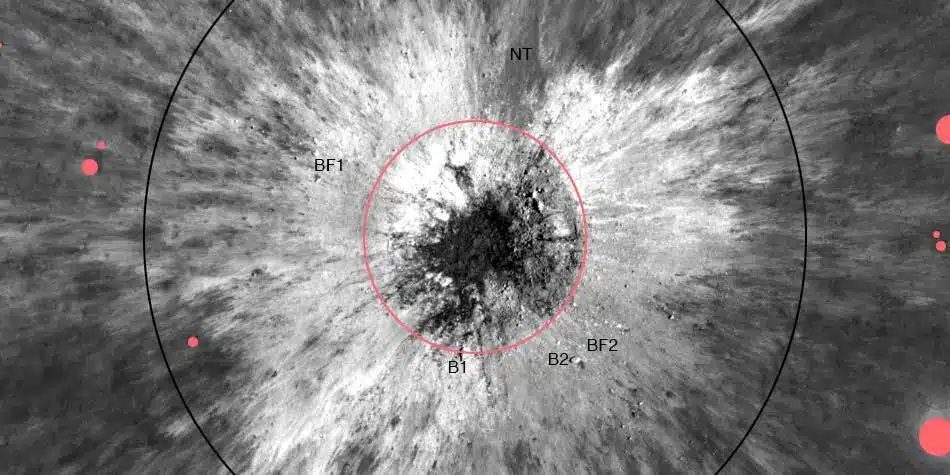
The impact did not stop at carving a hole in the surface. A bright blanket of ejecta, rock and dust expelled during the collision, surrounds the impact basin and extends hundreds of meters outward. As reported by the research, published in Universities Space Research Association (USRA), disturbances linked to the event were detected as far as 120 kilometers away.
This wide dispersal carries practical implications. Robinson warned that debris from such impacts can travel at speeds on the order of a kilometer per second. That means material ejected far from the impact site could still pose a threat to infrastructure.
First Appeared on
Source link






