


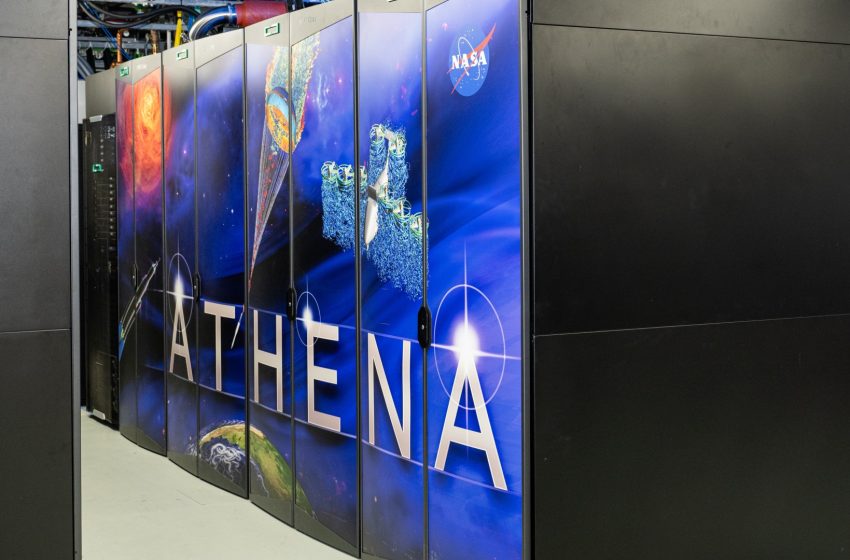
NASA unveils its most powerful supercomputer with 20 petaflops
As NASA ventures further into space, the agency is continuously scaling its supercomputing power to handle increasingly complex mission demands.
NASA has officially debuted Athena, its most powerful and efficient supercomputer to date.
Announced on January 27, this new system is designed to anchor the agency’s next-generation space, aeronautics, and scientific research.
Athena is the newest flagship of NASA’s High-End Computing Capability (HECC) project. It is based at NASA’s Ames Research Center’s Modular Supercomputing Facility in California’s Silicon Valley.
With its superior speed and efficiency, Athena allows NASA to tackle increasingly complex simulations and train large-scale AI models.
“Exploration has always driven NASA to the edge of what’s computationally possible,” said Kevin Murphy, chief science data officer and HECC lead.
“Now with Athena, NASA will expand its efforts to provide tailored computing resources that meet the evolving needs of its missions,” Murphy added.
20-petaflop brain
Athena acts as the agency’s premier engine for its most ambitious exploration goals.
It provides the heavy-duty processing power required to simulate complex rocket launches and model next-generation, fuel-efficient aircraft. With its power, NASA can save millions in physical testing.
Apart from physics simulations, NASA’s newest supercomputer serves as a training ground for large-scale artificial intelligence foundation models.
These AI systems can rapidly sift through petabytes of satellite and mission data, identifying patterns and scientific insights that would be impossible for human researchers to uncover on their own.
For instance, researchers can use Athena to simulate complex atmospheric patterns and forecast the terrestrial effects of solar storms
Interestingly, Athena marks a massive leap in computational power, delivering a peak performance of over 20 petaflops — surpassing the capabilities of its predecessors, Aitken and Pleiades.
The system utilizes 1,024 nodes powered by high-core-count AMD EPYC processors to execute countless calculations per second.
To support its massive processing power, the system features 786 TB of memory, enabling the analysis of enormous, complex datasets.
Reportedly, NASA moved Athena into full-scale operation for all users on January 14, 2026.
“The supercomputer is available to NASA researchers and external scientists and researchers supporting NASA programs who can apply for time to use the system,” NASA noted in the press statement.
Hybrid computing approach
Athena represents a shift in how NASA thinks about “the cloud.”
Rather than relying only on on-site hardware, the HECC portfolio now uses a hybrid computing approach. It allows scientists to bounce between Athena’s raw physical power and the flexibility of commercial cloud platforms.
This versatile setup empowers researchers to hand-pick the ideal computing environment for their specific mission, whether running complex physics simulations, training advanced AI, or processing massive streams of data
The name “Athena” was chosen by the workforce in 2025. The name fits because Athena is Artemis’s sister and a symbol of wisdom.
As NASA explores further into space, Athena will handle the complex math needed to keep every mission safe.
“With Athena, NASA is laying the digital foundation for the next era of discovery,” the US space agency stated.
At Kennedy Space Center, NASA teams are currently in the final stretch of preparations for the Artemis II test flight. Engineers are currently ahead of schedule, readying the SLS rocket and Orion spacecraft for a critical wet dress rehearsal.
This phase culminates in a full simulated launch scheduled as early as Saturday, Jan. 31, marking a major milestone in the agency’s return to lunar exploration.
First Appeared on
Source link






