


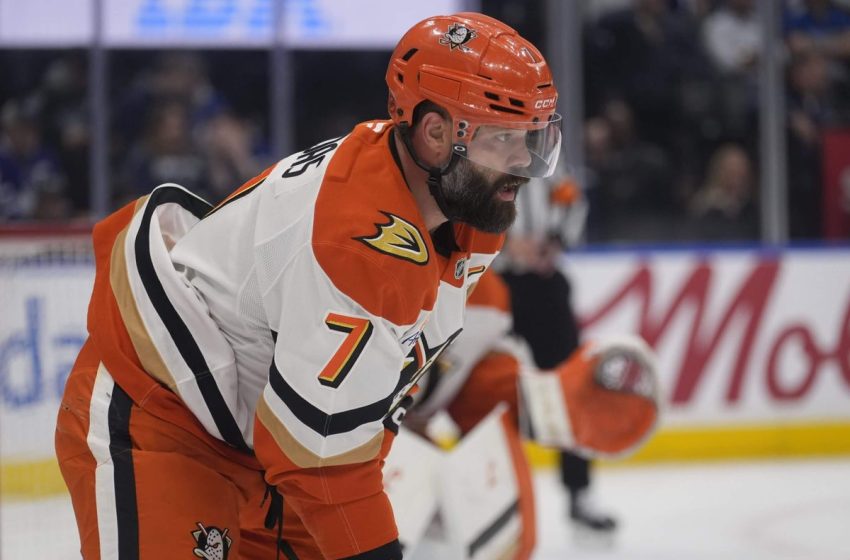
NHL’s thin suspension for Ducks’ Radko Gudas unlikely to keep league’s stars safe
One of the NHL’s top players, a former Hart Trophy winner and multi-time 60-goal scorer, is done for the season.
A third-pair defenseman with a significant history of suspensions and dirty hits will miss five games.
It hardly feels like justice. But unfortunately, that’s often the case when it comes to the NHL’s Department of Player Safety.
The league suspended Anaheim Ducks defenseman Radko Gudas for five games on Friday night for kneeing Toronto Maple Leafs captain Auston Matthews, stating that the onus was “on Gudas to ensure that he makes an approach that allows him to deliver a legal, full bodycheck.” This is Gudas’ fifth career suspension and brings his total games missed to 26.
Unmentioned in the NHL’s announcement was the severity of Matthews’ injury, which the Leafs revealed earlier in the night to be a Grade 3 MCL tear and quad contusion that will keep him out of Toronto’s remaining 16 games.
Whether or not he will require surgery in the offseason is unclear, but the consensus around the team is that Matthews was fortunate to escape with only this level of damage, given how, to use the NHL’s verbiage, “forceful and dangerous” the knee-on-knee collision was.
Anaheim’s Radko Gudas has been suspended for five games for kneeing Toronto’s Auston Matthews. https://t.co/jBq3cksIMt
— NHL Player Safety (@NHLPlayerSafety) March 14, 2026
Matthews’ agent, Judd Moldaver, was apoplectic after the suspension was announced, but he wasn’t the only one disappointed in the meager suspension. Other player agents we heard from Friday said they believed the decision showed player safety is not a priority in the league and that a five-game ban wouldn’t be enough to change someone like Gudas’ behavior in the future.
There is a precedent for longer suspensions for these types of knee-on-knee plays, with Matt Cooke receiving a seven-game ban during the 2014 playoffs for a similar hit on defenseman Tyson Barrie. The NHL typically considers playoff games to be of significantly higher value, too, so Cooke’s seven-game ban could be viewed as the equivalent of as many as 14 regular-season games using DOPS’ math.
Cooke had a similar rap sheet to Gudas at the time in that he was an older, veteran player who had been suspended five times previously for a total of 27 games (compared to Gudas’ four times and 21 games). Why Gudas received fewer games than Cooke for making a similarly dangerous play is unstated and unclear, but it’s most likely due to the fact that NHL suspension standards have fallen off over the years.
Back when Cooke hit Barrie in 2014, the NHL was just coming out of Brendan Shanahan’s three-year tenure as the head of the Department of Player Safety. (He left to become president of the Leafs less than two weeks prior to Cooke’s suspension.) Shanahan had led a charge to modernize the department, including introducing the explanatory videos that go with suspensions, such as the one embedded above. He also attempted to crack down harder on repeat offenders and especially dangerous hits, routinely handing out larger bans than the league had previously.
But Shanahan’s push was ultimately met with considerable counterpressure from NHL owners and general managers, who pushed back when their own players were hit with these longer suspensions. That eventually led to a softening by the DOPS, a pullback that has continued to this day, more than a decade later.
That’s how we’ve ended up here, with a system that doesn’t hammer repeat offenders hard enough to serve as a deterrent or protect star players when ugly plays such as this happen. It’s a system that’s long been defined by inconsistency and half measures, one that appears to satisfy no one other than those at the top who wish to maintain the status quo.
George Parros has helmed the DOPS for nearly nine years, and when these incidents happen, the Princeton-educated former enforcer becomes the primary target of fan (and agent) complaints. Parros, however, has remained in his role for this long because he is delivering on the mandate that the NHL’s brass wants. He is a functionary within the system; he is not there to remold it into something new because those who hired him aren’t looking for such re-envisioning.
The reality is that the old-school mentality that permeates upper management in the league perpetuates outdated standards for discipline, standards that haven’t received much, if any, challenge from within the system since Shanahan’s attempts back in the early days of the salary cap era. Whether criticisms from Moldaver and other high-profile agents — who act as proxies for the best players in the league, including fellow Moldaver client Connor McDavid — make an impact remains to be seen, but given the anger and disgust that’s percolating behind the scenes right now, it’s possible this incident serves as a flashpoint that leads to more people speaking up.
But the NHL has been here before. They’ve tried to change in the past and failed, long ago.
Color me skeptical that we get a different result this time around.
First Appeared on
Source link






