



Researchers Just Detected Unexpected Deformation in Earth’s Mantle That They Once Thought Was Rare
Deep inside Earth’s mantle, scientists have spotted something unexpected in a very common mineral. Tiny defects once thought to be rare may actually play a much bigger role in how the planet slowly shifts and moves.
Minerals might look solid and unchanging, but under extreme heat and pressure, they can bend and flow over time. This slow deformation is one of the forces behind plate tectonics, shaping continents and oceans over millions of years.
One mineral in particular, olivine, dominates the upper mantle. It has been studied for decades, yet researchers are still uncovering new details about how it behaves when pushed to its limits.
A “Rare” Mechanism That Isn’t So Rare After All
Scientists long believed olivine mainly deformed along two directions, called “a” and “c.” A third one, “b,” was mostly ignored, considered too uncommon to matter.
That assumption does not really hold up anymore. According to the study published in Geophysical Research Letters, about 17% of the crystals analyzed showed signs of deformation linked to “b” dislocations. That is not a tiny fraction. It is enough to suggest something important was being overlooked. John Wheeler, a geologist at the University of Liverpool, pointed out that :
“Our findings suggest that these dislocations may be more widespread than previously thought, improving our understanding of how the Earth’s mantle deforms.” He added, “Their presence may be influenced by pressure, temperature, and stress levels. Measuring ‘b’ dislocations in natural samples could therefore help scientists determine the depth of deformation and the conditions experienced during it.”
Seeing The Invisible With Powerful Tools
Spotting these defects is not easy. They are incredibly small and hard to find. Researchers first used Electron Backscatter Diffraction (EBSD) to scan crystals and detect subtle changes in their structure. Once they had clues about where to look, they switched to Transmission Electron Microscopy (TEM) for a closer view. According to the research, this step confirmed that the suspected zones did contain “b” dislocations.
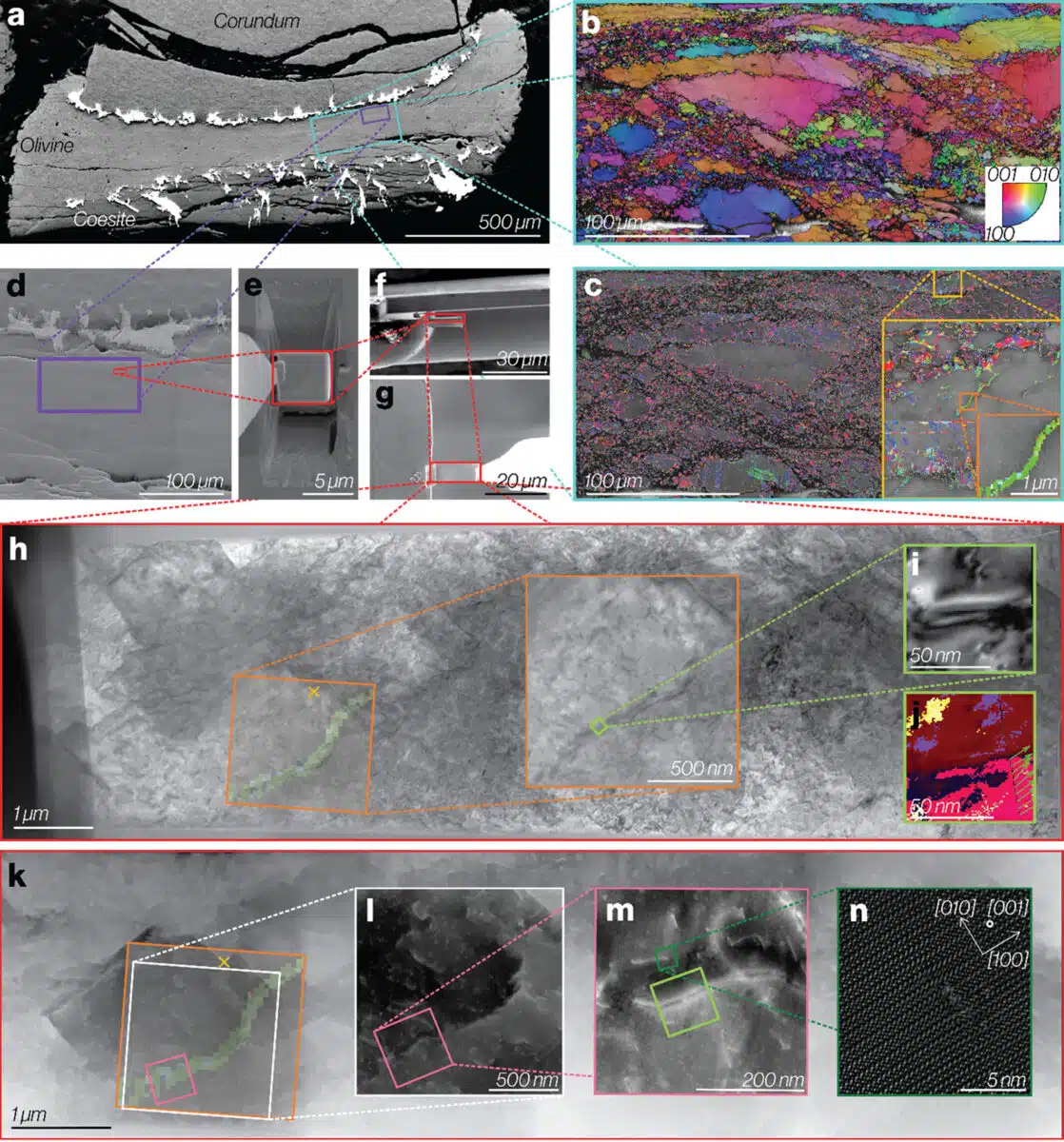
This two-step approach made a big difference. It allowed scientists to go from broad detection to direct observation, something that used to be extremely difficult with these kinds of features.
Why This Discovery Changes More Than You Think
These tiny defects could actually help scientists better understand what is happening deep underground. As explained by Wheeler, their presence may depend on factors like pressure, temperature, and stress, which vary depending on depth.
“Some materials such as semiconductors contain dislocations because of the manufacturing process which are deleterious to performance, so their abundance and arrangements need to be investigated,” Professor Wheeler explained.
First Appeared on
Source link






