


Scientists Discover New Magnetic Anomaly Hidden Beneath Australia’s Northern Territory
A recent study from the Commonwealth Scientific and Industrial Research Organisation (CSIRO) has unveiled an intriguing magnetic anomaly beneath Australia’s Northern Territory. The anomaly, shaped like the country itself, has raised curiosity among scientists and geologists. This discovery promises to enhance our understanding of Australia’s deep geological past and open new possibilities for resource exploration. With cutting-edge modeling techniques, the CSIRO team has significantly improved the accuracy of geological mapping, uncovering previously hidden structures that could revolutionize how we explore the Earth’s interior.
What Is the Australia Magnetic Anomaly?
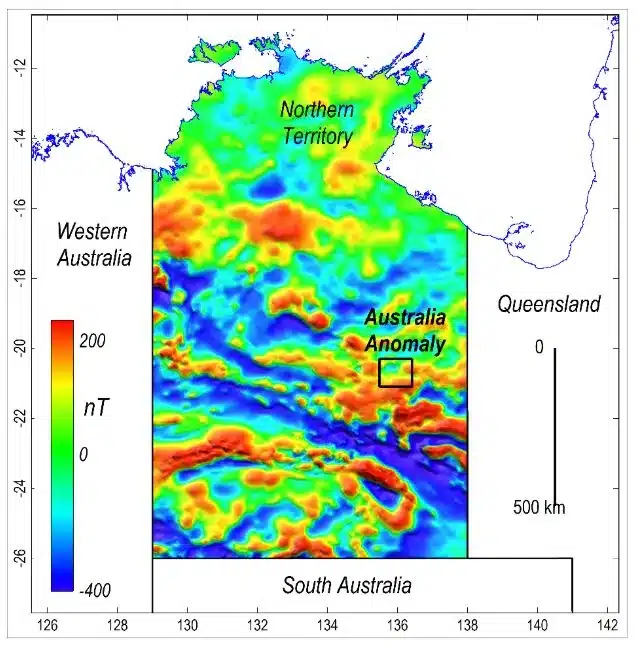
The Australia Magnetic Anomaly is a unique feature located beneath the Northern Territory that presents an oddly distinct magnetic pattern, roughly mirroring the shape of the country. This anomaly is formed by varying magnetic properties in the Earth’s crust, influenced by mineral deposits like iron ore. As rocks form, they acquire magnetic signatures that retain historical data about the direction and strength of Earth’s magnetic field at the time of formation. This “magnetic memory” can be used by scientists to reconstruct geological events that occurred billions of years ago. Through the anomaly, researchers can piece together vital details about the region’s geological development, offering valuable insights into the continent’s ancient past.
“Magnetic data allows us to see through the ground and understand geological architecture that would otherwise remain completely hidden,” said Clive Foss, the project lead and a senior research geoscientist at CSIRO.
This insight enables a deeper understanding of how the Earth’s magnetic field has influenced rock formations over time, giving scientists a glimpse into Australia’s untold geological history.
Advanced Modeling Techniques Revealing Hidden Layers
The magnetic anomaly beneath Australia’s Northern Territory was originally mapped in 1999 through a survey conducted by the Northern Territory Government. During this survey, planes equipped with magnetometers flew over the region, measuring the magnetic fields at regular intervals. However, earlier attempts to interpret the data were not entirely successful due to inconsistencies in the magnetic signals.
The CSIRO team, led by Foss, employed new modeling techniques to refine the data and generate clearer, more accurate images.
“The new modeling has solved this problem,” Foss noted. “My colleague, Dr. Aaron Davis, created an innovative gridding algorithm which refined the dataset and produced cleaner, more consistent images.”
This breakthrough in processing and modeling techniques allows researchers to extract far more geological information than previously possible, uncovering magnetic layers and geological boundaries that were once undetectable.
Implications for Geological Exploration and Resource Mapping
The enhanced accuracy of the magnetic data could have significant implications for resource exploration in the Northern Territory. Australia is known for its vast mineral deposits, including iron ore and gold, and mapping the magnetic anomaly could help pinpoint untapped resources that were previously hidden beneath the Earth’s surface. With clearer data, geologists are better equipped to identify regions where valuable minerals might be found, potentially boosting the economy through mining activities.
The CSIRO’s efforts also hold the promise of advancing geological science more broadly. By mapping the magnetic anomaly, the team has uncovered structures such as faults, folds, and basins that traditional mapping techniques missed. These discoveries will undoubtedly provide a more comprehensive understanding of the Earth’s crust and its evolution over millions of years.
“We can extract more geological information than ever before,” Foss explained. The increased understanding of geological features in the Northern Territory opens new doors for research and exploration, benefitting both academic scientists and industries seeking new resource deposits.
First Appeared on
Source link






