



Scientists Just Found a Well-Preserved Fossil With a Brain, and It’s Smaller than a Fingernail
A fossilized larva dating back over half a billion years has been discovered with its brain, digestive system, and nerve structures remarkably preserved. The tiny creature, an early arthropod ancestor, offers a rare and intimate look at internal anatomy from a time when complex animal life was just beginning to emerge.
The fossil, found in China and examined through advanced 3D imaging techniques, is a game-changer for evolutionary biology. According to a study, published in Nature, researchers were able to observe not only the organism’s external features, but also intricate internal structures that are almost never preserved in such ancient remains.
A Brain Frozen In Time For 520 Million Years
This larva belongs to the lineage that gave rise to today’s arthropods, a massive animal group that includes insects, crabs, and lobsters. Soft tissues like brains and guts usually decay long before fossilization, but this particular specimen defied those odds. Its exceptional state allows scientists to draw clearer evolutionary links between modern arthropods and their primitive ancestors.
Typical fossils capture hard structures, like bones, shells, exoskeletons, while soft tissues rarely survive the fossilization process. That’s why this 520-million-year-old larva is so valuable. As a press release reported, scientists were able to scan the tiny organism using synchrotron X-ray tomography, a technology that constructs detailed 3D models of internal features without damaging the sample.
The scans revealed a brain, digestive glands, traces of a circulatory system, and even nerves extending to the larva’s eyes and limbs. Co-author Katherine Dobson remarked in a press release that “natural fossilization has achieved almost perfect preservation.”
Evolution Etched In Stone
As stated by the research team, one key feature that stood out was the presence of a protocerebrum, a specific brain region that plays a central role in coordinating sensory input and movement in modern arthropods.
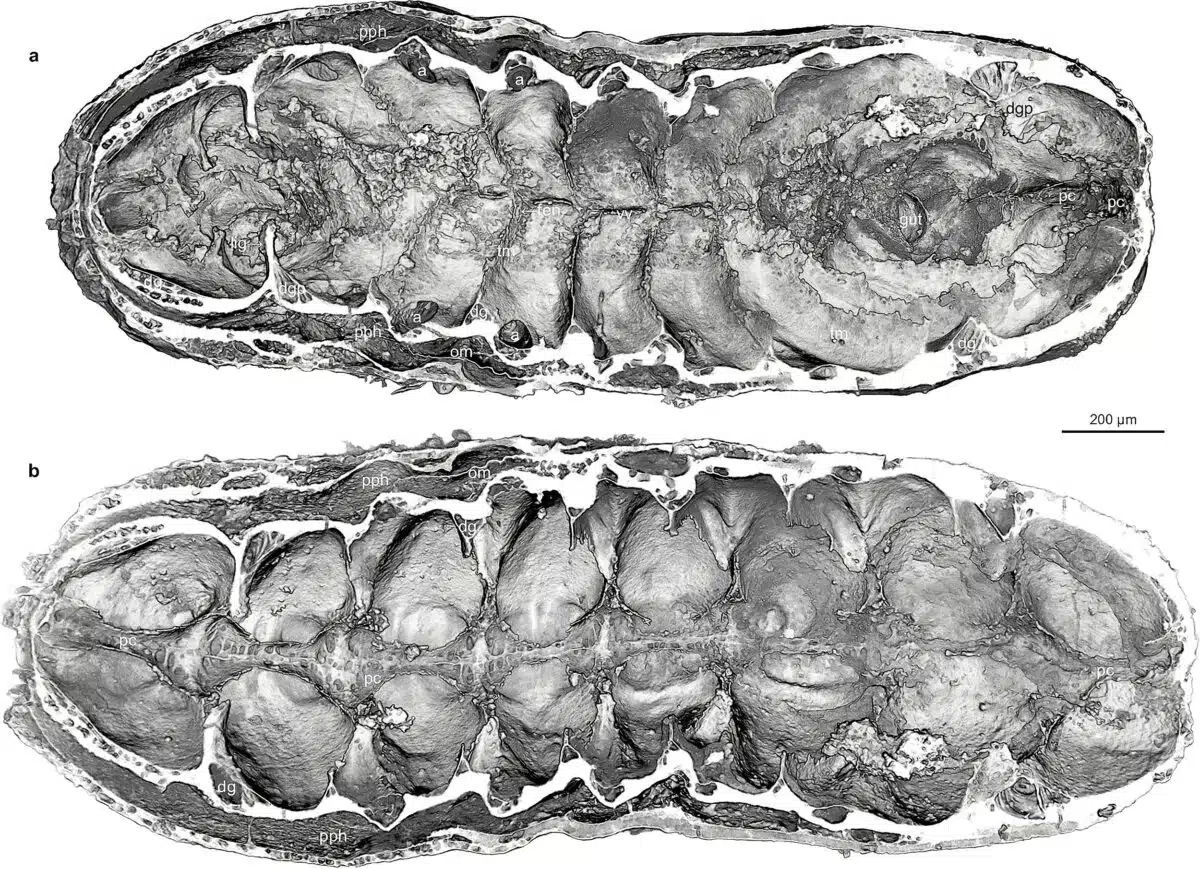
Its appearance in such an ancient specimen offers strong evidence of continuity in brain structure over hundreds of millions of years. According to lead researcher Martin Smith, discovering such complexity in a creature this old challenges previous assumptions about the simplicity of early arthropods.
“I already knew that this simple worm-like fossil was something special, but when I saw the amazing structures preserved under its skin, my jaw just dropped—how could these intricate features have avoided decay and still be here to see half a billion years later?” Smith said.
Scientists Stunned By Impossibly Rare Fossil
Fossilized larvae are exceedingly rare, largely because of their size and fragility. Their chances of preservation are close to zero. That’s what makes this find so extraordinary. The creature’s soft tissue was sealed and fossilized in such a way that even its most delicate systems remained visible after 520 million years.
As explained by the research, this exceptional preservation gives scientists the ability to compare ancient and modern body plans with unprecedented clarity. It confirms that even early arthropods had complex internal organization, potentially redefining how their evolutionary history is studied moving forward.
First Appeared on
Source link






