


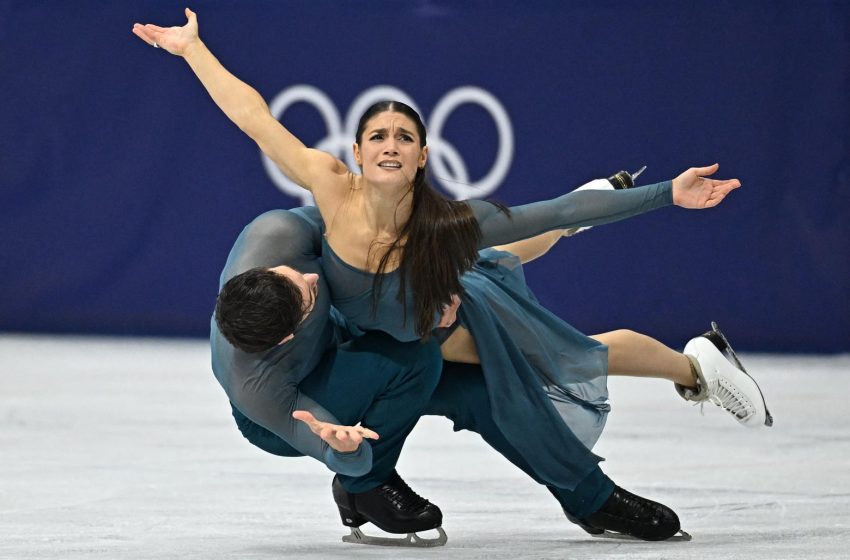
The difference between ice dancing and ice skating was on display Wednesday night.
This is part of Slate’s 2026 Olympics coverage. Read more here.
I would like to free you of the need to “understand” ice dance. I absolutely give you permission to learn what twizzles are, but if you’re coming into this as a once-every-four-years viewer, I encourage you to appreciate these performances based on how the skating made you feel. For me, watching it reminds me of the first time I was taken to a classical music performance: “What am I supposed to do with my brain during this?” I thought. I came to understand that there was nothing to “solve,” it was simply best to enjoy the music for its beauty. Ice dance is the same and should be appreciated as such.
Even after doing pairs figure skating for 16 years, I am a bit lost in the intricacies of judging ice dance. While yes, it is on skates, and yes, it is performed to music, it’s a whole different beast. Ice dancers are not allowed to perform jumps or overhead lifts. Their skating more closely resembles ballroom dance, focusing on musicality and edgework. The best analogy I can come up with is that in a restaurant, the chef creates your meal and the pastry chef creates your dessert—both are chefs, but they have wildly different skill sets. Ice dance is the dessert of figure skating. And tonight in Milan, the ice dancers created some particularly sweet confection for us.
One of the surprises of the night was the duo of Emilea Zingas and Vadym Kolesnik. Originally from Ukraine, Kolesnik was able to obtain U.S. citizenship last summer to be eligible for these games. In sixth place after the rhythm dance, Zingas and Kolesnik were able to pull up to the top 5 with a stunning performance to Prokofiev’s “Romeo and Juliet.” I found that their skating style really fit the character of the music, and they punctuated each beat of the piece beautifully. There was a sort of controlled abandon to this free skate, though I gasped a little when Kolesnik kissed Zingas in the middle of a spin. We suggest romance in skating, not actually perform it! I was a bit scandalized by that little kiss and I recently watched all of Heated Rivalry. But their romance isn’t forbidden; they’ve been happily dating since 2022. Zingas and Kolesnik were not the marquee American team at this Olympics, but they were able to step out of the shadow of Madison Chock and Evan Bates, making a case for being the future of U.S. ice dancing if the other pair retires.
Meanwhile, the hometown favorites of Charlène Guignard and Marco Fabbri have already stood on the podium at these Olympics, helping Team Italy win a hard-earned bronze in the team event. Guignard and Fabbri train in the very same facility where they performed, and they were hoping the comfort of home ice would elevate them to a podium finish. After a highly entertaining rhythm dance to the music of the Backstreet Boys, they were sitting in fifth place, very much in reach of a medal, but their free dance, to selections from the Diamanti soundtrack, was only able to bring them up to fourth place. Despite a mistake on a twizzle sequence from Fabbri, I found this performance so easy to watch. You could tell this team has been together for a long time (16 years!) and that intuitive understanding of each other’s bodies is apparent. I enjoyed how their performance was more about the beauty of skating than necessarily telling a literal story on the ice. At the end of their performance, they seemed overwhelmed with emotion, as this is their final season together. (Like the Americans, they are also in a relationship.) While this performance didn’t pick up any Olympic hardware for them, it was more than enough to do their country proud.
Getting into the medalists, it finally happened. An ice dance performance made me cry: the free dance of Piper Gilles and Paul Poirier, a team that has been to the Olympics twice before but has not previously won a medal. After their rhythm dance to RuPaul’s “Supermodel (You Better Work),” they were well positioned to make the podium. The over-the-top campiness of skating to a ‘90s track by a drag queen displayed a different energy from them that raised their charisma level to new heights. Then, their free dance to Don McLean’s “Vincent” was a masterpiece. Gilles and Poirier stand out because they train with different coaches than most of the top teams. They have an understated grace, demonstrated by moves like the spread eagles they laid backward on each other. These two have supported each other so well over the 15 years they’ve been a team, and while some skating performances deflate towards the end as the athletes’ legs get tired, this one built and built. When the final notes hit, you could tell they knew what they had achieved, bursting into tears at center ice, and these two athletes won an emotional bronze.
The American top-tier team, Chock and Bates, had been to four Olympics together but never won a medal in the ice dance event, instead landing a fourth-place finish in Beijing. Coming into Milan, this veteran team carried high expectations of becoming the second ever U.S. ice dance team to win gold. Their strong dances in the team event were instrumental in winning the U.S. team gold, but the question of whether they could triumph in their individual event remained. They threw down an excellent performance in the rhythm dance, skating to a Lenny Kravitz medley in a manner that was both precise and explosive. I thought their choice to lean away from the camp factor of the ‘90s theme actually helped them stand out. In a bit of a shock finish, however, the Americans, who have been skating together for 15 years, finished second in the rhythm dance, less than a point behind a French team that has been skating together for less than a year.
Watching their free dance, I felt they had the power to pull up to the top spot on the podium. Skating a paso doble and flamenco inspired piece where Chock portrays a matador and Bates the bull, I found it refreshing to see partners perform an antagonistic relationship on the ice (romance is so expected in this event). For the length of this free dance, Chock and Bates were totally dialed in, attacking each move. I appreciated Chock’s intense facial acting and Bates’ rock-solid sturdiness in the lifts. I got so lost in it, I realized I had stopped taking notes. Their Olympic free dance was enough to earn them a season’s best score, launching them into first place, but they had to wait for the French team to skate to see which medal they would get.
In a discipline where length of partnership is incredibly important to a team’s success, it has been stunning to see the meteoric rise of Laurence Fournier Beaudry and Guillaume Cizeron. It’s not like they came out of nowhere: Cizeron is the reigning gold medalist in ice dance with his former partner. And they have been friends for years, so they didn’t have to build a bond from scratch. But there has been a fair amount of scandal surrounding this newly formed team: Cizeron was accused of controlling behavior by his ex-skating partner in her recently released memoir, and Fournier Beaudry’s ex-skating partner Nikolaj Sørensen was banned by Skate Canada for six years for “sexual maltreatment.”
Their skating, though, was frankly magnificent. It felt like contemporary dance, and it was hard to tell where one move ended and the next one started. Their performance distilled skating into shapes and forms, and I found it the most aesthetically beautiful. I loved their chic outfits which highlighted the movements of their toned physiques (an odd choice when skating to the score from The Whale, but hey, good music is good music). The choreography was so detail-oriented, the type of skate that belongs in a museum. When the scores for the free dance came up, I was not surprised that they had surpassed the Americans to win gold.
I can only imagine how frustrating it must have been for Chock and Bates to spend 15 years together and come up just 1.43 points shy of their Olympic dream. (Then again, after 15 years competing together, what’s four more?)
Another winner of the night was the sport itself. At its worst, ice dancing has the corny sentiment of a Live Laugh Love poster in the guest bathroom at your mom’s house. At its best, ice dance enraptures you, draws you in to a hypnosis, each move seamlessly blending into the next creating a tapestry of emotion. In an event that started with ‘90s Eurodance remixes in the rhythm dance and ended with visual poetry in the free dance, I think the skaters made their point that ice dance is truly art in motion.
First Appeared on
Source link






